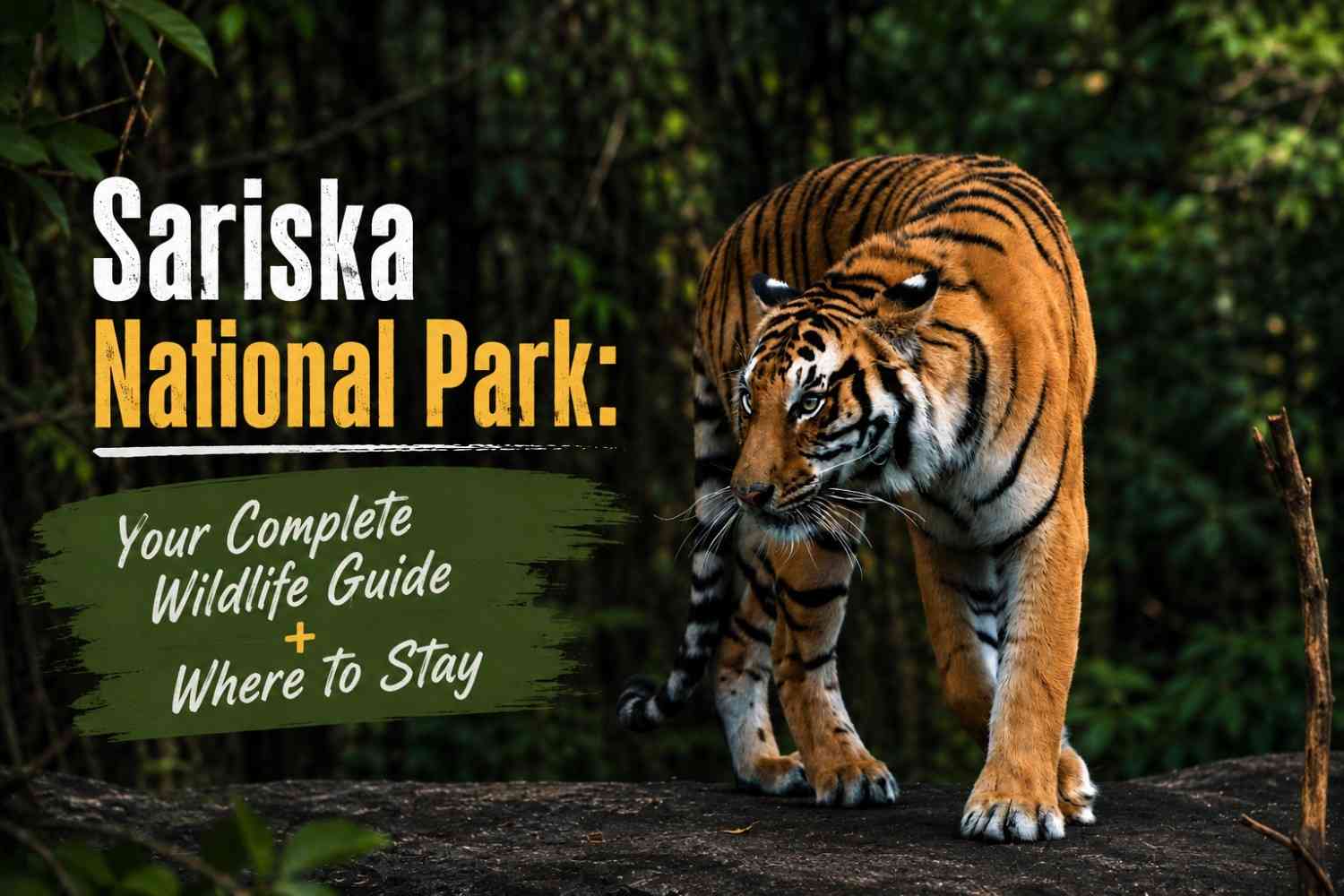
Sariska National Park: Your Complete Wildlife Guide + Where to Stay
-

- July 23rd, 2026
- 23 views

FREE SEO Topical Map Generator: Find Your Next Content Ideas
Most wildlife guides about Sariska lead with the tiger count. That is not where this one starts.
Because if a tiger count is all you came for, you are already planning the wrong trip. So here we will cover the wildlife, the history, the safaris, and — critically — where to stay in Sariska to make the trip worth the drive.
Sariska National Park is one of the most layered wildlife destinations in India — a place where a Bengal tiger can cross the same rocky Aravalli ridge that a 16th-century Mughal fort sits on, where a pilgrimage temple a thousand years old stands inside an active tiger corridor, and where a forest that was once declared dead has come back so completely that it now breeds the very animal it lost.
Sariska Tiger Reserve: The Comeback Story You Need to Know
Sariska Tiger Reserve was officially declared tiger-free in 2004. Poaching had wiped out the entire population. It was one of the most public wildlife failures in Indian conservation history.
What happened next is what makes Sariska unlike any other tiger reserve in India.
Between 2008 and 2012, tigers were translocated from Ranthambhore — a first-of-its-kind intervention under Project Tiger. The forest was allowed to recover. Anti-poaching measures were restructured. And slowly, Sariska's tigers came back. Today, the reserve has a growing, breeding tiger population — cubs born inside the reserve, raised here, living here.
When you spot a tiger at Sariska, you are not just watching wildlife. You are watching a forest that refused to stay dead.
Wildlife in Sariska: More Than Just Tigers
The focus on tigers sometimes obscures how rich Sariska's biodiversity actually is.
Mammals you can see at Sariska:
- Bengal Tiger — the reserve's flagship species, best spotted February to May near waterholes
- Leopard — more commonly sighted than tigers; rocky Aravalli ridgelines are their preferred terrain
- Striped Hyena — nocturnal, most visible on night drives along forest roads
- Golden Jackal — frequently seen at dawn and dusk near forest edges
- Nilgai — India's largest antelope, seen in open grassland zones regularly
- Sambar Deer — the tiger's primary prey species in Sariska; large herds near waterholes
- Indian Civet — nocturnal, spotted on night drives
- Rhesus Macaque and Langur — both common throughout the forest
Birds at Sariska: Over 150 species recorded. Top sightings include the Crested Serpent Eagle, Indian Pitta, Painted Spurfowl, Grey Partridge, Sand Grouse, and Great Indian Horned Owl. October and November are the best months for birdwatching in the reserve.
Reptiles: Monitor lizards, Indian pythons, and several species of chameleons are present in the rocky zones of the reserve. The Monitor Lizard is the one most commonly spotted on safari routes.
Sariska Safari: Everything You Need to Book It Right
Safari zones and types:
Sariska National Park offers two safari formats — a shared canter and a private jeep. For any serious wildlife experience, the private jeep is the only real choice.
- Private Jeep Safari: ₹8,500 per vehicle (up to 6 passengers). Access to quieter zones, flexible pace, stops wherever sightings are reported. The significant difference between a good safari and a great one.
- Shared Canter: ₹2,000 per person. Fixed route, fixed stops, 20 passengers per vehicle. Suitable for budget-conscious visitors or large groups.
Safari timings:
- Morning safari: Sunrise to approximately 10:00 AM
- Evening safari: 2:30 PM to sunset
- Night drives: Available along designated forest roads for nocturnal wildlife
Park entry fees: Approximately ₹100 to ₹200 per person for Indian nationals. Paid at the forest gate — carry cash.
Booking: Book through the official Rajasthan Forest Department portal or directly through your resort. Private jeeps fill fast between October and March — book at least a week in advance for peak season.
Best time for tiger sightings: February and March are the most productive months. The forest thins out and animals concentrate near waterholes, making sightings more likely. Early morning on a cold January day is when most serious wildlife photographers choose to be here.
Heritage Inside the Forest: What Most Safari Tourists Never Find
This is where Sariska National Park separates itself from every other tiger reserve within 300 km of Delhi.
Pandupol Hanuman Mandir
A 1,000-year-old Hanuman temple sitting inside the reserve's active wildlife corridor. Accessible only through the forest. Devotees believe this is where the Pandavas rested during their exile — where Hanuman stopped Bhima mid-journey.
The approach road passes through sal forest, langurs overhead, peacocks crossing the track. The temple appears without warning — bells, incense, and birdcall arriving simultaneously.
Busiest on Tuesdays and Saturdays. A weekday visit gives you the forest approach almost entirely to yourself.
Kankwari Fort
A 16th-century Mughal fortification on a rocky hilltop inside the reserve, accessible only via safari jeep route. Historically linked to the imprisonment of Dara Shikoh — Mughal crown prince — by his brother Aurangzeb after the War of Succession.
The battlements give panoramic Aravalli views. Almost nobody visits it. That is the point.
Neelkanth Mahadev Temple
An ancient Shiva temple inside the forest, reachable by safari route through the eastern zones of the reserve. Stone carvings, a forest clearing, complete quiet. Less visited than Pandupol — which is exactly why it is worth seeking out.
Best Hotels in Sariska Tiger Reserve: Honest Comparison
Searching for hotels in Sariska Tiger Reserve returns a wide range of options — from roadside guesthouses to boutique forest stays. Here is how they break down honestly.
Budget Guesthouses (Under ₹3,000/night) Located near Thanagazi or the forest gate. Clean, basic, no forest connection, no safari assistance. Right choice only if the safari is your sole objective and cost is the primary constraint.
Mid-Range Forest Camps (₹3,000–₹6,000/night) Tent setups in open clearings, some shared facilities. Good for groups. Limited nature programming and no direct park-boundary access.
Luxury Eco Resorts (₹6,000–₹15,000/night) The category where the stay becomes the experience, not just the accommodation. Chokhiwadi Forest Retreat is the benchmark in this category near Sariska.
Resort in Sariska National Park: Why Chokhiwadi Is the Right Choice
Chokhiwadi Forest Retreat in Guwara Dulawa, Ajabgarh, Thanagazi sits on the edge of Sariska National Park — not near it, on it.
The founders planted over 20,000 native trees across 9.5 acres before opening a single room. Today, more than 90% of the property is living forest, organic farm, and food garden. Solar-powered. Rainwater harvested. Every staff member hired from a village within 5 km.
Room types and rates:
Luxury Glamping Tents — From ₹5,999/night. African safari-style canvas with open porticos facing the Aravallis. Peacocks arrive outside before your alarm. AC, hot water, in-room dining.
Mud Villas — From ₹7,999/night. Handbuilt, painted with Mandana folk art by local women. Every wall unique, every stay different.
Stone Cottages — From ₹12,999/night. Full luxury in the forest. Most dramatic Aravalli hill views on the property. The right choice for those who want maximum comfort with maximum nature.
All room types include AC, hot water, free Wi-Fi, in-room dining, snack bar, and 24×7 assistance. Fully pet-friendly.
What sets the stay apart:
The Baori — a handmade stepwell at the heart of the property where the AQI regularly sits under 50. Rajeev Aggarwal, Senior VP at Samsung India, stood here on a clear winter night and saw Mars, Venus, and Saturn with the naked eye.
Spice Aangan — farm-to-table Rajasthani dining under a Maharaja tent. Dal baati churma. Slow-cooked laal maas. Ingredients from the property's own kitchen garden.
The 360-degree pool open on all sides to the Aravallis. The Food Forest — 7,000+ trees — open to guests for self-guided walks. Guided treks to Somsagar Waterfall. Bonfire evenings. Open-air yoga at Vaayu lawn. Night drives for nocturnal wildlife.
Safari bookings arranged directly by the resort. No third-party coordination needed.
Seasonal Guide: Best Time to Visit Sariska
October to March — Peak Season Best overall. Cool weather, post-monsoon greenery through November, and highest wildlife activity. Tiger sightings peak February to March. December and January bring cold nights — carry a proper jacket — and the clearest skies of the year.
April to June — Off-Peak Hot, genuinely hot from May onward. Crowds drop significantly. Waterholes dry up and concentrate wildlife for easier sightings. The resort pool becomes the anchor of the trip.
July to September — Monsoon The forest transforms. Somsagar Waterfall runs at full capacity. Some safari zones restrict access. Outstanding for landscape photography and the Food Forest experience.
Practical Tips Before You Go
- Book safari in advance — October to March private jeep slots go fast. Arrange at time of resort booking.
- Minimum two nights — One night covers a safari. Two nights covers Sariska, Pandupol, and Bhangarh Fort comfortably.
- How to reach — 3 to 3.5 hours from Delhi via NH48. Just over 1 hour from Jaipur. Self-drive recommended.
- Carry cash — Forest gate entry is cash only. Cards work at the resort.
- Safari clothing — Neutral colours. Khaki, olive, beige. No camouflage required.
- Morning vs evening safari — Morning produces more sightings. Evening has better light for photography.
Frequently Asked Questions
Q: Are there tigers in Sariska National Park in 2026?
Yes. Sariska has a growing, breeding tiger population following the landmark 2008 reintroduction from Ranthambhore. February and March offer the highest sighting rates, when the forest thins and animals concentrate near waterholes.
Q: What is the best hotel or resort in Sariska Tiger Reserve?
Chokhiwadi Forest Retreat in Ajabgarh, Thanagazi is the top-rated eco-luxury resort in Sariska National Park — on the park boundary, fully sustainable, with three room types from ₹5,999/night and direct safari booking assistance.
Q: How far is Sariska National Park from Delhi?
Sariska is approximately 3 to 3.5 hours from Delhi by road via NH48. It is the closest tiger reserve to Delhi NCR and one of the most accessible wildlife destinations in northern India.
Q: What is the best time to visit Sariska for a wildlife safari?
October to March is the best season overall. February and March are peak for tiger sightings. October and November offer post-monsoon greenery combined with active wildlife. December and January are ideal for birdwatching and stargazing.
Plan your Sariska trip: chokhiwadi.com | +91 9588903155 / +91 8287612664
Chokhiwadi Forest Retreat | Guwara Dulawa, Ajabgarh, Thanagazi, Rajasthan 301027 Resort in Sariska National Park | Best Hotel Near Sariska Tiger Reserve | Weekend Getaway from Delhi & Jaipur