AI Chatbots for Lead Qualification: A Complete Guide
-

- July 10th, 2026
- 26 views

FREE SEO Topical Map Generator: Find Your Next Content Ideas
An AI Chatbot helps businesses automatically qualify leads by engaging website visitors, asking relevant questions, identifying buying intent, collecting customer information, and routing high-quality prospects to sales teams. This improves conversion rates, reduces response times, and enables businesses to scale lead generation without increasing operational costs.
What You'll Learn (Key Takeaways)
AI Chatbots automate lead qualification 24/7.
Businesses can respond instantly to every inquiry without hiring additional staff.
AI-powered conversations improve customer experience and reduce lead leakage.
Qualified leads are automatically assigned to the right sales representative.
CRM, WhatsApp Business API, and cloud telephony integrations streamline the sales process.
AI Chatbots reduce manual work while increasing conversion opportunities.
Solutions like SparkTG combine conversational AI with business communication tools for end-to-end lead management.
Table of Contents
Introduction
What is an AI Chatbot?
Why Businesses Need AI Chatbots for Lead Qualification
Top Benefits of AI Chatbots
Key Features of AI Chatbots
How AI Chatbots Work
Industry Use Cases
Real Business Challenges Solved
Comparison Table
Introduction
Every business wants more qualified leads, but attracting prospects is only half the challenge. The real opportunity lies in identifying which inquiries are genuinely ready to buy.
Sales teams often spend valuable time following up with leads that lack interest, budget, or decision-making authority. At the same time, high-intent prospects may leave because they don't receive an immediate response.
This is where an AI Chatbot transforms the lead qualification process.
Unlike traditional chat widgets that simply collect contact information, modern AI Chatbots engage visitors in meaningful conversations, understand customer intent, ask qualifying questions, and automatically direct sales-ready leads to the right team. They work continuously, ensuring businesses never miss opportunities—even outside business hours.
When combined with technologies such as Cloud Telephony, WhatsApp Business API, IVR, CRM platforms, and Contact Center Software, AI Chatbots become a central part of an intelligent sales ecosystem.
For organizations aiming to improve customer engagement and automate sales workflows, platforms like SparkTG provide AI-powered communication solutions that integrate chat, voice, and omnichannel interactions into one unified experience.
What is an AI Chatbot?
An AI Chatbot is an intelligent software application that uses Artificial Intelligence, Natural Language Processing (NLP), and Machine Learning to understand customer queries, conduct human-like conversations, collect information, qualify leads, and automate customer interactions across multiple communication channels.
Unlike rule-based bots that rely on predefined decision trees, AI Chatbots understand context, recognize user intent, and adapt conversations based on customer responses.
For lead qualification, an AI Chatbot can automatically determine whether a visitor matches your ideal customer profile by asking questions related to:
Company size
Industry
Budget
Business requirements
Purchase timeline
Geographic location
Decision-making authority
Based on the responses, the chatbot assigns a lead score and routes the conversation accordingly.
Why Businesses Need AI Chatbots for Lead Qualification
Lead generation has become increasingly competitive. Customers expect immediate responses, personalized conversations, and seamless support across channels.
Businesses relying solely on manual lead qualification face several challenges:
Slow Response Times
Research consistently shows that businesses responding within minutes are significantly more likely to convert leads than those responding hours later. Delays often result in prospects moving to competitors.
High Volume of Unqualified Leads
Sales representatives frequently spend time contacting individuals who are only browsing, researching, or lack purchasing authority.
Rising Operational Costs
Hiring additional sales development representatives increases payroll expenses while limiting scalability.
Inconsistent Qualification
Different sales representatives may evaluate leads differently, resulting in inconsistent customer experiences.
Lost Opportunities
Leads arriving outside office hours often receive delayed follow-ups, reducing conversion potential.
AI Chatbots address these issues by engaging every visitor instantly, asking standardized qualification questions, and ensuring only high-potential prospects reach the sales team.
Top Benefits of AI Chatbots
1. Instant Customer Engagement
Visitors receive immediate responses regardless of business hours, improving customer satisfaction and increasing the likelihood of conversion.
2. Automated Lead Qualification
AI Chatbots ask predefined qualification questions and categorize leads based on buying intent, reducing manual effort for sales teams.
3. Higher Sales Productivity
Sales representatives spend more time speaking with qualified prospects instead of filtering irrelevant inquiries.
4. Improved Customer Experience
Personalized conversations create a smoother buying journey, making customers feel understood from the first interaction.
5. Lower Customer Acquisition Costs
Automation reduces dependency on large sales teams while improving efficiency across marketing and sales operations.
6. Better Data Collection
Every conversation captures valuable customer insights including:
Pain points
Product interests
Preferred communication channels
Purchase timeline
Budget expectations
This information supports better sales planning and personalized follow-ups.
7. Omnichannel Communication
Modern AI Chatbots integrate with:
Websites
WhatsApp Business API
Facebook Messenger
Instagram
Mobile Apps
Live Chat
CRM Systems
Email Platforms
Customers can continue conversations across multiple channels without repeating information.
Key Features of AI Chatbots
An enterprise-grade AI Chatbot offers far more than automated replies.
Natural Language Understanding (NLU)
Understands conversational language rather than relying solely on keywords.
Intelligent Lead Scoring
Automatically evaluates leads based on qualification criteria and buying intent.
CRM Integration
Synchronizes lead information with CRM platforms, enabling sales teams to access complete customer histories.
WhatsApp Business API Integration
Engages customers on one of the world's most popular messaging platforms while maintaining conversation continuity.
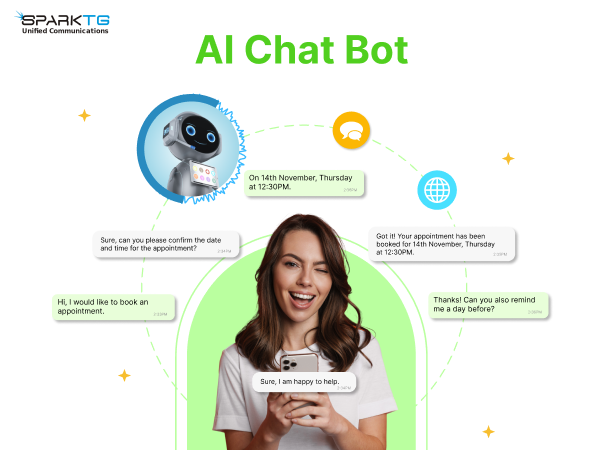
Appointment Scheduling
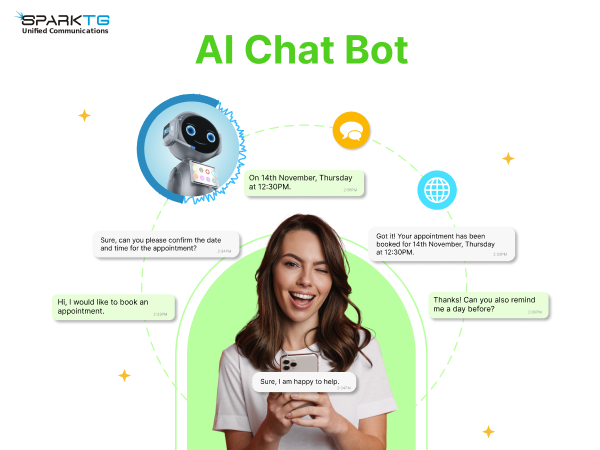
Books product demonstrations, consultations, or sales meetings without manual coordination.
Live Agent Handoff
Transfers complex conversations to human agents while preserving conversation history.
Multi-language Support
Communicates with customers in multiple regional and international languages.
Analytics Dashboard
Provides insights into:
Conversion rates
Chat completion rates
Qualified leads
Customer satisfaction
Sales funnel performance
How AI Chatbots Work
The lead qualification process typically follows these steps:
Step 1: Visitor Initiates Conversation
A customer visits your website or messaging platform and starts a conversation.
↓
Step 2: AI Understands Intent
Natural Language Processing identifies what the customer wants.
↓
Step 3: Qualification Questions
The chatbot asks relevant questions such as:
What solution are you looking for?
What's your company size?
What's your estimated budget?
When are you planning to purchase?
↓
Step 4: Lead Scoring
The chatbot evaluates responses using predefined business rules and AI models.
↓
Step 5: CRM Update
Customer information is automatically stored in the CRM.
↓
Step 6: Smart Routing
Qualified leads are transferred to the appropriate sales representative, department, or contact center queue.
↓
Step 7: Follow-up Automation
Automated reminders, emails, WhatsApp messages, or callback requests ensure continuous engagement until conversion.
Industry Use Cases
Healthcare
Hospitals and clinics use AI Chatbots to:
Qualify patient inquiries
Book appointments
Answer FAQs
Route emergency cases
Collect medical information before consultations
Real Estate
Property developers use AI Chatbots to:
Identify buyer preferences
Schedule site visits
Recommend suitable properties
Capture investment budgets
Assign leads to sales consultants
Education
Educational institutions automate:
Course recommendations
Admission inquiries
Fee information
Student eligibility checks
Counseling appointments
E-commerce
Online retailers leverage AI Chatbots for:
Product recommendations
Cart recovery
Personalized offers
Order tracking
Customer support
BFSI
Banks and financial institutions automate:
Loan eligibility screening
Credit card inquiries
Insurance consultations
KYC guidance
Customer verification
Travel & Hospitality
Travel companies use AI Chatbots to:
Recommend destinations
Handle booking inquiries
Collect travel preferences
Upsell packages
Provide real-time travel updates
Real Business Challenges Solved
Business Challenge |
How AI Chatbots Solve It |
Slow lead response |
Instant engagement 24/7 |
Low conversion rates |
Qualify high-intent prospects faster |
Overloaded sales teams |
Automate repetitive conversations |
Inconsistent qualification |
Standardized qualification workflows |
Missed after-hours inquiries |
Continuous customer engagement |
Poor lead tracking |
CRM integration with complete conversation history |
High support costs |
Automation reduces manual workload |
Fragmented communication |
Omnichannel engagement across web, WhatsApp, and voice |
Comparison Table
Feature |
Traditional Lead Qualification |
Cloud-Based Automation |
SparkTG AI Chatbot Solution |
Availability |
Business Hours Only |
24×7 |
24×7 AI-Powered Support |
Response Time |
Minutes to Hours |
Seconds |
Instant Responses |
Lead Qualification |
Manual |
Partially Automated |
AI-Driven Qualification |
CRM Integration |
Manual Entry |
Available |
Seamless Integration |
WhatsApp Business API |
Limited |
Available |
Native Integration |
Cloud Telephony |
Separate Systems |
Optional |
Unified Platform |
Lead Scoring |
Manual |
Rule-Based |
AI-Powered Scoring |
Human Handoff |
Manual |
Available |
Intelligent Agent Routing |
Analytics |
Basic |
Standard |
Advanced Insights & Reporting |
Scalability |
Limited |
Moderate |
Enterprise-Grade Scalability |
Why Choose SparkTG for AI Chatbot Solutions
Choosing the right AI Chatbot provider goes beyond conversational capabilities. Businesses need a solution that integrates seamlessly with existing communication systems, scales with growth, and delivers measurable ROI. SparkTG offers an enterprise-grade platform designed to support lead generation, customer engagement, and sales automation.
1. Reliable Enterprise Infrastructure
SparkTG provides cloud-based communication solutions with high availability, ensuring your AI Chatbot remains operational around the clock. This enables businesses to capture and qualify leads without interruption.
2. Scalable for Growing Businesses
Whether you're a startup handling hundreds of monthly inquiries or a large enterprise managing thousands of conversations daily, SparkTG's AI Chatbot platform scales effortlessly without compromising performance.
3. Secure Business Communications
Security is essential when handling customer information. SparkTG follows industry best practices for data protection, secure integrations, and controlled access to ensure sensitive customer data remains protected.
4. Omnichannel Integration
SparkTG integrates AI Chatbots with:
WhatsApp Business API
Cloud Telephony
IVR
CRM Platforms
Contact Center Software
Toll-Free Numbers
Website Live Chat
This unified communication ecosystem creates a seamless customer journey across every touchpoint.
5. Customizable Workflows
Every business has unique lead qualification criteria. SparkTG allows organizations to customize chatbot conversations, lead scoring rules, routing logic, and integrations based on industry-specific requirements.
6. Cost-Effective Automation
By automating repetitive sales and support interactions, businesses can reduce operational costs while increasing lead conversion rates and team productivity.
Implementation Process
Deploying an AI Chatbot doesn't have to be complicated. A structured implementation approach ensures faster adoption and better results.
Step 1: Define Business Goals
Identify the primary objectives, such as increasing qualified leads, reducing response times, or automating customer support.
Step 2: Map the Customer Journey
Analyze how customers interact with your business and identify opportunities where an AI Chatbot can improve the experience.
Step 3: Build Conversation Flows
Design chatbot conversations that collect relevant lead qualification data while maintaining a natural and engaging user experience.
Step 4: Integrate Existing Systems
Connect the chatbot with CRM software, WhatsApp Business API, Cloud Telephony, IVR, and analytics platforms.
Step 5: Test Before Launch
Validate conversation flows, routing rules, integrations, and fallback responses to ensure smooth customer interactions.
Step 6: Monitor and Optimize
Track key performance indicators such as conversation completion rates, qualified leads, conversion rates, and customer satisfaction to continuously improve chatbot performance.
Best Practices for AI Chatbot Lead Qualification
To maximize results, businesses should follow these best practices:
Keep conversations short and focused.
Ask qualification questions progressively instead of overwhelming users.
Personalize conversations using customer data whenever possible.
Provide easy access to a live agent when required.
Use AI insights to continuously improve conversation flows.
Integrate chatbot data with CRM systems for better sales visibility.
Monitor chatbot performance regularly and refine workflows based on analytics.
Ensure consistent branding and tone across all communication channels.
Common Mistakes to Avoid
Even the most advanced AI Chatbot can underperform if implemented incorrectly.
❌ Asking Too Many Questions
Lengthy conversations increase abandonment rates.
❌ Ignoring Human Escalation
Not every conversation should remain automated. Complex or sensitive inquiries should be transferred to human agents.
❌ Poor CRM Integration
Disconnected systems create duplicate work and incomplete customer records.
❌ Not Updating Conversation Flows
Customer expectations evolve. Regular optimization keeps chatbot interactions relevant.
❌ Focusing Only on Automation
The goal is to enhance customer experience, not eliminate human interaction entirely.
Future Trends in AI Chatbots
AI Chatbots continue to evolve rapidly, offering new opportunities for businesses.
Generative AI Conversations
Large Language Models (LLMs) enable more natural, context-aware conversations that improve customer engagement.
Predictive Lead Scoring
AI will increasingly analyze behavioral signals, historical interactions, and intent data to predict purchase readiness.
Voice AI Integration
Businesses are combining AI Chatbots with Voice Bots and Intelligent IVR to provide seamless voice and text experiences.
Hyper-Personalization
Future chatbots will tailor conversations based on customer preferences, previous purchases, and browsing behavior.
Unified Omnichannel Experiences
Customers will move effortlessly between websites, WhatsApp, voice calls, mobile apps, and social media while maintaining conversation context.
Expert Recommendations
Based on industry best practices, organizations implementing AI Chatbots for lead qualification should:
Clearly define what qualifies as a high-quality lead.
Align chatbot workflows with your sales process.
Integrate chatbot interactions with CRM and marketing automation platforms.
Measure KPIs such as response time, qualified lead rate, conversion rate, and customer satisfaction.
Continuously review chatbot conversations and refine responses based on user behavior.
Combine AI automation with human expertise to deliver the best customer experience.
Choose a scalable platform like SparkTG that supports omnichannel communication and future business growth.
Frequently Asked Questions (FAQs)
1. What is an AI Chatbot?
An AI Chatbot is software that uses Artificial Intelligence and Natural Language Processing to understand customer queries, automate conversations, qualify leads, and provide personalized responses.
2. How does an AI Chatbot qualify leads?
It asks predefined qualification questions, evaluates customer responses, assigns lead scores, and routes qualified prospects to the appropriate sales team.
3. Can AI Chatbots replace human sales representatives?
No. AI Chatbots automate repetitive tasks and initial lead qualification, while human representatives focus on complex discussions and closing sales.
4. Which industries benefit the most from AI Chatbots?
Healthcare, BFSI, education, e-commerce, real estate, travel, logistics, SaaS, and customer support organizations benefit significantly.
5. Can AI Chatbots integrate with CRM software?
Yes. Modern AI Chatbots integrate with leading CRM platforms to automatically store customer information and conversation history.
6. Are AI Chatbots available 24/7?
Yes. AI Chatbots operate continuously, ensuring businesses never miss customer inquiries outside working hours.
7. Can AI Chatbots work with WhatsApp Business API?
Absolutely. Integration with WhatsApp Business API enables businesses to engage customers on one of the world's most popular messaging platforms.
8. How secure are AI Chatbots?
Enterprise-grade AI Chatbots use secure cloud infrastructure, encrypted communications, and access controls to protect customer data.
9. How long does implementation take?
Implementation timelines vary depending on complexity, integrations, and customization requirements, but many businesses can deploy an AI Chatbot within a few weeks.
10. Why choose SparkTG for AI Chatbots?
SparkTG combines AI Chatbots with Cloud Telephony, WhatsApp Business API, IVR, Contact Center Software, and CRM integrations to provide a complete business communication solution.
Conclusion
An AI Chatbot has evolved from a customer support tool into a strategic asset for modern businesses. By automating lead qualification, improving response times, and integrating seamlessly with sales and communication platforms, AI Chatbots help organizations increase conversions while reducing operational costs.
Whether you're a startup seeking scalable lead generation or an enterprise looking to streamline sales operations, investing in AI-powered automation delivers measurable business value. With SparkTG's unified communication solutions, businesses can build intelligent, omnichannel customer journeys that improve efficiency, strengthen customer relationships, and drive sustainable growth.