
Can wireless fire alarms work in large buildings?
-

- July 17th, 2026
- 37 views

FREE SEO Topical Map Generator: Find Your Next Content Ideas
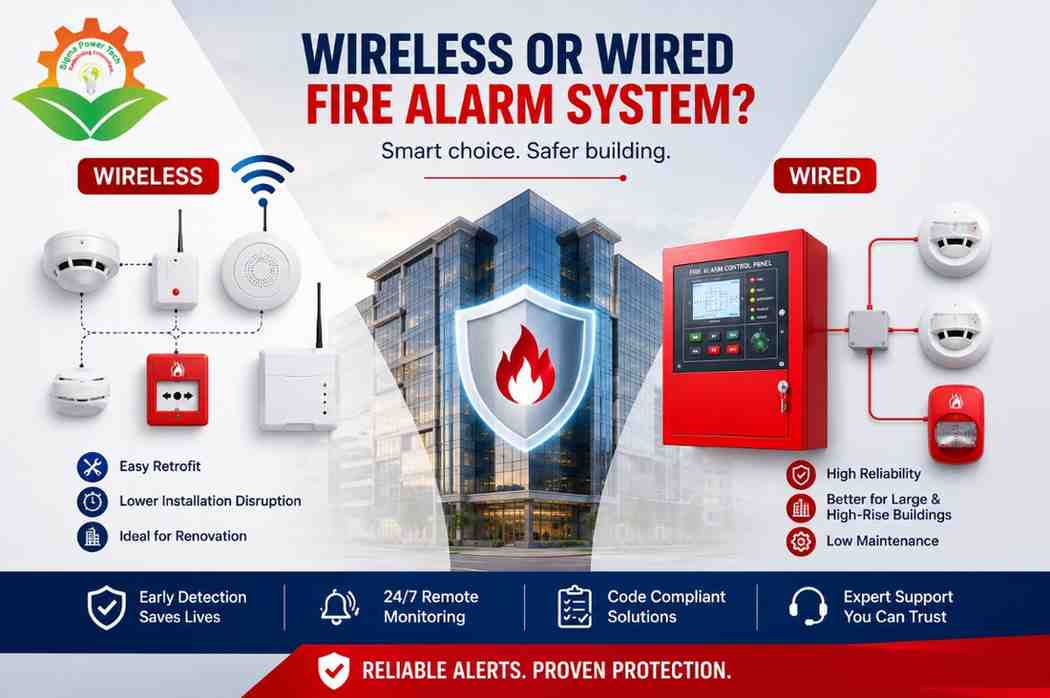
Yes — but with limits. A wireless fire alarm system can meet life-safety requirements in many large-building applications if the design is driven by radio planning, redundancy, and a realistic maintenance strategy. For high-rise, deep-basement, heavy concrete, or mission-critical facilities, wired or hybrid architectures often remain the safer default.
Where wireless makes sense (typical use cases)
Retrofit and occupied interiors: Installing wireless detectors avoids removing ceilings or walls in finished spaces, reducing downtime and cost.
Heritage or architecturally sensitive buildings: Wireless preserves fabric while providing modern detection.
Isolated zones or annexes: Outbuildings, mezzanines, and temporary structures where running cabling is impractical.
Low- to mid-rise commercial buildings with predictable RF environments and good access for maintenance.
Where wired remains preferable
High-rise towers and very large footprints: Vertical shafts, lift cores, and long vertical runs create RF shadowing and multipath problems that are hard to guarantee.
Deep basements, plant rooms, and service tunnels: Dense reinforced concrete and metalwork attenuate signals severely.
Critical infrastructure and high-occupancy assembly spaces: Where the tolerance for communication failure is extremely low.
Very large campuses requiring thousands of points: Wired loops scale more predictably and simplify power distribution.
Direct trade-offs: wireless vs wired
Reliability and latency: Wired loops have deterministic performance and very low latency. Wireless depends on RF margin; properly designed systems meet latency requirements but need redundancy.
Scalability: Wired systems scale by adding loops and panels. Wireless systems are limited by gateway capacity (devices per gateway) and radio congestion; mesh networks help but add complexity.
Installation cost: Wireless often lowers initial civil/trade disruption costs, especially in retrofits. Long-term lifecycle costs include periodic battery replacement and radio maintenance.
Maintenance: Wireless detectors require scheduled battery management (typical battery life 3–5 years depending on polling/reporting intervals). Wired detectors generally rely on central battery backup.
False-alarm and interference risk: Properly certified wireless systems have robust anti-interference measures, but poorly planned deployments can see higher nuisance reports.
Monitoring integration: Both can integrate with fire alarm system remote monitoring; wireless requires additional verification of signalling gateways and failover behaviour.
Practical engineering limits and mitigations
Radio planning: Conduct a site survey with a qualified RF engineer. Target a conservative link margin (industry practice commonly requires >20 dB fade margin for reliable links in buildings).
Gateways and mesh topology: Avoid a single point of failure. Use multiple gateways or hybrid wired-gateway panels to localise risk.
Repeaters and antenna placement: Use ceiling- or void-mounted antennas where allowed; avoid placing gateways near large metal structures or plant.
Device density: Verify maximum nodes per gateway from the vendor; plan logical sub-zoning so one gateway outage doesn’t blind an entire floor.
Battery strategy: Specify battery models and lifecycle replacements in the maintenance contract. For many installations, expect 3–5 years battery life for detectors; plan replacement windows accordingly.
EMC and building materials: Reinforced concrete, dense metal, and electrical equipment rooms reduce RF range. For such areas, prefer wired detection or dedicated wired runs to gateways.
Failover signalling: Test fire alarm system remote monitoring paths (GSM/IP/leased line) and ensure secondary paths exist for critical sites.
Scenario-based recommendations (practical answers)
6–10 storey office retrofit: Wireless-first approach is reasonable after a radio survey. Use multiple gateways, plan for battery logistics, and confirm remote monitoring integration for alarms and troubles.
20+ storey new high-rise: Wired addressable loops for primary detection with wireless only in isolated, low-risk pockets (e.g., temporary partitions).
Large industrial campus: Hybrid model — wired panels for main buildings and reliable inter-building links, wireless for outbuildings where trenching is expensive.
Heritage building: Wireless recommended where invasiveness must be minimised; ensure redundant gateways and a robust maintenance regime.
Code, testing, and documentation considerations
Compliance: Indian projects commonly reference NBC and NFPA guidance. Confirm local authority having jurisdiction (AHJ) acceptance of wireless solutions and obtain written approvals early.
Commissioning and acceptance tests: Include full radio surveys, device commissioning logs, battery-discharge records, and simulated end-to-end alarm tests to the remote monitoring station. Record measured link margins and gateway load during commissioning for auditors.
Maintenance records: Track device battery dates, RF health metrics, firmware revisions, and gateway logs. These records are critical for proving ongoing compliance to inspectors.
A practical engineering rule-of-thumb (EEAT detail)
Plan for device-level battery replacement every 3–5 years under normal reporting intervals, and specify a radio link margin target of at least 20 dB during the site survey. Also verify vendor limits — some gateways support only a few hundred nodes, which directly constrains a “large building” wireless-only strategy.
When to pilot, when to convert
Always run a pilot radio survey and a limited pilot deployment before committing to building-wide wireless. If the pilot shows frequent loss-of-lock, low link margins in critical areas, or impractical gateway counts, switch to a hybrid or wired design.
Next step (where to find professional help)
If you want a reliable, code-compliant outcome, engage an experienced integrator to perform a radio survey, pilot installation, and end-to-end commissioning. For professional fire detection services and to evaluate wired versus wireless options for your site, consider arranging a site assessment with a certified provider who can supply test data, spare-part logistics, and a maintenance plan.