UAE E-Invoicing Mandate 2026–2027: How Dynamics 365 Finance Gets You Compliant
-

- July 21st, 2026
- 15 views

FREE SEO Topical Map Generator: Find Your Next Content Ideas
If your finance team is still issuing PDF invoices, the countdown has already started. The UAE’s e-invoicing mandate isn’t a future possibility — it’s a confirmed, dated regulatory shift, and the businesses that treat it as an afterthought are going to be the ones scrambling in Q4 2026.
Here’s what’s actually happening, what it means for your ERP, and how to get ahead of it instead of reacting to it.
What the UAE E-Invoicing Mandate Actually Requires
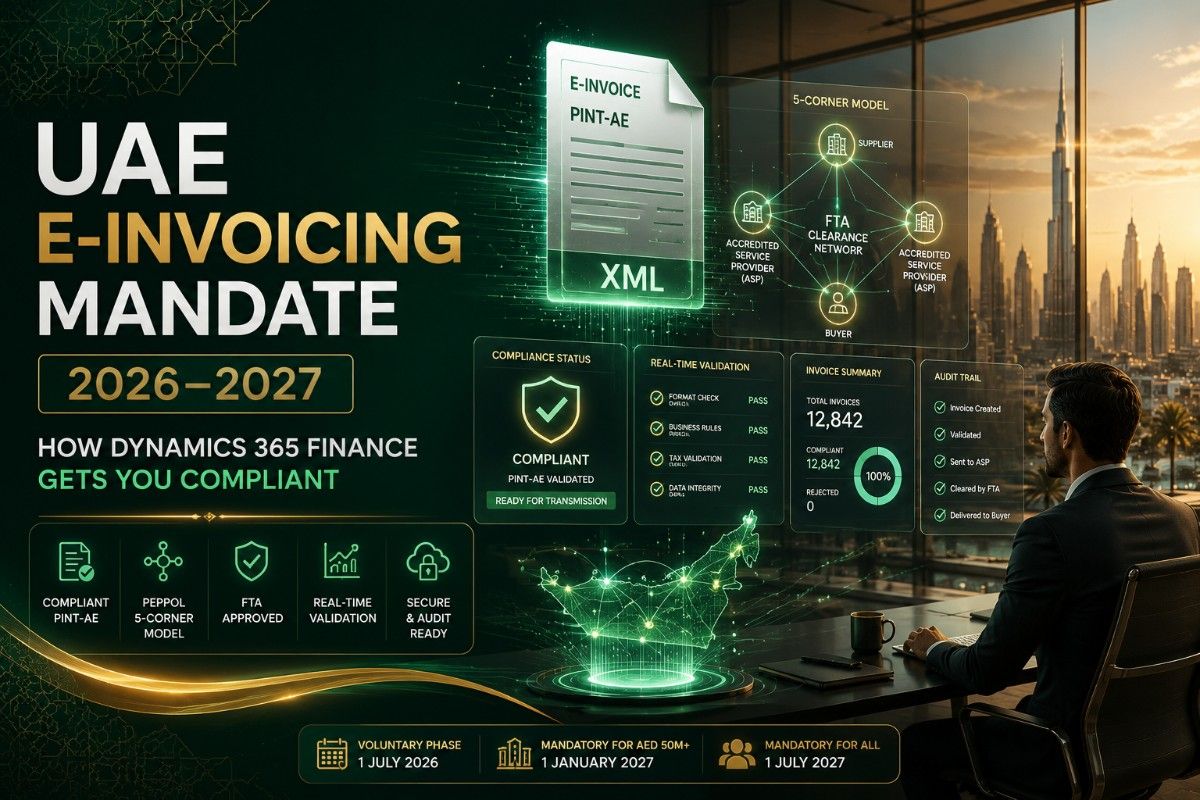
The UAE’s e-invoicing framework is built on Ministerial Decisions №243 and 244 of 2025, issued under the VAT law, and runs on a Peppol-based five-corner model — meaning invoices move through Accredited Service Providers (ASPs) rather than being emailed as static PDFs. The required format is PINT-AE, a UAE-specific structured XML standard.
The rollout is phased:
- From 1 July 2026 — voluntary adoption opens, giving businesses a pilot window to test before penalties apply.
- From 1 January 2027 — mandatory for businesses with annual revenue of AED 50 million or more.
- From 1 July 2027 — mandatory for the remaining VAT-registered businesses.
Large businesses also face an earlier deadline to appoint an Accredited Service Provider, which the Ministry of Finance has already extended once — a sign that the compliance infrastructure around this mandate is still tightening, not loosening. The initial scope covers B2B and B2G transactions; B2C is out of scope for now.
This is not optional, and it’s not something your accountant can patch with a workaround at the last minute. Penalties for failing to implement the system or appoint an ASP are already written into Cabinet Decision №106 of 2025.
Why This Isn’t Just a Tax Team Problem
E-invoicing changes how invoices are created, validated, transmitted, and reconciled — which means it touches AR, AP, tax, and IT all at once. A PDF invoice is a static document. A UAE e-invoice is a structured data exchange that has to pass validation against the Peppol network before it’s considered issued at all.
If your ERP can’t generate, validate, and transmit invoices in that structured format automatically, someone on your team will be doing it manually — and manual e-invoicing at transaction volume is not a sustainable answer past the pilot phase.
How Dynamics 365 Finance Handles This
Microsoft has built native e-invoicing functionality for the UAE directly into Dynamics 365 Finance, designed specifically around the DCTCE (five-corner) model the FTA has mandated. For organizations already running Dynamics 365, this means compliance can largely be handled through configuration rather than custom development or a bolt-on third-party tool.
What this looks like in practice:
- Structured invoice generation in the PINT-AE format directly from your existing AR and AP transactions, without manual reformatting.
- Built-in validation against the required schema before an invoice is transmitted, reducing rejected invoices and payment delays.
- ASP connectivity designed to work with the Accredited Service Provider network rather than requiring a parallel system.
- Audit-ready records of every invoice’s compliance status, useful for both FTA reporting and internal finance controls.
For companies not yet on Dynamics 365, this mandate is often the trigger that makes a broader ERP modernization conversation worth having — not because e-invoicing alone justifies a new system, but because it exposes exactly how much manual, disconnected process still sits between your finance team and clean data.
What Finance Leaders Should Be Doing Right Now
- Confirm which phase applies to you. Revenue threshold determines your deadline — don’t assume you have until 2027 without checking.
- Audit your current invoicing process. If invoices are built manually or in disconnected systems, that’s your biggest risk point.
- Use the voluntary phase as a real pilot, not a formality. Testing before the mandatory deadline is the difference between a smooth go-live and a scramble.
- Confirm your ERP’s readiness directly — don’t assume “we’re on Dynamics 365” automatically means “we’re compliant.” Configuration and ASP connectivity still need to be set up correctly.
- Loop in IT and tax together, not sequentially. This is a cross-functional project, and treating it as a pure IT ticket or a pure tax filing update both lead to gaps.
Why Work With Dynamic Netsoft Technology
Getting Dynamics 365 e-invoicing configuration right isn’t just a technical checkbox — it requires understanding UAE VAT law, the Peppol five-corner model, and how your specific invoicing volume and business structure map onto the FTA’s requirements. Dynamic Netsoft Technology works directly with enterprise and mid-market businesses across the UAE, the wider Middle East, and Africa on Dynamics 365 Finance implementations, including e-invoicing readiness, ASP connectivity, and broader finance automation.
We’ve seen how quickly “we’ll deal with it closer to the deadline” turns into a compressed, high-risk implementation. The businesses moving early are the ones treating the voluntary phase as free insurance.
Don’t Wait for the Mandatory Deadline to Find Out You’re Not Ready
The voluntary phase opening in July 2026 is the cheapest, lowest-risk time to test your e-invoicing setup. Waiting until your mandatory go-live date means testing under pressure, with penalties on the table if something goes wrong.
Get a free UAE E-Invoicing Readiness Assessment from Dynamic Netsoft Technology. In one session, we’ll map your current invoicing process against the FTA’s requirements, flag exactly where your Dynamics 365 environment needs configuration, and give you a clear go-live timeline — before your deadline decides it for you.