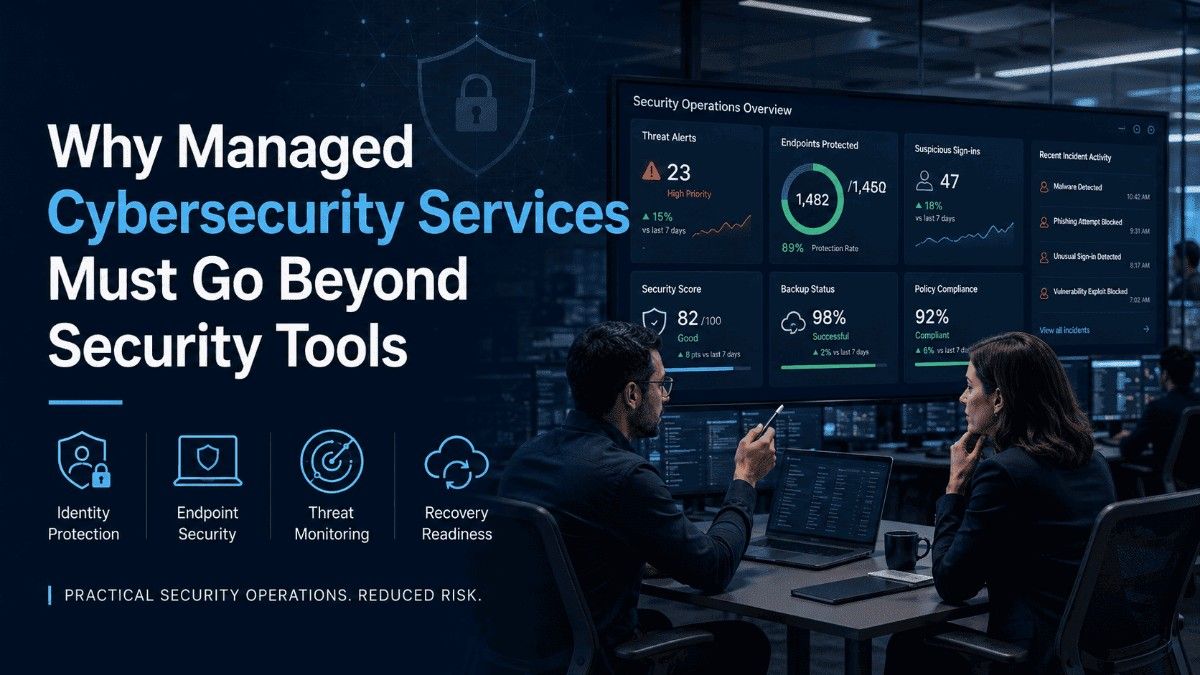
Why Managed Cybersecurity Services Must Go Beyond Security Tools
-

- July 31st, 2026
- 33 views

FREE SEO Topical Map Generator: Find Your Next Content Ideas
Cybersecurity purchasing often begins with technology. Organizations invest in firewalls, endpoint protection, multifactor authentication, email security, backup platforms, and monitoring tools. These controls are important, but tools alone do not create an effective security program.
Most security failures occur in the gaps between products, processes, people, and accountability. A tool may generate an alert, but someone still needs to investigate it. Multifactor authentication may be enabled, but access policies may still be weak. Backups may exist, but recovery may never have been tested. An endpoint platform may be deployed, but devices may remain unmanaged or incorrectly configured.
For IT decision-makers, the value of managed cybersecurity is not simply gaining more software. It is establishing the operational discipline required to configure, monitor, maintain, and improve security controls over time.
Cybersecurity Is an Operating Model
A practical cybersecurity program should define who is responsible for identity protection, endpoint security, vulnerability management, monitoring, backup readiness, incident response, vendor risk, and policy enforcement.
Without clear ownership, important tasks become assumptions. The internal IT team may believe the security provider is reviewing alerts, while the provider may assume the customer is responsible. These gaps are dangerous because attackers do not care which party misunderstood the contract.
Organizations evaluating managed cybersecurity services should begin by clarifying responsibilities. The service model should explain what is monitored, how alerts are handled, when incidents are escalated, what actions require customer approval, and how security improvements are prioritized.
Identity Has Become a Primary Security Boundary
Cloud platforms and remote work have changed the traditional security perimeter. Users can access email, files, applications, and administrative systems from many locations and devices. As a result, identity protection is now central to cybersecurity.
Multifactor authentication remains essential, but it is not sufficient by itself. Organizations also need conditional access policies, appropriate administrative roles, strong account recovery controls, device compliance requirements, session management, and monitoring for suspicious sign-ins.
Privileged accounts deserve additional attention. Administrative access should be limited, reviewed regularly, and separated from normal user activity. Former employees, contractors, service accounts, and dormant accounts should not remain active without a valid business reason.
Managed security providers should help customers establish and maintain these controls instead of treating identity as a one-time configuration project.
Endpoint Protection Requires Ongoing Management
Laptops, desktops, and servers remain common entry points for attackers. Endpoint Detection and Response, or EDR, helps identify suspicious activity on individual devices. Extended Detection and Response, or XDR, can connect signals across endpoints, identity, email, cloud, and other security layers.
The technology is useful, but deployment quality matters. Devices must be enrolled correctly, policies must be applied consistently, alerts must be reviewed, exclusions must be controlled, and response procedures must be defined.
Some EDR or XDR platforms may support rollback or recovery capabilities for certain attacks, depending on the tool, configuration, and incident type. These features can be valuable, but they are not universal and do not replace tested backups.
IT leaders should ask how the provider handles unmanaged devices, stale agents, policy failures, alert triage, false positives, and endpoint isolation during an incident.
Monitoring Without Response Is Not Enough
Security tools can generate large volumes of alerts. If no one investigates them, the organization has visibility without protection.
Managed Detection and Response, often called MDR, combines security technology with managed monitoring, investigation, and response support. A strong MDR model should explain how alerts are prioritized, what evidence is reviewed, how quickly customers are notified, and which response actions the provider can perform.
Backup Readiness Must Be Tested
Many organizations assume they are protected because backups are running. That assumption can fail during ransomware, hardware failure, accidental deletion, or cloud account compromise.
A complete backup program should consider which systems and data are protected, how frequently backups occur, whether copies are isolated, who can delete them, and how long recovery would take. Recovery procedures should be tested rather than documented and forgotten.
Managed cybersecurity should therefore connect prevention with resilience. Even strong controls cannot guarantee that an incident will never occur. The organization must be prepared to restore operations when prevention fails.
Security Improvement Should Be Continuous
Threats, platforms, users, and business processes change. A security configuration that was appropriate last year may no longer reflect the current environment.
The provider should conduct regular reviews of identity settings, endpoint coverage, vulnerabilities, administrative access, backup status, incident trends, and policy exceptions. Findings should be translated into a prioritized improvement plan rather than presented as an overwhelming list of technical issues.
IT decision-makers need to understand which risks are most likely, which could cause the greatest business impact, and which improvements can be implemented within available budget and staffing constraints.
Reporting Should Support Decisions
Security reporting should not be limited to the number of blocked threats. Leadership needs visibility into exposure, control coverage, unresolved risks, incident activity, recovery readiness, and progress against the security roadmap.
Useful reports may include endpoint coverage, privileged account status, vulnerability aging, backup test results, suspicious sign-in trends, open security actions, and major policy exceptions.
The purpose of reporting is not to create fear. It is to support informed decisions about risk, investment, and operational priorities.
Final Perspective
Managed cybersecurity services should combine technology with disciplined execution. The provider must help configure controls, monitor activity, investigate alerts, strengthen identity, manage endpoints, support recovery planning, and continuously improve the security environment.
No provider can guarantee that a breach will never occur. The realistic objective is to reduce the likelihood of successful attacks, identify suspicious activity earlier, limit potential damage, and improve the organization’s ability to recover.
For IT decision-makers, that operational maturity is the difference between owning security products and operating a security program.