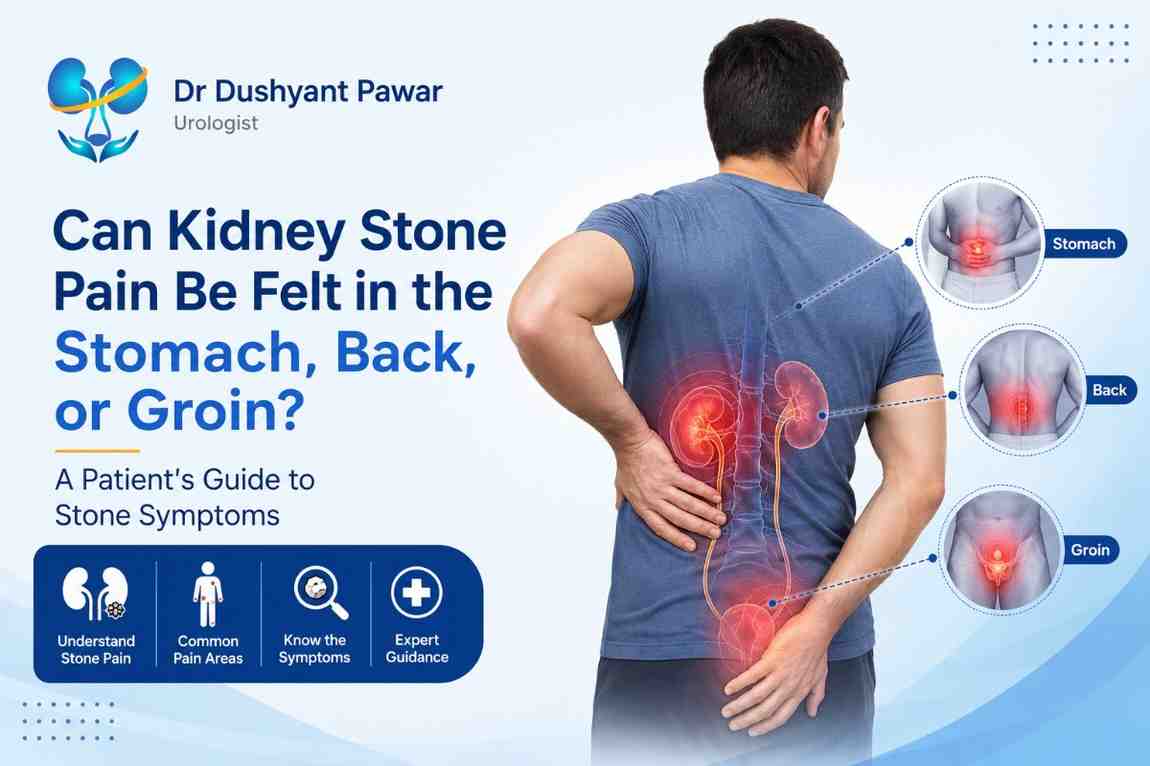
Can Kidney Stone Pain Be Felt in the Stomach, Back, or Groin? A Patient's Guide to Stone Symptoms
-

- July 22nd, 2026
- 13 views

FREE SEO Topical Map Generator: Find Your Next Content Ideas
One of the most confusing aspects of Kidney Stone Pain is that it does not always stay in one place. Some people experience sharp pain in their lower back, while others feel discomfort in the stomach, side, pelvis, or groin. Because the symptoms can appear in different areas of the body, many patients initially mistake kidney stones for digestive problems, muscle strain, appendicitis, urinary infections, or even reproductive health issues.
The location of the pain often changes as the stone moves through the urinary tract. Understanding these pain patterns can help patients identify potential kidney stone symptoms earlier and seek timely care from a qualified Urologist in Ahmedabad when needed.
Why Does Kidney Stone Pain Move?
The kidneys are connected to the bladder by narrow tubes called ureters. When a kidney stone starts moving from the kidney toward the bladder, it can irritate or partially block these tubes.
As the stone travels, the pain often travels too.
This is why many patients describe Kidney Stone Pain as pain that starts in the back and gradually spreads to the lower abdomen or groin. The exact location depends on where the stone is positioned within the urinary tract at that particular moment.
Unlike muscular pain, kidney stone discomfort often comes in waves and may suddenly increase or decrease in intensity.
Pain in the Back: The Most Common Starting Point
For many patients, the first symptom of Kidney Stone Pain is discomfort in the back or side, usually below the ribs.
This pain may:
- Develop suddenly
- Affect one side of the body
- Feel sharp or stabbing
- Come in intense waves
- Radiate toward the front of the body
The pain often occurs because the stone is causing pressure inside the kidney or blocking urine flow.
Many people initially assume they have pulled a muscle or slept in an awkward position. However, kidney stone pain is typically much more severe than ordinary back pain and may not improve with changes in posture.
Can Kidney Stone Pain Be Felt in the Stomach?
Yes.
As the stone moves lower into the ureter, pain may extend into the front of the abdomen.
Many patients describe:
- Lower abdominal pain
- Cramping sensations
- Pressure in the stomach area
- Discomfort around the belly button
Because abdominal symptoms are common, some individuals mistakenly believe they have:
- Indigestion
- Stomach infection
- Food poisoning
- Gas-related discomfort
The difference is that Kidney Stone Pain is often accompanied by urinary symptoms such as burning urination, blood in the urine, or changes in urinary frequency.
Pain in the Groin: A Common Sign of Stone Movement
A Sign That the Stone Is Moving Downward
One of the most distinctive features of Kidney Stone Pain is its ability to radiate into the groin.
As a stone approaches the lower ureter closer to the bladder, patients may notice:
- Groin pain
- Pelvic discomfort
- Sharp pain during movement
- Sudden bursts of severe discomfort
Men may feel pain extending toward the testicular area, while women may notice discomfort near the pelvic region.
This doesn't necessarily mean the condition has become worse. Instead, it often indicates that the stone has changed position within the urinary tract.
Can Kidney Stone Pain Affect the Pelvis?
Absolutely.
When a stone gets closer to the bladder, many patients experience symptoms in the pelvic region.
Common complaints include:
- Pelvic pressure
- Frequent urination
- Strong urgency to urinate
- Burning sensation during urination
- Feeling unable to completely empty the bladder
These symptoms can closely resemble a urinary tract infection.
Because of this overlap, proper diagnosis is essential before starting treatment.
Why Does the Pain Come and Go?
Many patients become concerned when severe pain suddenly disappears.
However, fluctuating pain is actually common with kidney stones.
Pain may come and go because:
- The stone changes position
- Urine flow temporarily improves
- Muscle spasms around the ureter decrease
- The blockage becomes intermittent
A temporary reduction in discomfort does not always mean the stone has passed.
Some patients continue to have stones present even after the pain improves.
Symptoms That Often Occur Along With Kidney Stone Pain
In addition to discomfort in the back, stomach, pelvis, or groin, other symptoms may develop.
Blood in the Urine
When a stone rubs against the lining of the urinary tract, it may cause bleeding.
You may notice:
- Pink urine
- Red urine
- Brownish urine
- Microscopic blood detected in testing
Nausea and Vomiting
The kidneys and digestive system share nerve pathways.
Severe Kidney Stone Pain can trigger nausea and, in some cases, vomiting.
Frequent Urination
Stones near the bladder often create the sensation of needing to urinate frequently.
Burning During Urination
This symptom commonly occurs when the stone reaches the lower urinary tract.
When Should You See a Urologist?
While some small stones pass naturally, professional evaluation is recommended if you experience:
- Severe pain
- Repeated pain attacks
- Blood in urine
- Fever or chills
- Difficulty passing urine
- Persistent nausea or vomiting
Seeking care from an experienced Urologist in Ahmedabad can help determine the size and location of the stone and whether treatment is necessary.
Early diagnosis often prevents complications such as urinary obstruction or infection.
How Are Kidney Stones Diagnosed?
Doctors use several methods to confirm a kidney stone diagnosis.
Ultrasound
A commonly used imaging test that helps identify stones and urinary tract abnormalities.
CT Scan
Provides detailed information about stone size, location, and blockage.
Urine Tests
Help detect blood, infection, and crystal formation.
Blood Tests
Evaluate kidney function and overall health.
These investigations help create an accurate treatment plan tailored to the patient's condition.
Conclusion
Kidney Stone Pain can be felt in the back, side, stomach, pelvis, or groin depending on where the stone is located within the urinary tract. This shifting pattern is one reason kidney stones can be difficult for patients to recognize and are sometimes mistaken for other health conditions.
Understanding how pain changes as a stone moves can help patients identify symptoms earlier and seek timely medical care. Whether the discomfort starts in your back or spreads to your abdomen and groin, persistent symptoms should never be ignored.
Experiencing unexplained back pain, abdominal discomfort, pelvic pressure, or groin pain that could be related to Kidney Stone Pain? Don't wait for symptoms to worsen.
Dr. Dushyant Pawar provides expert evaluation and personalized treatment for kidney stones and other urological conditions. If you're looking for a trusted Urologist in Ahmedabad, schedule a consultation to get an accurate diagnosis and the right treatment plan for your urinary health.