How Intuit Enterprise Suite Helps Growing Businesses Manage Complexity
-

- June 26th, 2026
- 27 views

FREE SEO Topical Map Generator: Find Your Next Content Ideas
Growth is an exciting milestone for any business, but it often comes with operational challenges that many organizations underestimate. A company that once relied on basic accounting software may suddenly find itself managing multiple locations, subsidiaries, larger workforces, and increasingly complex financial reporting requirements. As operations expand, manual processes, disconnected systems, and spreadsheet-based reporting become barriers to efficiency rather than tools for growth.
This shift is one reason why many mid-sized organizations are adopting Intuit Enterprise Suite, a cloud-based ERP platform designed to unify accounting, payroll, reporting, and operational workflows within a single environment. Rather than managing several disconnected applications, businesses can centralize financial data, improve collaboration, and gain real-time visibility into performance. Companies evaluating modern ERP solutions can also benefit from implementation guidance offered by specialists such as Minding My Books, helping ensure the technology is aligned with business goals from the very beginning.
When Accounting Software Is No Longer Enough
Traditional accounting software is designed to record financial transactions accurately, making it an excellent solution for startups and small businesses. However, growth introduces new requirements that basic accounting platforms were never intended to address.
Finance teams often need to consolidate information from multiple legal entities, monitor project profitability, manage expanding payroll operations, and provide executives with timely financial insights. Completing these tasks through spreadsheets or disconnected software increases the likelihood of reporting errors, duplicate work, and delayed decision-making.
An ERP platform addresses these challenges by connecting financial processes across the organization. Instead of switching between separate systems for accounting, payroll, reporting, approvals, and forecasting, teams work within a unified platform where information is automatically updated and accessible. This creates a more consistent flow of data while giving decision-makers greater confidence in the accuracy of their reports.
What Makes Intuit Enterprise Suite Different?
Many ERP systems are known for lengthy implementations, significant infrastructure investments, and steep learning curves. Intuit Enterprise Suite ERP takes a different approach by delivering enterprise-level functionality through a modern cloud platform that is designed for growing businesses rather than large global enterprises alone.
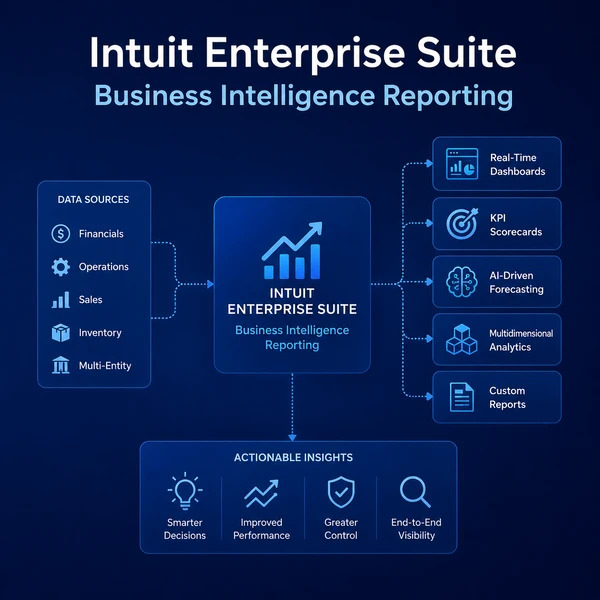
The platform combines financial management, payroll, reporting, and operational capabilities into one integrated solution. Businesses can manage multiple entities, automate intercompany processes, assign role-based access, and create multidimensional reports that provide meaningful insights into business performance.
One of its greatest strengths is flexibility. Organizations can analyze financial data by location, department, project, subsidiary, or other business dimensions, allowing leadership teams to understand performance from multiple perspectives instead of relying solely on standard financial statements.
Another advantage is the platform's intelligent analytics. Instead of simply storing financial information, Intuit Enterprise Suite helps organizations identify trends, monitor key performance indicators, forecast future performance, and make informed business decisions using real-time data. This improved visibility enables leaders to respond more quickly to changing market conditions while planning confidently for future growth.
Businesses interested in exploring these capabilities further can review this comprehensive overview of Intuit Enterprise Suite, including its core features, implementation services, and practical applications for growing organizations.
Why Cloud ERP Supports Long-Term Scalability
As businesses expand, scalability becomes just as important as functionality. A solution that works well for a team of ten employees may struggle to support an organization with multiple business units, hundreds of employees, and increasingly sophisticated reporting requirements.
Cloud ERP platforms eliminate many of the limitations associated with legacy software. Teams can securely access financial information from different locations, collaborate more efficiently, and benefit from continuous software updates without maintaining expensive on-premises infrastructure. This flexibility allows organizations to adapt more quickly as business needs evolve.
Equally important, cloud ERP provides a foundation for automation. Routine activities such as approvals, financial reconciliations, reporting, and workflow management can be streamlined, reducing administrative workloads while improving operational consistency across departments.
Technology Alone Doesn't Guarantee Success
Selecting the right ERP system is only one part of a successful digital transformation. The greatest value comes from implementing the technology in a way that reflects an organization's unique financial processes, reporting requirements, and operational workflows.
Without proper planning, businesses may experience inconsistent reporting, low user adoption, or inefficient configurations that reduce the return on their investment. A thoughtful implementation strategy helps ensure data is migrated accurately, automation is configured effectively, and employees receive the training necessary to use the system confidently.
Working with experienced ERP implementation professionals can also help organizations avoid common deployment challenges while establishing a scalable foundation that supports future expansion rather than requiring another technology replacement a few years later.
Looking Ahead
Business growth inevitably increases financial complexity, but it also creates opportunities to modernize operations. Investing in ERP software for growing businesses is no longer simply about replacing accounting software—it is about building an integrated platform that improves visibility, supports informed decision-making, and enables sustainable growth.
For organizations evaluating their first ERP platform or considering an upgrade from legacy financial systems, Intuit Enterprise Suite offers a practical combination of scalability, automation, and intelligent reporting designed for today's evolving business environment. Choosing the right implementation partner is equally important to achieving long-term success. If you're ready to explore how Intuit Enterprise Suite could support your organization's goals, you can connect with the team at Minding My Books to discuss your business requirements and implementation strategy.