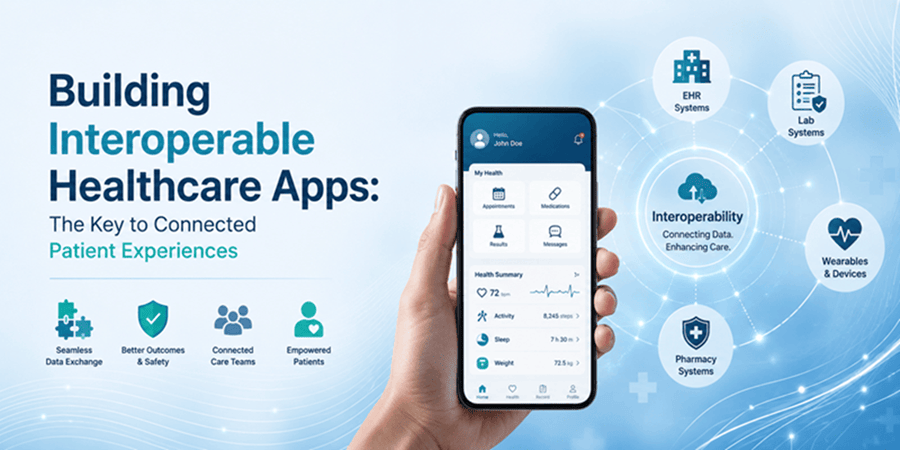
Building Interoperable Healthcare Apps: The Key to Connected Patient Experiences
-

- July 29th, 2026
- 38 views

FREE SEO Topical Map Generator: Find Your Next Content Ideas
Two patient apps launch in the same quarter. One pulls a full medication history from three health systems the moment a patient logs in. The other shows a blank screen and a request to fax records. Six months later, one has referral partners and renewals; the other has churn and a support queue. The difference was never the interface. It was whether the app could speak the languages the rest of healthcare already speaks. That is the quiet stakes behind healthcare app development services today: connection, not features, separates the products clinicians recommend from the ones they abandon.
Interoperability tends to get filed under compliance, a box a security team checks before launch. That framing costs money. When an app exchanges data cleanly with electronic health records, labs, pharmacies, and payers, it earns a place in the referral flow and keeps patients from rebuilding their history at every visit. When it cannot, the friction lands on the patient first and the business second. Treating connection as a design principle rather than a legal chore is what modern healthcare it solutions get right.
Why Connection Decides Who Gets the Referral
A referral is a bet. When a primary care physician sends a patient to a specialist who uses a particular app, that physician is trusting the app to carry the chart forward without loss. If the specialist's team ends up phoning for records or retyping allergies, the referral becomes a liability, and the next one goes elsewhere. Clean data exchange turns an app into a dependable link in a chain of care. Broken exchange turns it into a bottleneck that colleagues route around.
Patients make the same calculation with their feet. Demand for connected access has moved from a nice feature to a baseline expectation. In 2024, more than three in four individuals were offered online access to their medical records, and nearly two-thirds accessed those records at least once. An app that surfaces a partial chart, or one stitched together from a single source, reads as broken to people who now expect their full history on a phone. Retention follows the completeness of the data far more than the polish of the screens.
Trust compounds quietly. A patient who sees accurate medications, recent labs, and prior visits without re-entering anything begins to rely on the app. A caregiver managing a parent's care relies on it harder. That reliance is the retention engine, and it runs on data that arrives complete and current. The apps that win this are rarely the flashiest; they are the ones that never make a patient explain what the system should already know.
The Standards That Carry the Data
Interoperability is not a single switch. It is a stack of agreements about how information is structured, transmitted, and authorized. Four pieces matter most for a patient-facing product, and each solves a distinct problem:
FHIR: Fast Healthcare Interoperability Resources defines data as modular, web-friendly resources such as a Patient, a Medication, or an Observation. It is the standard most new apps build against because it maps cleanly to modern APIs.
HL7v2: an older messaging standard still running inside most hospital systems for admissions, orders, and results. A serious app plans to speak it, since a large share of live clinical traffic still moves this way.
SMART on FHIR: a framework that lets an app launch inside an electronic health record and authenticate through it, so a clinician opens the app in context rather than juggling a separate login.
USCDI: the United States Core Data for Interoperability sets the baseline data classes and elements every certified system must exchange, giving apps a predictable floor of information to expect.
These standards work together. FHIR describes the resource, USCDI defines which fields must be present, SMART on FHIR governs how an app gets authorized access, and HL7v2 keeps the app fluent with the installed base. An app that supports all four can join conversations already happening across a health network. One that supports only its own format has to convince every partner to translate on its behalf, which few will do.
Application programming interfaces are the connective tissue that carries these standards between systems. A well-designed API is documented, versioned, and predictable, so a partner can integrate against it without a support ticket for every field. Poorly designed APIs, or the absence of any, are where integration projects quietly go to die. The strongest healthcare software development services treat the API as a first-class product, not an afterthought bolted on before launch.
The Mandates Are No Longer Optional
Federal policy has turned interoperability from a competitive edge into a floor. The CMS Interoperability and Prior Authorization Final Rule, known as CMS-0057-F, requires impacted payers to implement four FHIR-based APIs, generally by January 1, 2027: a Patient Access API, a Provider Access API, a Payer-to-Payer API, and a Prior Authorization API. Operational provisions, including faster prior authorization decisions, begin taking effect in 2026. Any app that touches Medicare Advantage, Medicaid, or federally facilitated exchange plans now sits inside that timeline.
The direction of travel is set at the certification layer too. Nearly all hospitals and most physicians run electronic health records certified through the ONC Health IT Certification Program, and certified systems must exchange the USCDI data classes on standard APIs. That means the endpoints an app needs to connect to are increasingly standardized and available. An app built for those endpoints inherits a growing network of ready partners. An app built around a proprietary format has to keep negotiating one-off connections while the rest of the market plugs in by default.
The read for anyone planning a product is straightforward. Building against FHIR, USCDI, and the mandated APIs today aligns a roadmap with where every major payer and health system is legally required to be within the next two years. Waiting means retrofitting under a deadline, which is slower and more expensive than designing for it from the start.
Where Apps Fail to Connect
Most interoperability failures are not exotic. They are predictable, and they show up in patterns worth naming before a build begins:
Data silos: the app stores its own records and never establishes bidirectional exchange, so a patient's history stops at the app's own boundary.
Partial FHIR support: the app implements a handful of FHIR resources and calls itself interoperable, then breaks the first time a partner sends a resource it never mapped.
Proprietary formats: the app invents its own data model and asks every integration partner to translate into it, which turns each new connection into a custom project.
Read-only integration: the app can pull data but cannot write back, so a clinician's notes or a patient's updates never rejoin the source of truth.
Neglecting HL7v2: the app supports only modern FHIR endpoints and cannot talk to the older messaging that still runs much of the hospital.
Each of these ships as a working demo. The failure surfaces later, in production, when a real health system sends real data and the app cannot use it. By then the fix means reopening the data layer, which is the most expensive part of the codebase to change. Naming these traps early is cheaper than discovering them after a partner integration stalls.
What Healthcare App Development Services Get Right From the First Sprint
Interoperability that works is designed in, not sprinkled on. A practical sequence keeps the connective layer central rather than peripheral:
Model data on FHIR resources from day one, so the app's internal representation already matches what partners send and expect.
Map to USCDI early, confirming the app captures and exchanges every required data class before feature work piles on top.
Adopt SMART on FHIR for authorization, letting the app launch and authenticate inside an electronic health record rather than living in isolation.
Plan HL7v2 pathways for the systems that still speak it, so the app connects to the installed base and not only to greenfield endpoints.
Test against real endpoints, using sandbox environments from major health record vendors instead of validating only against internal mock data.
The order matters. Teams that model on FHIR and validate against real endpoints early catch mismatches while they are cheap to fix. Teams that treat interoperability as a final integration phase discover the mismatches after the architecture has hardened around a private format. Engaging healthcare app development services that build this way from the first sprint is the difference between an app that connects on launch day and one that spends its first year in remediation.
Security Is Part of the Connection, Not a Tax on It
Connected apps move protected health information, so the Health Insurance Portability and Accountability Act (HIPAA) governs every exchange. More endpoints mean more surface to secure, and the answer is to build security into the data layer rather than wrap it around a finished product. Encryption in transit and at rest, strict authentication through standards like SMART on FHIR, granular consent so patients control what they share, and audit logging on every access form the working baseline.
Consent deserves particular attention as exchange widens. A patient granting an app access to one health system is not consenting to share that data everywhere. Interoperable design has to carry the patient's permission with the data, honoring the scope they set and revoking cleanly when they change their mind. Handled well, security and interoperability reinforce each other: an app that patients trust with their data is an app they keep using, and reliable use is the whole point.
What Patient-Mediated Exchange Changes Next
The next shift puts the patient at the center of exchange. The Trusted Exchange Framework and Common Agreement (TEFCA) is building a nationwide network of networks that lets health information flow across previously disconnected systems. Adoption is accelerating; 11 QHINs and over 71,000 organizations now participate in TEFCA Exchange, connecting a widening slice of the country's clinical data under one governance framework.
Patient-mediated exchange rides on this foundation. Rather than each app negotiating separate connections to each health system, an app connected to the national framework lets a patient direct their own records to the tools they choose. The habit is already forming: frequent portal use more than doubled from 2019, with 34 percent of individuals accessing records six or more times in 2024, up from 15 percent before the pandemic. Apps that plug into patient-mediated exchange inherit reach that would take years to build one integration at a time. Apps that stay outside it will watch that reach form around them.
The trajectory points one direction. Data will keep flowing toward the patient and the applications the patient trusts, carried by open standards and enforced by federal mandate. The products positioned to receive that flow are the ones being architected for exchange right now.
Interoperability sorts healthcare apps into two groups: the ones that get referred and retained, and the ones that quietly lose both. The winners treat connection as strategy, model data on FHIR and USCDI from the first sprint, speak HL7v2 to the installed base, and secure every exchange as a condition of trust rather than a compliance afterthought. With the CMS mandates arriving in 2026 and 2027 and patient-mediated exchange expanding through TEFCA, the advantage belongs to teams that build for connection now. Damco brings that discipline to healthcare app development services engineered for exchange from day one. The apps clinicians recommend next year are the ones being wired to connect today.
Sources
ASTP/ONC, Individuals' Access and Use of Patient Portals and Smartphone Health Apps (Data Brief No. 77), https://www.healthit.gov/data/data-briefs/individuals-access-and-use-patient-portals-and-smartphone-health-apps-2024/ (2025)
Centers for Medicare & Medicaid Services, CMS Interoperability and Prior Authorization Final Rule (CMS-0057-F), https://www.cms.gov/newsroom/fact-sheets/cms-interoperability-prior-authorization-final-rule-cms-0057-f (2024)
ONC/ASTP Health IT Buzz, Who's Participating in TEFCA Exchange, https://www.healthit.gov/buzz-blog/tefca/take-a-look-at-whos-participating-in-tefca (2025)