Hotel Advertising: How Paid Media Can Increase Direct Hotel Bookings
-

- July 30th, 2026
- 14 views

FREE SEO Topical Map Generator: Find Your Next Content Ideas
The hotel industry is highly competitive. Travelers can compare properties, prices, reviews, locations, and amenities within minutes, making visibility across search engines and digital channels essential for hotel businesses.
While organic SEO and social media can build long-term visibility, hotel advertising gives properties another way to reach travelers when they are actively searching, comparing options, or preparing to book.
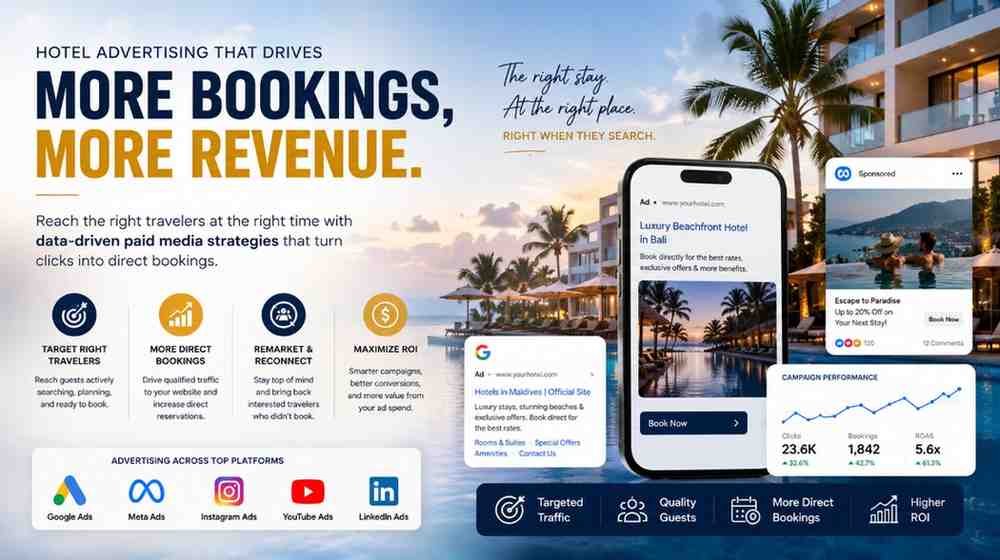
A well-planned hotel digital marketing strategy can combine Google Ads, paid social, remarketing, audience targeting, and conversion-focused landing pages to attract qualified visitors and encourage more direct bookings.
The goal is not simply to generate clicks. The goal is to turn relevant traffic into measurable bookings while reducing unnecessary dependence on third-party booking platforms.
What Is Hotel Advertising?
Hotel advertising refers to paid promotional campaigns designed to put a hotel, resort, or hospitality business in front of potential guests across search engines, social platforms, travel-related websites, and other digital channels.
Unlike traditional advertising, digital hotel advertising allows businesses to target audiences based on factors such as:
Search behavior
Location
Travel intent
Device
Demographics
Previous website interactions
Interests and online behavior
This makes paid advertising particularly useful when a hotel wants to reach travelers closer to the booking decision.
For example, someone searching for "hotels in Miami near South Beach" has a different level of intent from someone casually watching a travel video. A strong advertising strategy should recognize that difference.
Why Paid Media Matters for Hotels
Hotel businesses compete for attention at multiple stages of the traveler's journey.
A potential guest might first discover a destination through social media, research hotels through Google, compare prices on booking platforms, visit a hotel's website, and return several days later before making a decision.
Paid media can support different stages of this journey.
1. Reach Travelers With Strong Booking Intent
Search advertising can place a hotel in front of people actively searching for accommodation.
Keywords such as:
"hotel in New York"
"luxury hotel in Miami"
"family hotel near Orlando"
"hotel near [destination]"
"best hotels in [city]"
can indicate that a user is already researching accommodation.
The closer a user's search is to an actual booking decision, the more important it becomes to provide a relevant landing page and a clear path to reservation.
2. Increase Direct Hotel Bookings
One of the biggest advantages of a strong paid media strategy is the ability to drive travelers directly to a hotel's website.
A direct booking allows the hotel to control more of the customer journey, from the initial advertisement through the reservation experience.
However, advertising alone does not guarantee direct bookings.
The complete journey matters:
Ad → Relevant Landing Page → Trust Signals → Room/Offer Information → Booking Process → Conversion
If any part of this journey creates friction, advertising spend can produce traffic without producing enough reservations.
3. Build Visibility Beyond Organic Search
SEO is valuable for sustainable growth, but organic rankings can take time and are influenced by many factors.
Paid media provides an additional visibility channel.
A hotel can use paid campaigns to promote specific destinations, seasonal offers, room categories, packages, or booking opportunities while its organic visibility continues to develop.
This makes hotel digital marketing stronger when paid and organic strategies work together instead of operating independently.
Google Ads for Hotels: Where Should You Start?
Google Ads for hotels can be valuable because search advertising reaches users when they are actively looking for accommodation or related travel services.
A practical campaign structure can separate keywords according to search intent.
High-Intent Searches
These searches are often closest to a booking decision:
"book hotel in [city]"
"hotel in [destination]"
"luxury hotel [destination]"
"hotel near [landmark]"
"best hotel in [destination]"
Research-Oriented Searches
These searches may indicate earlier-stage consideration:
"best area to stay in [city]"
"where to stay in [destination]"
"best hotels for families in [city]"
"luxury hotels in [destination]"
The landing page should match the search intent.
Someone searching for a specific hotel should not be sent to a generic homepage if a more relevant booking or property page exists.
Paid Media for Hotels Should Go Beyond Search Ads
Search advertising is only one part of a broader paid media for hotels strategy.
Paid Social Advertising
Platforms such as Facebook and Instagram can help hotels introduce properties, experiences, offers, and destinations to targeted audiences.
Paid social can be useful for:
Destination campaigns
Seasonal promotions
Romantic getaways
Family packages
Luxury travel
Events
New property launches
Retargeting website visitors
Visual creative is especially important in hospitality because travelers often make decisions based on the overall experience they expect.
High-quality photography, short videos, room visuals, amenities, and destination-focused creative can communicate value quickly.
Remarketing and Retargeting
Not every traveler books during their first website visit.
A potential guest may compare several hotels, check dates, discuss the trip with others, or simply postpone the decision.
Remarketing allows hotels to reconnect with people who previously interacted with their website or digital content, subject to applicable platform policies and privacy requirements.
For example, a hotel could create a campaign for visitors who viewed room pages but did not complete a booking.
The messaging should provide a useful reason to return rather than repeatedly showing the same generic advertisement.
How to Increase Direct Hotel Bookings With Paid Advertising
Increasing direct bookings requires more than increasing advertising spend.
Here are several practical areas hotels should focus on.
1. Target High-Intent Keywords
Start with searches that closely relate to the property's location, accommodation type, and booking intent.
Instead of targeting every possible travel-related keyword, prioritize terms that have a clear connection to what the hotel offers.
For example:
Broad:
"travel destinations"
More relevant:
"boutique hotel in Austin"
The second search is more closely connected to a hotel booking decision.
2. Create Dedicated Landing Pages
Sending every advertisement to the homepage can weaken the user journey.
A dedicated landing page should closely match the advertisement and provide the information the visitor needs to make a decision.
Depending on the campaign, this could include:
Property information
Room options
Amenities
Location
Photos
Reviews
Availability
Offers
Cancellation information
Clear booking CTA
3. Make the Value Proposition Clear
Travelers need a reason to choose one hotel over another.
Your advertising and landing pages should communicate genuine differentiators such as:
Convenient location
Unique amenities
Flexible booking options
Property experience
Business facilities
Family-friendly facilities
Resort experiences
Special packages
Avoid making unsupported claims simply to improve click-through rates.
Trust is especially important in hospitality.
4. Optimize the Booking Experience
A successful advertisement can still fail if the booking process is difficult.
Check whether visitors can quickly:
Select dates
See available rooms
Understand pricing
Review important policies
Choose a room
Complete payment
The fewer unnecessary obstacles between the advertisement and reservation, the better the potential conversion experience.
5. Use Remarketing Strategically
Travelers often need multiple interactions before booking.
Retargeting can help bring qualified visitors back to the website.
For example, audiences can potentially be segmented based on actions such as:
Viewed the hotel homepage
Viewed a room page
Viewed a package page
Started the booking process
Abandoned the booking process
The campaign should be designed around the user's previous interaction rather than treating every visitor identically.
Hotel PPC: What Should You Measure?
A successful hotel PPC campaign should be evaluated using business outcomes, not clicks alone.
Important metrics can include:
Click-Through Rate
CTR can indicate how effectively advertisements attract attention from eligible users.
Conversion Rate
Conversion rate helps determine how effectively landing-page visitors complete the desired action.
For hotels, this may include completed bookings, booking inquiries, calls, or other meaningful actions.
Cost Per Acquisition
CPA helps determine how much advertising spend is required to generate a conversion.
Return on Ad Spend
ROAS compares advertising revenue with advertising spend.
However, hotels should interpret ROAS alongside booking value, cancellations, margins, seasonality, and other business factors rather than treating it as the only performance metric.
Direct Booking Revenue
Ultimately, one of the most important measurements is the revenue generated through the hotel's own booking channel.
A campaign generating traffic but no meaningful booking revenue requires optimization, regardless of how impressive its click volume appears.
Common Hotel Advertising Mistakes to Avoid
Targeting Too Broadly
Targeting large audiences without considering location, intent, or relevance can waste budget.
Using the Same Ad for Every Audience
A business traveler, family vacationer, and luxury traveler may respond to completely different messages.
Sending Traffic to Irrelevant Pages
A highly relevant advertisement should lead to a page that continues the same message.
Focusing Only on Clicks
Clicks are an intermediate metric. The real objective is meaningful business action.
Ignoring Mobile Users
Travel research frequently happens on smartphones. A slow or difficult mobile booking experience can create unnecessary friction.
Forgetting Existing Visitors
A visitor who already viewed rooms or started a booking may be more valuable than a completely cold audience. Appropriate remarketing can help reconnect with these users.
How SEO and Paid Media Work Together for Hotels
Paid media and SEO should not be treated as competing marketing channels.
They can support one another.
SEO can help a hotel build long-term visibility for searches related to destinations, accommodations, travel information, and hospitality services.
Paid advertising can provide immediate visibility for selected commercial opportunities and campaigns.
The combined approach can look like this:
SEO → Long-Term Organic Visibility
Paid Media → Targeted Immediate Visibility
Remarketing → Re-engage Interested Visitors
Conversion Optimization → Turn Traffic Into Bookings
This integrated approach creates a stronger hotel marketing strategy than relying on a single acquisition channel.
Why Choose Morphiaas for Hotel Digital Marketing?
Choosing the right digital marketing partner is important because hospitality marketing requires more than simply launching advertisements.
Morphiaas approaches digital marketing by connecting acquisition channels with broader business objectives.
1. Performance-Focused Marketing
The focus should go beyond impressions and clicks. Campaign performance can be evaluated against meaningful objectives such as qualified traffic, conversions, acquisition costs, and revenue-related outcomes.
2. Integrated Digital Marketing
Paid media can work more effectively when supported by other digital marketing activities.
Morphiaas provides services across:
SEO
Paid Media
Social Media Marketing
Branding
Website Design & Development
UI/UX
E-commerce
This allows businesses to consider the complete digital customer journey rather than treating advertising as an isolated activity.
3. Conversion-Focused Approach
Getting potential guests to a hotel website is only one part of the process.
The website experience, landing pages, messaging, calls to action, and booking journey all influence what happens after the click.
A conversion-focused approach considers these touchpoints together.
4. Data-Driven Optimization
Effective paid media requires continuous analysis.
Campaign data can help identify which audiences, keywords, advertisements, and landing pages are producing meaningful results and where improvements may be required.
5. Strategy Built Around Business Goals
Every hotel has different locations, audiences, room categories, seasonality, offers, and business objectives.
Instead of relying on a one-size-fits-all approach, marketing activity should be aligned with the property's specific goals and target audience.
For hotels looking to strengthen their hotel marketing strategy, this combination of paid media, SEO, social media, website optimization, and conversion-focused thinking can create a stronger foundation for sustainable digital growth.
A Practical Hotel Advertising Framework
Hotels can use the following framework when developing a paid media strategy:
Step 1: Define the Business Objective
Decide whether the campaign is designed to generate direct bookings, booking inquiries, calls, package sales, or another measurable outcome.
Step 2: Understand the Audience
Identify who the hotel wants to attract and what motivates their booking decision.
Step 3: Research Search Intent
Identify relevant keywords and separate high-intent searches from informational searches.
Step 4: Build Relevant Campaigns
Create campaigns based on destination, service, audience, offer, or intent rather than putting everything into one campaign.
Step 5: Create Conversion-Focused Landing Pages
Ensure the landing page provides the information and functionality necessary for the visitor to take action.
Step 6: Track Conversions
Implement reliable conversion tracking before making major optimization decisions.
Step 7: Analyze Performance
Review campaign performance based on meaningful business metrics such as conversion rate, CPA, revenue, and return on advertising investment.
Step 8: Optimize Continuously
Test keywords, advertisements, audiences, landing pages, bidding strategies, and creative based on actual performance data.
Frequently Asked Questions About Hotel Advertising
1. How can hotel advertising increase direct bookings?
Hotel advertising can increase direct booking opportunities by putting a property in front of relevant travelers through search, paid social, and remarketing campaigns. The advertising should be connected to relevant landing pages, a clear value proposition, a simple booking process, and reliable conversion tracking.
2. Is Google Ads effective for hotels?
Google Ads for hotels can be useful for reaching travelers who are actively searching for accommodation or destinations. Effectiveness depends on factors such as search intent, targeting, competition, advertising quality, landing-page relevance, budget, and the hotel's booking experience.
3. What is the difference between hotel PPC and hotel SEO?
Hotel PPC uses paid advertising to gain visibility on advertising platforms, while hotel SEO focuses on improving organic visibility in search results. PPC can provide targeted paid visibility, while SEO can support longer-term organic search growth. Using both can create a more comprehensive hotel digital marketing strategy.
4. How much should a hotel spend on paid advertising?
There is no universal advertising budget that works for every hotel. Budget decisions should consider factors such as property size, location, average booking value, seasonality, competition, occupancy goals, target audience, and historical campaign performance. Hotels should establish measurable objectives before deciding how much to invest.
5. How can hotels measure whether paid media is working?
Hotels can evaluate campaigns using metrics such as conversion rate, cost per acquisition, booking revenue, return on ad spend, qualified traffic, and direct booking performance. The most useful metrics depend on the campaign's business objective. Measuring only clicks or impressions does not provide a complete picture of campaign effectiveness.
Final Thoughts
Effective hotel advertising is not simply about spending more money to appear in front of travelers.
It is about reaching the right audience with a relevant message, sending them to the right destination, providing a trustworthy booking experience, and measuring what happens after the click.
For hotels and travel businesses looking to increase direct hotel bookings, paid search, paid social, remarketing, and conversion-focused landing pages can become valuable components of a broader digital marketing strategy.
The strongest results usually come from treating paid media as part of the entire customer journey rather than as an isolated advertising activity.
When advertising, SEO, landing-page optimization, analytics, and the booking experience work together, hotels have a stronger foundation for attracting qualified travelers and turning digital visibility into measurable business results.
Looking to strengthen your hotel's digital marketing strategy? Explore how Morphiaas can help your business build a more connected approach to SEO, paid media, social media marketing, branding, website development, UI/UX, and e-commerce.