
How Geometric Shape Puzzles Improve Problem-Solving Skills
-

- July 22nd, 2026
- 32 views

FREE SEO Topical Map Generator: Find Your Next Content Ideas
Introduction
Every parent wants their child to become a confident thinker and an effective problem solver. While there are many ways to develop these abilities, some of the most powerful learning experiences happen through play.
Geometric shape puzzles may look like simple educational activities, but they challenge children to think, analyse, compare, and make decisions. Every time a child picks up a puzzle piece and tries to figure out where it belongs, they are exercising important cognitive skills that contribute to their overall development.
Unlike passive forms of entertainment, puzzle-based activities require active participation. Children must observe details, test solutions, learn from mistakes, and try different approaches until they find success. These experiences help build resilience, confidence, and critical thinking abilities that benefit them throughout their lives.
Let's explore how geometric shape puzzles support problem-solving skills and why they are an important part of early childhood learning.
What Is Problem-Solving?
Problem-solving is the ability to identify a challenge, analyse possible solutions, and make decisions to achieve a desired outcome.
For young children, problem-solving often begins with simple situations such as:
Completing a puzzle
Matching shapes correctly
Sorting objects into groups
Building structures with blocks
Finding patterns and relationships
Although these activities seem basic, they help children develop thinking skills that later support academic learning, decision-making, and real-life situations.
Why Geometric Shape Puzzles Are Effective Learning Tools
Geometric shape puzzles combine learning and play in a way that feels natural to children.
When a child works with a puzzle, they are not simply memorising information. Instead, they are actively exploring possibilities and discovering solutions through experience.
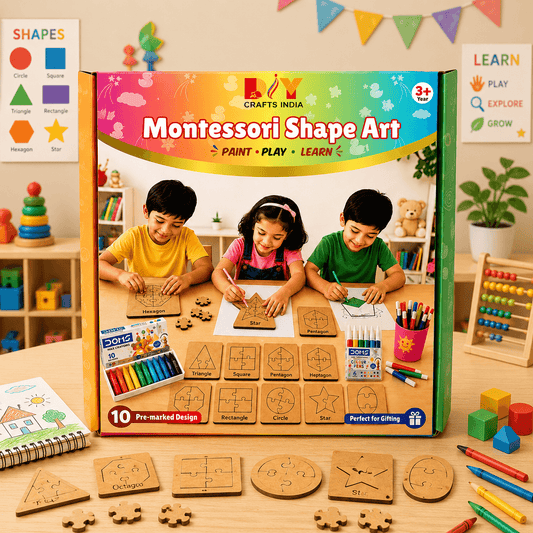
A montessori puzzle encourages children to work independently while strengthening their ability to think critically. Rather than being told the answer, children learn how to find the answer themselves.
This process builds confidence and encourages a growth mindset from an early age.
Puzzles Teach Children to Analyse Information
Before placing a puzzle piece, children must observe its characteristics.
They examine:
The shape
The size
The edges
The position
The available spaces
This analysis helps them determine whether a piece belongs in a particular location.
Over time, children become better at gathering information and using it to make informed decisions. These analytical skills are valuable not only in mathematics but also in science, reading, and everyday problem-solving situations.
Learning Through Trial and Error
One of the most important lessons puzzles teach is that mistakes are part of learning.
A child may try placing a shape in the wrong position several times before finding the correct solution. At first, this can feel frustrating. However, with encouragement and practice, children learn that mistakes provide useful information.
Instead of giving up, they begin asking themselves questions:
Why didn't that piece fit?
What should I try next?
Which shape looks similar?
This trial-and-error process develops persistence and resilience, both of which are essential problem-solving skills.
Strengthening Logical Thinking
Problem-solving requires logical thinking.
When children complete geometric puzzles, they learn to use reasoning rather than guessing. They start identifying clues and recognising patterns that help them make better decisions.
For example, a child may notice that a square-shaped piece will only fit into a square-shaped space. They begin using logic to eliminate incorrect options and focus on possible solutions.
These experiences strengthen reasoning skills that support future learning in mathematics, science, and technology.
Improving Spatial Awareness
Spatial awareness plays a major role in problem-solving.
Children must understand how objects fit together, how shapes can be rotated, and how different pieces relate to one another.
A wooden shapes puzzle kit for kids provides an excellent hands-on opportunity to develop these skills. As children manipulate puzzle pieces and explore different positions, they learn to visualise objects and understand spatial relationships.
Strong spatial awareness often contributes to better performance in geometry, engineering, architecture, and other STEM-related fields later in life.
Building Patience and Concentration
Many children want immediate results. Puzzles teach them that some challenges require time and effort.
When children focus on finding the correct solution, they learn to concentrate on a task for longer periods. They also develop patience as they work through difficulties and continue trying despite setbacks.
These qualities become increasingly important as children encounter more complex learning situations in school.
Encouraging Independent Thinking
One of the greatest benefits of puzzle-based learning is that it promotes independence.
Children often work through puzzles on their own, making decisions without constant guidance from adults. They learn to trust their observations and develop confidence in their ability to solve problems.
This sense of independence helps children become more willing to take on new challenges and explore unfamiliar situations.
The satisfaction of solving a puzzle independently creates a positive learning experience that motivates children to keep trying.
The Montessori Approach to Puzzle Learning
Montessori education encourages children to learn through exploration and discovery.
Rather than providing direct answers, Montessori materials are designed to help children uncover solutions on their own. Geometric shape puzzles fit perfectly within this philosophy because they encourage active learning and self-correction.
Children can immediately see whether a piece fits correctly, allowing them to learn from experience without relying on external feedback.
This hands-on approach supports both cognitive development and problem-solving abilities.
How Parents Can Encourage Puzzle-Based Learning
Parents can support problem-solving development by making puzzles a regular part of playtime.
Some simple strategies include:
Choosing age-appropriate puzzles
Allowing children time to solve challenges independently
Encouraging effort rather than focusing only on results
Asking open-ended questions during activities
Celebrating persistence and progress
The goal is not to complete the puzzle quickly but to enjoy the learning process.
Beyond Problem-Solving: Additional Benefits of Shape Puzzles
While problem-solving is one of the biggest benefits, geometric shape puzzles also support:
Fine motor development
Hand-eye coordination
Shape recognition
Memory improvement
Concentration
Logical reasoning
Early mathematical thinking
These combined benefits make puzzles one of the most effective educational activities for young children.
Conclusion
Geometric shape puzzles do much more than keep children entertained. They help develop observation skills, logical thinking, spatial awareness, concentration, and most importantly, problem-solving abilities.
Every puzzle presents an opportunity for children to think independently, test solutions, and learn from experience. These moments may seem small, but they contribute significantly to cognitive growth and confidence.
By incorporating puzzle-based activities into everyday play, parents can help children build valuable skills that support learning both inside and outside the classroom. Sometimes the simplest puzzle can teach some of life's most important lessons.
FAQ
How do geometric shape puzzles improve problem-solving skills?
Geometric shape puzzles encourage children to analyse information, test solutions, identify patterns, and learn through trial and error. These activities strengthen critical thinking and decision-making abilities.
What age is suitable for shape puzzles?
Shape puzzles can be introduced as early as 2 years old, with more complex puzzles added as children grow and develop stronger cognitive skills.
Why are Montessori puzzles beneficial for children?
Montessori puzzles promote independent learning, self-correction, concentration, and problem-solving while encouraging children to explore concepts through hands-on activities.
Can puzzles help improve maths skills?
Yes. Puzzles develop spatial awareness, logical reasoning, pattern recognition, and analytical thinking, all of which support mathematical learning.
How often should children play with puzzles?
Even 15–20 minutes of puzzle play several times a week can help children strengthen cognitive and problem-solving skills over time.