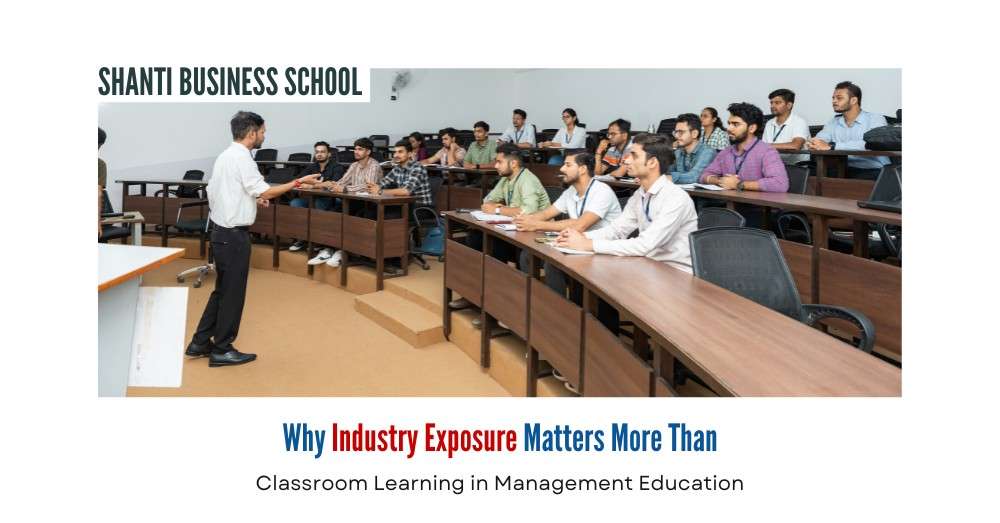
Why Industry Exposure Matters More Than Classroom Learning in Management Education
-

- July 09th, 2026
- 21 views

FREE SEO Topical Map Generator: Find Your Next Content Ideas
Management education has evolved significantly over the past decade. While classroom lectures continue to provide the theoretical foundation of business concepts, today's employers expect much more from management graduates. Companies are looking for professionals who can solve real business problems, work in dynamic environments, collaborate with diverse teams, and make informed decisions from day one.
This is where industry exposure becomes a defining factor. It bridges the gap between academic learning and practical application, helping students understand how businesses actually function. For PGDM and MBA aspirants, gaining hands-on experience during college is no longer an added advantage—it has become an essential part of building a successful management career.
The Difference Between Learning and Applying
Classroom learning introduces students to concepts such as marketing strategies, financial management, organisational behaviour, and business analytics. These subjects build a strong academic foundation, but understanding a concept and applying it in a real business environment are two very different experiences.
For example, developing a marketing strategy in a classroom assignment is valuable, but working with a company to solve an actual marketing challenge teaches students how customer behaviour, budgets, deadlines, and market competition influence decision-making. Practical exposure transforms knowledge into experience, making learning more meaningful and relevant.
Internships: The First Step into the Corporate World
Internships provide students with an opportunity to experience professional life before graduation. They help students understand workplace culture, corporate expectations, and industry practices while applying classroom knowledge in real business situations.
Beyond technical skills, internships develop professionalism, communication, teamwork, and time management. They also help students discover their strengths, identify areas for improvement, and make informed career choices.
Many organisations consider internship performance during final placements, making it an important stepping stone toward full-time employment.
Live Projects Build Problem-Solving Skills
Unlike academic assignments, live projects involve solving real business challenges faced by companies. Students interact with industry professionals, collect data, analyse situations, and present practical solutions.
These experiences encourage critical thinking, creativity, and decision-making under realistic conditions. Students also gain confidence by working on projects where their recommendations can contribute to actual business outcomes.
Live projects demonstrate to recruiters that students have practical exposure and understand how to approach real-world business problems.
Corporate Interaction Broadens Professional Perspective
Industry interactions through guest lectures, workshops, seminars, panel discussions, and networking events expose students to current business trends and emerging opportunities.
Listening to experienced business leaders helps students understand how organisations are adapting to technology, globalisation, artificial intelligence, and changing consumer expectations. Such interactions also allow students to ask questions, learn from professionals' experiences, and build valuable industry connections.
These insights often cannot be fully captured through textbooks alone.
Practical Learning Develops Workplace Confidence
One of the biggest advantages of industry exposure is confidence. Students who participate in internships, presentations, simulations, business competitions, and consulting projects become comfortable working in professional environments.
They learn how to communicate ideas effectively, collaborate with teams, handle feedback, and adapt to changing situations. These experiences prepare students for placement interviews as well as their first day in the corporate world.
Employers value candidates who require less time to adjust because they have already experienced professional work environments during their education.
Recruiters Value Experience Along with Knowledge
Today's recruiters evaluate candidates based on more than academic performance. During interviews, they often ask students about internships, projects, leadership experiences, certifications, and real business challenges they have handled.
Practical exposure demonstrates initiative, adaptability, and problem-solving ability—qualities that employers consider essential for future managers.
Students who can confidently discuss real experiences often stand out among candidates who possess only theoretical knowledge.
Preparing for a Dynamic Business Environment
Business environments continue to evolve with digital transformation, artificial intelligence, sustainability initiatives, and global market changes. Management graduates need to be flexible, continuously learn new skills, and adapt to changing business models.
Industry exposure helps students understand these evolving trends while developing the practical mindset required to succeed in modern organisations. It encourages lifelong learning and prepares students to contribute from the beginning of their careers.
At Shanti Business School, learning extends far beyond the classroom. The PGDM curriculum is designed to integrate academic excellence with practical business exposure through internships, live projects, corporate interactions, industry visits, guest lectures, and experiential learning opportunities. This industry-oriented approach helps students develop the confidence, professional skills, and business acumen that employers value, ensuring they graduate not only with a management qualification but also with the practical experience needed to succeed in today's competitive corporate world.