Use Digital Twin Technology in Real Estate to Let Buyers Experience Projects Before Construction Starts
-

- July 31st, 2026
- 14 views

FREE SEO Topical Map Generator: Find Your Next Content Ideas
A buyer stands on a plot of bare, levelled earth. There is no tower, no lobby, no clubhouse — just red soil, a boundary wall, and a site office. You hand them a brochure and ask them to imagine a Rs. 1.5 crore home inside it.
That is the moment most real estate sales are lost.
Digital twin technology in real estate solves this exact problem. It replaces imagination with experience, letting a buyer walk through a full-scale, true-to-detail 3D replica of a tower, unit, or entire township months or years before the first slab is cast. Instead of asking buyers to trust a drawing, you let them stand inside the finished product — digitally — and decide with their own eyes.
For developers launching pre-construction inventory, this isn't a nice-to-have anymore. It's the difference between a sales gallery buyers walk out of undecided, and one they walk out of ready to book.
The Problem: Selling Something That Doesn't Exist Yet
Most Indian township and pre-launch sales happen exactly the way described above — on flat, empty land, months before construction is visible from the road.
The tools available to sales teams haven't kept pace with buyer expectations:
Floor plans communicate dimensions, not livability. A buyer cannot tell if a bedroom feels cramped or spacious from a 2D line drawing.
Site models show the layout but say nothing about light, finishes, or how a specific unit's balcony faces the sunrise.
Verbal explanations vary from one sales executive to another, so two family members visiting on different days can walk away with two different understandings of the same flat.
Renders show one frozen moment — one lighting condition, one angle, one mood — when buyers actually want to know how the space feels at 7 a.m. and at 7 p.m.
None of this is a failure of effort. It's a failure of format. You cannot sell spatial confidence with flat documents, and most hesitation in pre-construction sales has nothing to do with price — it comes from buyers who simply don't feel certain about what they're committing to.
What Is a Digital Twin in Real Estate?
A digital twin is a live, explorable 3D replica of a property, built directly from architectural drawings and design data, rendered in real time rather than pre-recorded. Unlike a static render or a walkthrough video, a digital twin responds to input — a buyer or sales executive can move through it, change the time of day, switch floors, swap finishes, and view the exact unit they are considering, all inside a single session.
Where a 3D render answers one question ("what does the lobby look like from this angle?"), a real-time digital twin lets the buyer ask their own questions and get instant, accurate answers. That distinction is what makes it a sales tool rather than a marketing visual.
At its core, this technology stitches together architectural data, lighting engines, and interactive controls — usually run on platforms like Unreal Engine — to create an environment accurate enough to represent unbuilt construction with confidence. V-Estate's Spaci platform is built specifically for this purpose, giving developers a high-fidelity digital twin that runs on LED walls, touchscreen TVs, or a single iPad, without needing an internet connection to function.
How a Digital Twin Gets Built and Deployed
Building a digital twin isn't a plug-and-play export from a CAD file. It follows a structured pipeline:
Design data intake — Approved architectural drawings, elevations, and masterplans are handed over as the source of truth, so every wall, window, and setback in the digital twin matches what will actually be constructed.
Environment construction — The tower, interiors, landscape, and surrounding vicinity are modelled and textured, with real-world lighting behaviour (sun position, shadows, seasonal changes) mapped to the site's actual GPS coordinates.
Interactivity layer — Navigation controls, unit-switching, finish customisation, and lighting toggles are built in, so a sales executive — or the buyer themselves — can drive the experience live.
Hardware integration — The finished twin is calibrated for whichever format the experience centre uses: curved LED panels, touchscreen displays, iPad-controlled kiosks, or a web-based version for remote buyers.
Sales team training — Because the tool is only as effective as the person guiding it, teams are trained on navigation, storytelling sequence, and how to answer objections using the twin as visual proof rather than just decoration.
This process typically runs in parallel with construction planning, so the digital twin is ready at the exact moment sales need to begin — often well before excavation is complete.
Which Projects Benefit Most
Digital twin technology isn't equally valuable everywhere. It delivers the sharpest return in specific situations:
Pre-launch and under-construction townships, where there is genuinely nothing physical to show buyers yet.
Large-scale, multi-tower developments, where the relationship between towers, amenities, and open spaces is too complex to explain verbally.
Projects in emerging or outskirts locations, where buyers are also being asked to trust an unfinished neighbourhood, not just an unfinished building.
Premium and luxury inventory, where buyers expect a presentation standard that matches the price point.
Projects competing in crowded micro-markets, where three or four nearby launches are fighting for the same footfall and the best presentation often wins the booking.
The Buyer Journey, Reimagined
A buyer walking into a digital-twin-enabled experience centre moves through a very different sequence than a traditional site visit:
They start with the masterplan view — seeing exactly where their tower sits, how far it is from the entrance, the clubhouse, and the nearest amenity block.
They move into tower-specific navigation, understanding floor stacking, unit orientation, and which side faces the road versus the garden.
They enter their specific unit, walking room to room, checking how morning light enters the bedroom and how the kitchen window frames the view.
They preview amenities at true scale — the pool, the clubhouse, the landscaped gardens — instead of reading a bullet list in a brochure.
They leave having answered their own questions, rather than having questions answered for them.
This sequence matters because it mirrors how people actually evaluate a home in real life — zoom out, then zoom in, then imagine themselves living there.
What Changes for the Sales Team
For sales executives, a digital twin removes the burden of describing something invisible. Every team member navigates the same environment, so two buyers hearing about the same 3BHK on different days receive identical information — no inconsistency, no verbal shortcuts, no confusion when families compare notes later.
It also compresses the sales conversation. Instead of spending the first fifteen minutes helping a buyer mentally construct the property from a floor plan, the team can spend that time on financing, timelines, and closing — the parts of the conversation that actually move a booking forward.
V-Estate in Practice: Rustomjee Urban Woods, Dombivli
The clearest proof of what this technology does under real pressure comes from Rustomjee Urban Woods, a large affordable-housing launch in Dombivli.
The brief was demanding. Rustomjee needed to launch a premium-feeling sales experience on a site where no physical structure existed — only empty land — while going head-to-head with three competing launches in the same micro-market, and handling an expected 190 to 210 families visiting daily.
V-Estate built a four-zone experience around the challenge:
Zone 1 – AV Theatre: A five-minute film opening with transport links and location benefits, then moving into the project's vision and lifestyle story.
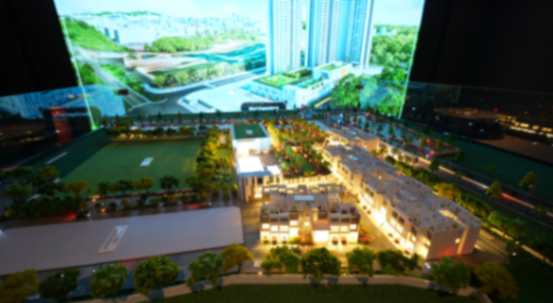
Zone 2 – Interactive LED Scale Model: A physical scale model wired to 28 IoT-enabled touchpoints, synced to an iPad — touch an amenity, and it lights up on the model and the big screen simultaneously.
Zone 3 – Sample Flat with Real Window Views: A fully built flat where the "view" outside each window was actual 360° drone footage of what residents would eventually see.
Zone 4 – Discussion Rooms: Ten dedicated rooms with 65-inch screens, used to walk buyers through masterplans, tower placement, and amenities in a closing-focused conversation.
Because the land itself offered little to work with visually, the team leaned on Unreal Engine 5.4 with Procedural Content Generation to populate the environment with dense, realistic landscaping without sacrificing performance — keeping the experience running at a smooth 30–35 FPS even during peak hours.
The Results
The system supported 190–210 families per day at peak, roughly 30 families an hour across ten discussion pods, without queues or slowdown.
It delivered 100% operational uptime across more than six months of continuous live operation.
33 amenities were shown with real-time, touch-triggered interaction.
The entire framework was built to be reusable for Rustomjee's future project launches — turning a one-time investment into a repeatable sales asset.
That last point is easy to miss but matters most: a well-built digital twin isn't a one-project expense. It becomes reusable sales infrastructure.
What to Plan For
In the interest of giving you a complete picture, digital twin deployments come with a few honest planning considerations:
Design data has to be finalised before the environment can be built accurately — last-minute layout changes mean rework.
It complements, rather than replaces, a physical sample flat or site visit for buyers who want to touch finishes and materials directly.
Lead time matters. A high-fidelity twin for a large township takes real production time, so it needs to be commissioned early in the sales planning calendar, not two weeks before launch.
Hardware and connectivity planning at the experience centre (power backup, display calibration, network stability for remote access) needs to be part of the rollout, not an afterthought.
Sales teams need training, not just access. The tool's impact depends heavily on how confidently the team uses it in conversation.
None of these are dealbreakers — they're simply what separates a rushed deployment from one that performs the way Rustomjee Urban Woods did.
Frequently Asked Questions
Is digital twin technology only useful for luxury projects? No. As the Rustomjee Urban Woods project shows, it works just as effectively — arguably more so — for volume and affordable housing, where high daily footfall makes consistent, fast communication essential.
Can a digital twin be updated as construction data changes? Yes. Because it is built on the underlying design data rather than pre-rendered videos, updates to layouts, finishes, or masterplans can be reflected without rebuilding the entire environment from scratch.
Do buyers need any special equipment to experience it? No. Deployment formats include LED walls, touchscreen TVs, iPad-controlled kiosks, and web-based versions for remote buyers — no VR headset or app download required.
How is this different from a 3D walkthrough video? A video is fixed and pre-recorded. A digital twin is interactive and responds in real time, letting the buyer or sales executive choose the path, the unit, and the lighting condition on the spot.
Sell the Vision, Not Just the Blueprint
If your next launch is sitting on bare land right now, the question isn't whether buyers can imagine what you're building. It's whether you're going to make them do that work alone, or show them.
V-Estate's digital twin technology turns unbuilt inventory into a confident, bookable experience — the same way it did for Rustomjee Urban Woods. If you're planning a pre-construction launch, book a demo with V-Estate and see what your project looks like before a single brick is laid.