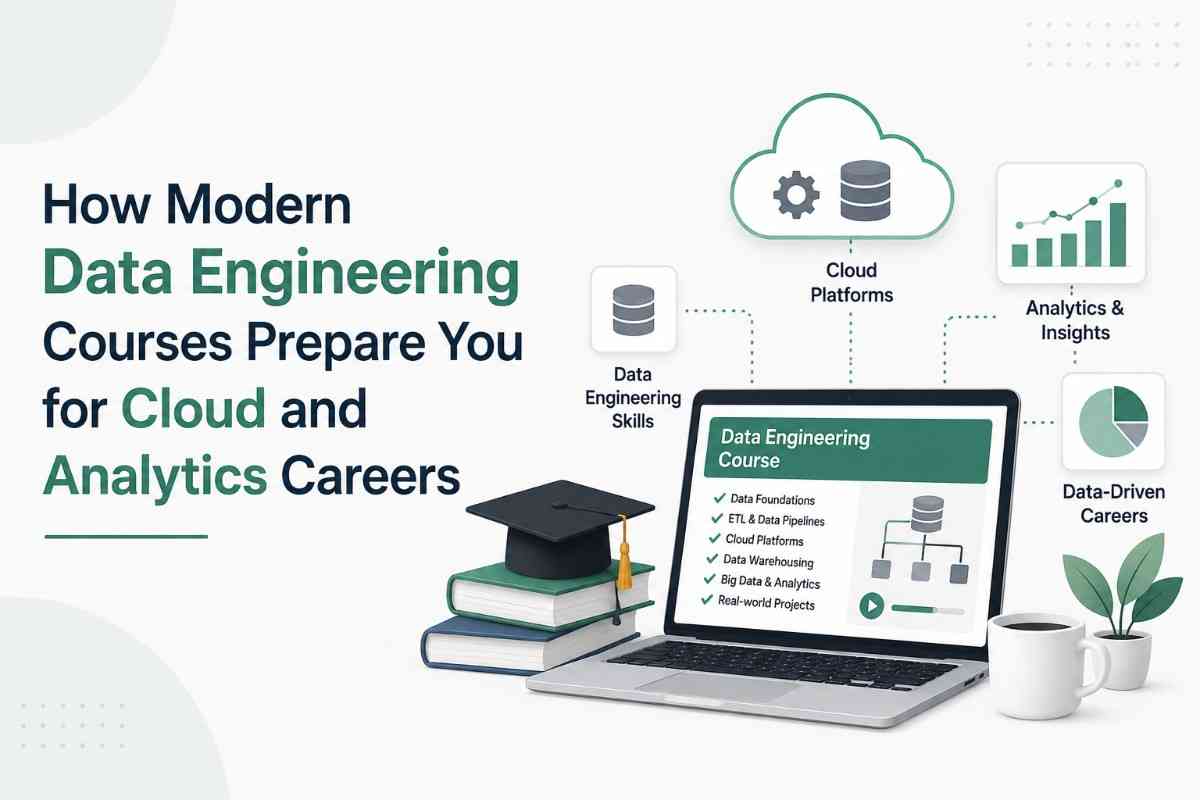
How Modern Data Engineering Courses Prepare You for Cloud and Analytics Careers
-

- July 27th, 2026
- 23 views

FREE SEO Topical Map Generator: Find Your Next Content Ideas
Introduction
Organizations today rely on data to drive every major business decision, from forecasting customer demand and optimizing supply chains to developing AI-powered applications. As businesses generate massive volumes of structured and unstructured data, the need for professionals who can manage, transform, and analyze this information has grown significantly. This has made data engineering one of the fastest-growing career paths in the technology industry.
Modern businesses are no longer looking for professionals who only understand databases or ETL processes. They want data engineers who can build scalable cloud architectures, automate data pipelines, manage analytics platforms, and support artificial intelligence initiatives. As a result, professionals are increasingly enrolling in data engineering courses that combine cloud technologies, real-world projects, and hands-on experience.
Whether your goal is earning a Microsoft Azure Data Engineer Certification, becoming a Fabric Data Engineer, or building expertise across modern cloud ecosystems, choosing the right learning path can help you develop the technical skills employers expect in today's competitive job market. Programs that combine Azure, Microsoft Fabric, Python, SQL, Spark, and modern analytics platforms provide learners with practical experience that closely aligns with enterprise requirements.
Why Data Engineering Has Become Essential for Every Business
Every digital interaction creates data. Websites, mobile applications, financial transactions, IoT devices, CRM platforms, and enterprise systems continuously generate information that organizations use to improve operations and customer experiences.
However, collecting data is only the beginning. Businesses need reliable systems that ingest information from multiple sources, clean and transform it, store it securely, and make it available for reporting, business intelligence, machine learning, and AI applications.
Data engineers design these systems by building scalable pipelines, integrating cloud services, optimizing storage, and ensuring high-quality data is available across the organization. Without strong data engineering practices, businesses struggle with inconsistent reporting, delayed analytics, and poor decision-making.
The Shift Toward Cloud-Based Data Engineering
Traditional on-premises infrastructure required organizations to invest heavily in physical servers, storage systems, and maintenance. Cloud computing has transformed this approach by providing flexible, scalable, and highly available platforms for managing enterprise data.
Cloud platforms allow businesses to process massive datasets, automate workflows, scale computing resources, and reduce operational complexity. This transition has also changed employer expectations, making cloud expertise one of the most valuable skills for aspiring data engineers.
Today, companies actively seek professionals who understand cloud-native architectures, distributed processing, modern analytics platforms, and workflow automation.
What Makes Modern Data Engineering Courses Different?
Unlike traditional training programs that focus mainly on theory, modern data engineering courses emphasize practical implementation and real-world business scenarios.
Students typically begin by learning Python programming, SQL, and database fundamentals before progressing to ETL development, cloud computing, distributed processing, and workflow orchestration. As the course advances, learners work with technologies such as Azure Data Factory, Databricks, Apache Spark, Kafka, Snowflake, Microsoft Fabric, and Airflow while building projects that simulate production environments.
This hands-on approach helps learners understand how modern organizations build scalable data platforms rather than simply memorizing concepts for certification exams. Prepzee's Data Engineering Job Oriented Program, for example, includes Azure, Microsoft Fabric (DP-700), Databricks, Snowflake, Airflow, Kafka, and multiple industry projects designed around production-ready data pipelines.
Why Microsoft Azure Skills Continue to Be in Demand
Microsoft Azure has become one of the leading cloud platforms for enterprise organizations worldwide. Businesses use Azure to build secure, scalable, and integrated solutions for data processing, analytics, and cloud computing.
Professionals pursuing a Microsoft Azure Data Engineer Certification learn how to work with Azure Data Factory, Azure Data Lake Storage, Azure Synapse Analytics, Azure Databricks, Azure SQL Database, and other Azure services that support enterprise-scale data engineering.
In addition to cloud services, Azure training typically includes topics such as data ingestion, transformation, monitoring, security, optimization, and pipeline orchestration. These skills help professionals design robust cloud solutions capable of supporting analytics, reporting, and AI workloads.
Many organizations also value Azure-certified professionals because the certification demonstrates the ability to implement data processing solutions and manage cloud-based architectures using Microsoft's ecosystem. Prepzee's DP-203 training combines instructor-led learning, hands-on projects, certification preparation, and career support to help learners become job-ready.
The Growing Importance of Microsoft Fabric
As organizations modernize their analytics infrastructure, Microsoft Fabric has emerged as a unified platform that brings together data engineering, data integration, data warehousing, real-time analytics, and business intelligence.
Instead of managing multiple disconnected services, organizations can build end-to-end analytics solutions within a single environment using OneLake, Data Factory, Dataflows Gen2, Lakehouse architecture, notebooks, pipelines, and integrated analytics capabilities.
Because of this shift, the demand for a skilled Fabric Data Engineer has increased rapidly. These professionals design and manage modern analytics solutions while helping organizations simplify data movement, improve collaboration, and accelerate business insights.
Learning Microsoft Fabric enables professionals to work with unified analytics environments while preparing for enterprise data engineering projects that increasingly adopt Fabric's integrated architecture. Prepzee's DP-700 Microsoft Fabric Data Engineer Course includes training on Dataflows Gen2, pipelines, OneLake, Lakehouse implementation, real-time analytics, and certification preparation through instructor-led sessions and projects.
Essential Technical Skills Every Data Engineer Should Learn
A successful data engineer requires expertise across multiple technologies rather than relying on a single programming language or cloud platform.
Python remains the preferred language for automation and data processing, while SQL continues to serve as the foundation for querying and managing relational data. Data modeling helps engineers design scalable warehouse architectures, and ETL or ELT development ensures reliable movement of information across systems.
Modern professionals also work extensively with Apache Spark for distributed processing, Apache Airflow for workflow orchestration, Databricks for large-scale analytics, Snowflake for cloud data warehousing, and Microsoft Fabric for unified analytics.
Understanding cloud security, version control, monitoring, automation, and performance optimization further strengthens a data engineer's ability to manage enterprise-scale solutions.
Why Hands-On Projects Matter More Than Theory
One of the biggest differences between job-ready professionals and beginners is practical experience.
While certifications demonstrate technical knowledge, employers often prioritize candidates who can explain how they built data pipelines, optimized cloud workloads, automated workflows, and solved business challenges through real implementations.
Project-based learning allows students to understand data ingestion, transformation, cloud deployment, troubleshooting, monitoring, and optimization under realistic conditions. These experiences also strengthen resumes and provide valuable discussion points during technical interviews.
Programs that include multiple industry projects, case studies, and cloud laboratories prepare learners much more effectively than theory-only courses.
Career Opportunities After Completing Data Engineering Training
Organizations across industries continue investing in cloud migration, analytics, and artificial intelligence, creating strong demand for skilled data engineers.
Professionals who complete comprehensive training can pursue positions such as Azure Data Engineer, Fabric Data Engineer, Cloud Data Engineer, Data Platform Engineer, ETL Developer, Analytics Engineer, Big Data Engineer, Data Integration Specialist, or Data Warehouse Engineer.
Industries including banking, fintech, healthcare, retail, manufacturing, logistics, telecommunications, education, and SaaS regularly recruit professionals capable of designing scalable cloud-based data solutions.
As Microsoft's analytics ecosystem continues evolving, professionals with expertise in Azure and Microsoft Fabric are expected to remain highly valuable across enterprise organizations.
Choosing the Right Learning Program
Before enrolling in a training program, evaluate whether the curriculum emphasizes practical implementation alongside certification preparation.
The best data engineering courses include live instructor-led sessions, real-world projects, cloud laboratories, interview preparation, resume-building assistance, and exposure to industry-standard technologies. A strong curriculum should cover Python, SQL, Azure, Microsoft Fabric, Databricks, Snowflake, Apache Spark, Airflow, and modern analytics concepts instead of focusing solely on theoretical knowledge.
If your career objective includes enterprise cloud engineering, pursuing a Microsoft Azure Data Engineer Certification provides a strong foundation in Azure services. Professionals interested in unified analytics platforms can further strengthen their expertise by becoming a Fabric Data Engineer, gaining practical experience with Microsoft's latest analytics technologies.
Conclusion
The future of data engineering continues to evolve alongside cloud computing, unified analytics, and artificial intelligence. Organizations need professionals who can build scalable cloud architectures, manage enterprise data platforms, and deliver reliable data for analytics and AI applications.
Building expertise through comprehensive data engineering courses provides learners with the technical foundation required for modern cloud environments. Strengthening these skills through a Microsoft Azure Data Engineer Certification and expanding knowledge as a Fabric Data Engineer prepares professionals for enterprise-scale projects while improving long-term career opportunities.
By combining cloud technologies, hands-on projects, and practical implementation, aspiring data engineers can develop the skills needed to succeed in one of the technology industry's most rewarding and rapidly growing career paths.
FAQs
What is Microsoft Azure Data Engineer Certification?
Microsoft Azure Data Engineer Certification validates your ability to design, implement, monitor, and optimize data solutions using Azure services such as Azure Data Factory, Azure Data Lake, and Azure Synapse Analytics.
Who should enroll in data engineering courses?
Data engineering courses are suitable for software developers, database administrators, ETL developers, data analysts, cloud professionals, IT graduates, and anyone looking to build a career in cloud-based data engineering.
What does a Fabric Data Engineer do?
A Fabric Data Engineer builds and manages data pipelines, Lakehouse architectures, OneLake implementations, data integration workflows, and analytics solutions using Microsoft Fabric.
Are hands-on projects included in modern data engineering courses?
Many industry-focused programs include practical assignments, live projects, case studies, and cloud labs to help learners develop job-ready skills alongside certification preparation.
Is Microsoft Fabric replacing Azure Data Engineering?
Microsoft Fabric complements Azure's data ecosystem by providing a unified analytics platform. Many organizations use both Azure services and Microsoft Fabric together depending on their business requirements.
What skills are important for becoming a successful data engineer?
Key skills include Python, SQL, data modeling, ETL development, cloud computing, Azure services, Microsoft Fabric, Apache Spark, Airflow, Databricks, and cloud security, along with practical experience building real-world data pipelines.