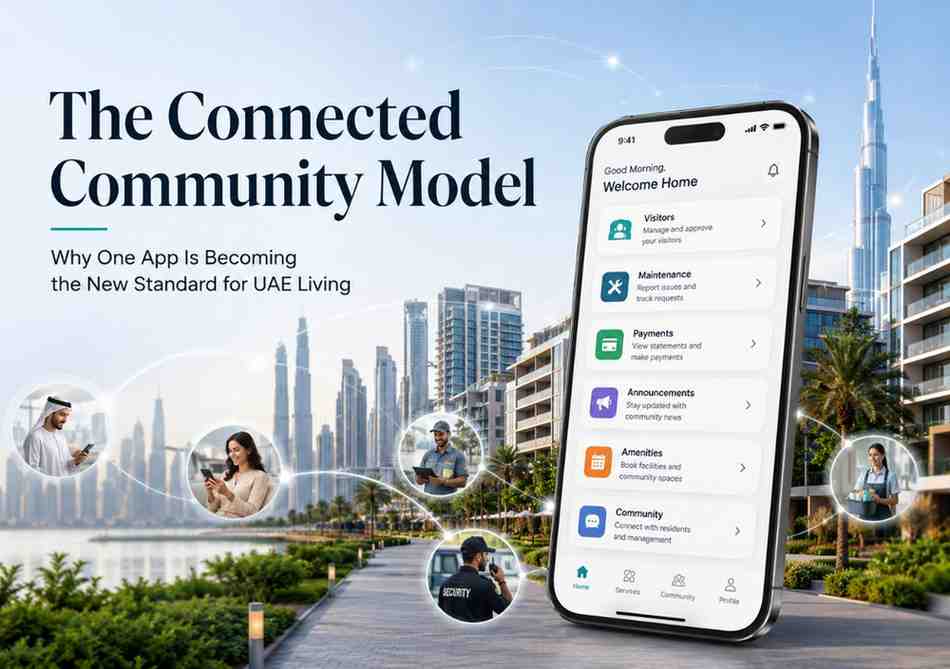
The Connected Community Model: Why One App Is Becoming the New Standard for UAE Living
-
- July 20th, 2026
- 34 views

FREE SEO Topical Map Generator: Find Your Next Content Ideas
Community living in the UAE is changing quickly.
For many years, residential communities were judged mainly by their location, amenities, architecture, security, and maintenance quality. These factors still matter, especially in Dubai and Abu Dhabi, where residents expect high standards from the buildings and communities they choose to live in.
But today, another factor is becoming equally important: how connected the living experience feels.
Residents do not want to deal with different systems for visitor access, service requests, payments, announcements, move-in forms, facility bookings, document submissions, and community communication. They expect a single, simple, reliable digital experience that brings everyday community living into one place.
That is why the connected community model is becoming the new standard for UAE living.
The UAE is already built around digital convenience
The shift toward one-app community living is not happening in isolation. It reflects the broader digital direction of the UAE.
Dubai has spent years building itself as a smart city, with digital services becoming part of daily life. The UAE government’s smart city initiatives highlight Dubai’s focus on transforming public services and using digital systems to improve urban life. (u.ae)
The real estate sector is also moving in the same direction. Dubai Land Department’s Real Estate Sector Strategy 2033 focuses on innovation, sustainability, transparency, digital solutions, and AI-driven decision-making across the property lifecycle. (dubailand.gov.ae)
This creates a clear expectation. If banking, government services, mobility, food delivery, retail, and payments are already mobile-first, community living cannot remain fragmented.
Residents now expect the same convenience inside their buildings and communities.
Community living is no longer only about facilities
In the UAE, residential communities are becoming more service-driven.
A resident does not experience a community only through the gym, pool, parking, lobby, or landscaping. They experience it through daily interactions:
How easy is it to invite a guest?
How quickly is a maintenance request acknowledged?
How clearly are notices communicated?
How simple is it to pay community dues or rent?
How convenient is it to book an amenity?
How transparent is the communication from management?
How easily can documents, approvals, and move-in processes be handled?
These small interactions define the real resident experience.
A community may have world-class facilities, but if residents need to chase updates, repeat the same request, or use different channels for every small task, the living experience starts to feel disconnected.
The connected community model solves this by bringing the resident journey, management workflows, and daily communication into one digital environment.
One app is becoming the resident’s front desk
In a modern UAE community, the resident app is becoming the digital front desk.
It is where residents expect to raise issues, receive updates, invite visitors, access documents, pay charges, book amenities, join community discussions, and stay informed about building activities.
This is especially important in high-rise towers, villa communities, mixed-use developments, and large rental buildings where hundreds or thousands of residents interact with management teams every month.
Without a connected app, the management team becomes the only bridge between all departments. Every request, update, approval, or complaint adds pressure on community managers, security teams, accountants, facility teams, and front-desk staff.
With a connected app, many daily interactions become structured. Residents know where to go. Managers know what is pending. Service teams know what needs action. Security teams know who is expected. Accountants have clearer payment and statement visibility.
The app becomes more than a convenience tool. It becomes the operating layer of community life.
Visitor management is part of the community experience
Visitor access is often treated as a security function. In reality, it is also a resident experience function.
In UAE communities, visitor movement can include guests, delivery riders, service providers, domestic staff, contractors, move-in vendors, maintenance teams, and short-term visitors. If this process is slow or unclear, it affects everyone: residents, guards, visitors, and management teams.
A connected community model makes visitor management smoother by linking approvals, entry records, resident notifications, gate teams, and community rules. Residents get more control. Guards get clearer instructions. Management gets better visibility.
This is why visitor management is becoming part of the larger resident experience conversation.
A good entry experience creates trust. A poor entry experience creates frustration even before the visitor reaches the apartment.
Maintenance is where resident trust is won or lost
For most residents, maintenance is one of the most important parts of community living.
A broken AC, water leakage, parking issue, lift problem, electrical fault, pest concern, or common-area complaint can quickly affect satisfaction. But the issue itself is only one part of the experience. The bigger question is how the community responds.
Was the complaint recorded properly?
Was it assigned to the right team?
Was the resident updated?
Was the issue closed with proper confirmation?
Was the same issue repeated?
Was the vendor accountable?
When maintenance is handled through disconnected channels, residents often feel they have no visibility. They may not know whether the request was seen, assigned, delayed, or forgotten.
A connected app creates a clear service trail. It gives residents confidence that their issue exists in the system and gives managers a better view of response time, vendor performance, repeat problems, and unresolved complaints.
This is why maintenance tracking is not just an operational feature. It is a trust-building mechanism.
Payments and financial communication need clarity
In UAE communities, financial communication can involve rent, service charges, utility-related payments, deposits, penalties, invoices, receipts, and account statements.
For owners, tenants, and residents, clarity matters. They want to know what is due, when it is due, what has been paid, and where to find records.
For management teams, payment visibility reduces repeated follow-ups and improves accountability. It also helps create a more transparent relationship between the community and the people living there.
Dubai’s real estate ecosystem places strong emphasis on transparency and regulated processes. Dubai Land Department has also highlighted technology and digital services as key tools for improving operational efficiency and customer experience in real estate. (dubailand.gov.ae)
In this environment, financial communication cannot feel informal or scattered.
A connected community app helps residents access information without confusion and helps managers maintain cleaner communication around dues, payments, and records.
Community managers need one operating view
The connected community model is not only about residents. It is equally important for community managers, owners association managers, facility managers, and rental property managers.
Community teams handle a wide range of responsibilities: resident communication, complaints, maintenance coordination, vendor follow-ups, visitor access, move-ins, move-outs, compliance workflows, document requests, payments, amenity bookings, and management reporting.
If these functions sit in separate places, managers lose time and visibility.
A connected system gives management teams one operating view across the community. It helps them understand what is happening, which issues are pending, where delays are occurring, and which areas need attention.
This is especially important in the UAE because communities are often professionally managed, compliance-sensitive, and service-quality driven. Residents expect responsiveness, while owners and landlords expect governance, reporting, and accountability.
One app for residents must be supported by one strong back-end for management.
Without that, the resident-facing experience will eventually break.
Rental buildings are also becoming communities
The connected community model is not limited to owners associations or large residential communities. It is becoming equally important for rental buildings.
In Dubai, rental buildings are no longer just collections of leased units. Many are becoming experience-led assets, especially in premium towers, build-to-rent developments, and professionally managed rental portfolios.
Tenants want more than a lease. They want a smooth move-in, easy rent payment, quick service response, clear building communication, visitor access, amenity booking, and support during renewals.
This changes how rental property managers need to think.
A rental management platform should not only help with contracts and rent collection. It should help improve the full tenant lifecycle.
From move-in to daily living to renewal, the tenant experience needs to feel connected.
The market is moving toward experience platforms
Across the UAE PropTech market, software platforms are already moving in this direction.
Property management and community management platforms are no longer positioning themselves only around back-office work. They are increasingly focusing on tenant communication, landlord visibility, maintenance, payments, resident apps, service requests, and digital journeys.
For example, HappyTenant positions itself around property management apps for landlords, tenants, property managers, and maintenance teams. Goyzer highlights centralised property management, landlord and tenant communication, accounting tools, lease management, and reporting. (happytenant.io) (goyzer.com)
Platforms such as ADDA, HappyTenant, and Goyzer reflect this wider shift toward connected living and tenant experience in the UAE. ADDA, in particular, has been recognised at the World Realty Congress 2025 for Best Tenant Engagement Solution, showing how resident engagement is becoming a serious PropTech category rather than just an add-on feature. (blog.adda.ae)
The point is not that every platform is the same. The point is that the category itself is changing.
Community management software is becoming community experience infrastructure.
AI will make connected communities more proactive
The next phase of connected community living will likely be shaped by AI.
Today, most community systems help residents submit requests and help managers respond. Tomorrow, these systems may help predict recurring issues, identify complaint patterns, detect dissatisfaction, support faster ticket routing, and give managers early warning signals.
Dubai Land Department’s REES initiative was launched to support a global roadmap for real estate technology and bring together industry stakeholders around innovation, operational efficiency, and user satisfaction. (dubailand.gov.ae)
For communities, this means AI should not only be used for futuristic concepts. Its most useful role may be in practical, everyday operations.
AI can help answer common resident queries.
It can classify complaints.
It can identify delayed tickets.
It can help managers understand which issues are recurring.
It can support better communication and faster decision-making.
This is where AI becomes valuable: not by replacing community managers, but by helping them run communities with better visibility.
A connected community is easier to manage and easier to live in
The strongest argument for one-app community living is simple: it benefits both sides.
Residents get convenience, clarity, and control.
Managers get structure, visibility, and accountability.
Security teams get cleaner visitor workflows.
Facility teams get better maintenance tracking.
Accountants get clearer payment communication.
Owners and landlords get better service quality and stronger asset protection.
This is why the connected community model is becoming more than a technology trend.
It is becoming a management standard.
In the UAE, where residents are used to digital-first services and property expectations are high, communities that offer a fragmented living experience may start to feel outdated.
The buildings and communities that perform better will be the ones that make daily living easier.
The future of UAE living is connected
The UAE has already built some of the world’s most ambitious residential communities. The next stage is not only about building more towers, villas, and mixed-use developments. It is about managing them with the same level of sophistication.
One app will not solve every problem on its own. But it can become the foundation for a more connected, transparent, and resident-friendly way of living.
For residents, it means fewer gaps.
For managers, it means better control.
For owners, it means stronger asset value.
For communities, it means a more reliable living experience.
The future of UAE living will not only be smart buildings.
It will be connected communities.