Clothing Inventory Management Software: Why Fashion Retail Is the Hardest Inventory Problem in Retail
-

- July 03rd, 2026
- 25 views

FREE SEO Topical Map Generator: Find Your Next Content Ideas
Walk into a clothing store, and the variety on display looks appealing. Behind the scenes, every single item on those racks represents a tracking problem that most basic inventory systems were never built to handle.
A single shirt style in six sizes and five colours is thirty distinct SKUs. Carry fifty shirt styles, and that's fifteen hundred SKUs for shirts alone. Add trousers, jackets, accessories, and seasonal lines, and a mid-sized clothing store is routinely managing thousands of unique items that each need individual tracking, accurate stock counts, and intelligent reorder logic.
This is why apparel retail consistently produces more inventory errors than almost any other retail category. It's not that clothing retailers are careless. It's that the product structure of fashion variants, seasonality, returns, and multi-channel selling breaks the tools that work perfectly well everywhere else.
The Variant Problem Is Bigger Than Most People Realize
In most retail categories, a product is a product. In clothing, a product is a family of products, a style that exists in multiple size-colour combinations, each of which needs its own stock count.
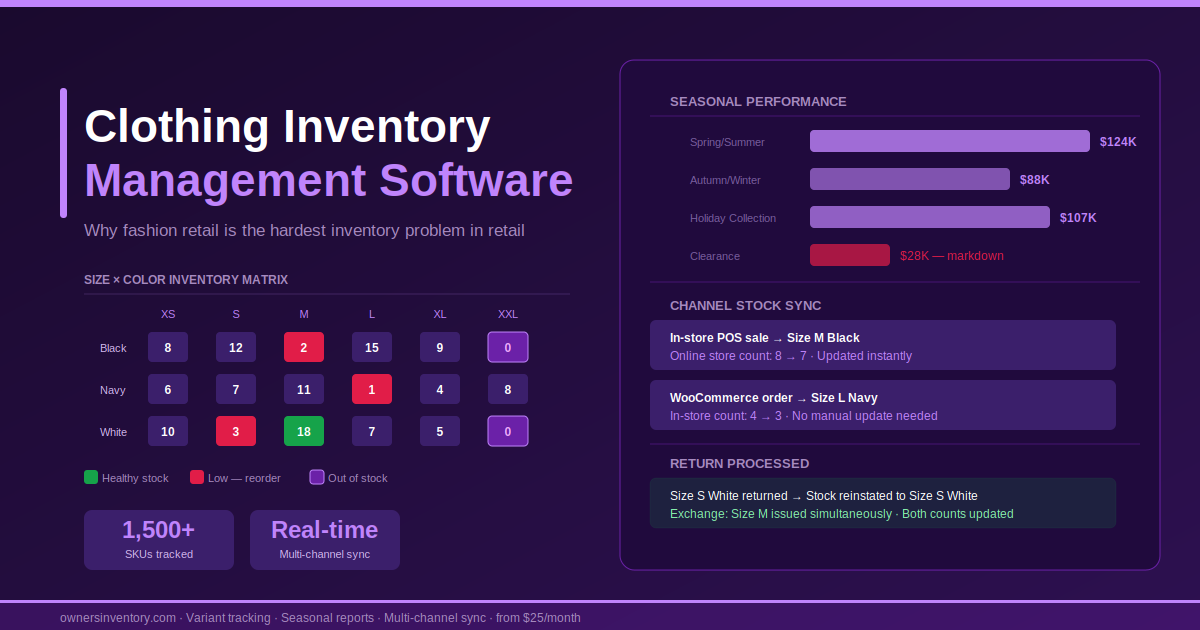
When a size 10 blue dress sells, the stock count for size 10 blue needs to drop not the count for size 12 black and not some aggregate number for "blue dress." A dedicated system handles this through a size-colour inventory matrix, allowing a retailer to track all variants of one style in a single view, rather than maintaining thousands of disconnected product records.
What happens without this structure:
The system shows a product as "in stock" because some variants still exist, even though the size the customer is asking for has been sold out for weeks
Reorders go to the wrong variants because nobody has accurate visibility into which specific sizes are actually running low
Staff spend significant time manually searching stock rather than serving customers
Stockout rates climb on the most popular sizes while less popular variants pile up
Keeping too little of the right sizes makes it impossible to complete customer orders. Keeping too much of the wrong ones wastes capital on storage and forces markdowns to clear unsellable stock. Both problems stem from the same root cause: a system that can't track inventory at the variant level accurately.
Seasonality Creates a Timing Problem That Compounds Every Year
Fashion operates on seasonal cycles. Spring/summer collections replace autumn/winter ones. Holiday capsule collections arrive and need to be sold before they become unmarketable. Promotional lines have a window of relevance that closes quickly.
Without proper inventory data, these transitions are handled by gut instinct and rough estimates. How much of last season's stock is still on hand? Which sizes sold fast and which ones are still sitting? What should the open-to-buy be for the incoming season based on how the current one performed?
Retailers who fail to anticipate seasonal shifts end up with excess inventory of outdated styles. The result is lost sales opportunities, forced markdowns, and capital tied up in stock that no longer sells at full price.
A clothing inventory management software solution that captures historical sales data at the variant and category level turns these questions into answerable ones. Which SKU moved fastest in the last summer season? Which supplier's lead time meant stock arrived too late for peak demand? What was the markdown rate on end-of-season clearance, and what would a better buy plan have looked like?
These aren't complicated analyses; they're basic reports that are only possible when the data was captured accurately in the first place.
Returns and Exchanges: The Hidden Inventory Drain
Fashion is known for a high rate of returns and exchanges among buyers. Their handling only adds to the complexity of inventory management, making it more difficult to maintain accurate inventory levels and effectively manage replenishment.
A returned item has to go somewhere. Sometimes it goes back into sellable stock at the same price. Sometimes it needs to be inspected first. Sometimes it's damaged and needs to be written off. Sometimes it's a size exchange: the original item goes back, a different size comes out, and both transactions need to update inventory simultaneously and accurately.
When returns flow through a disconnected or manual system, the counts drift. Stock that's been returned appears available online before it's been inspected. A size that was exchanged shows as sold out when the exchanged item is sitting in the backroom. Over time, these small discrepancies compound into stock counts that nobody trusts, and the consequence is that staff override the system with their own judgement, which makes the data even less reliable.
Multi-Channel Selling Multiplies Every Existing Problem
Most apparel companies have embraced multichannel sales models, selling in their own stores, through other retail outlets, via their own ecommerce platforms, and in other online stores or marketplaces, all at once.
Every additional channel that draws from the same physical stock but doesn't update in real time creates the same risk: selling something online that isn't actually available. For a clothing retailer, this risk is multiplied by variants. A customer who orders a medium in red and receives a cancellation because that specific variant was actually out of stock is a customer who may not come back.
The solution is a system where every channel, in-store POS, ecommerce shopfront, and wholesale orders, draws from the same live inventory pool. When a medium red sells in-store, it's unavailable online within the same transaction. No manual sync. No end-of-day reconciliation. No cancelled orders.
This is one of the clearest areas where clothing inventory management software creates directly measurable value: cancelled orders and lost sales from variant-level stockouts drop significantly when inventory syncs across channels in real time.
Purchasing and Supplier Management in Apparel
Clothing inventory management doesn't begin when stock arrives at the store; it begins when purchase orders go to suppliers. And this is another area where most clothing retailers operate with less control than they should.
Key requirements for the purchasing side of a clothing retail operation:
Purchase orders by variant. A POS for a new jacket needs to specify quantities by size and colour, not just total units. When stock arrives, the receiving process should verify what actually came against what was ordered at the variant level.
Supplier performance tracking. Lead times, fill rates, and delivery accuracy vary significantly by supplier. This data, captured in a system, informs smarter buying decisions on future seasons.
Automated reorder triggers by SKU. When a specific variant hits a minimum threshold, the system should flag it for reorder rather than relying on a buyer to notice before a stockout happens.
Cost tracking per item. Knowing the landed cost of each SKU, including the allocated freight, duties, and handling, is what makes true margin calculation possible at the product level.
Owners Inventory supports purchase order creation, supplier management, bulk product import via Excel and CSV, and real-time inventory updates when stock is received, covering the purchasing workflow a clothing retailer needs without requiring a separate procurement system bolted alongside the inventory tool.
What to Look For When Evaluating a System
Not every clothing retailer has the same needs, but a few capabilities are non-negotiable for any apparel business managing more than a handful of SKUs.
Variant-level inventory tracking with a matrix view. The system must let you see, in a single screen, how many units of each size-colour combination you have for any given style. This is the single most important feature for clothing retail.
Multi-channel stock sync. Online and in-store inventory must draw from the same source and update simultaneously. If this isn't real-time, the data can't be trusted.
Returns and exchange processing connected to inventory. A returned item should update stock immediately, with the option to flag it for inspection before making it available for sale again.
Reporting at the variant level. Sales by size, sales by colour, and slow-moving variant identification: these reports are what make seasonal buying decisions data-driven rather than intuitive.
Pricing and promotions by category or collection. End-of-season markdowns across an entire category should be a single action, not a product-by-product update.
Fashion retail demands more from an inventory system than almost any other retail format. The businesses that manage it well with accurate variant counts, clean purchase data, and real-time multi-channel sync protect margin, reduce stockouts, and make better seasonal buying decisions than those still relying on disconnected tools or manual tracking.
Owners Inventory is built for exactly this level of complexity, supporting product variants by size, colour, and style. Real-time POS-to-inventory sync, multi-location stock management, ecommerce integration with Shopify and WooCommerce, purchase order management, and financial reporting from $25 per month with a 30-day free trial on every plan.