Cinematic vs. Documentary Wedding Films: Which Style Is Right for Your Destination Wedding?
-

- August 01st, 2026
- 33 views

FREE SEO Topical Map Generator: Find Your Next Content Ideas
Wedding?
Somewhere between the moment you book your château in Provence and the moment your save-the-dates go out, a quieter decision has to get made — one that has almost nothing to do with flowers or seating charts, and everything to do with how you'll actually remember the day. That decision is your wedding film style.
Most couples researching wedding videography styles run into the same two words almost immediately: cinematic and documentary. They sound like a simple either/or. In practice, they represent two different philosophies of memory-keeping, and for a destination wedding — where the location itself is doing so much emotional and visual work — the choice carries more weight than it would for a wedding down the road from home.
This guide breaks down what each style actually means, how they perform differently against the light, architecture, and rhythm of a French wedding specifically, and how couples are increasingly blending the two rather than choosing one outright.
It's worth saying up front why this decision deserves more attention for a destination wedding than it might for a hometown ceremony. When you marry somewhere you don't live — a hilltop village in Provence, a private estate in the Loire, a terrace overlooking the Mediterranean — most of your guests will only ever experience that place once. Parents, siblings, close friends who flew in for a long weekend won't casually revisit that château or that stretch of coastline the way they might drive past a hometown venue years later. The film becomes the primary way almost everyone in your life gets to return to that specific place and day. That's a different kind of responsibility than filming a backyard wedding an hour from home, and it's part of why so many couples researching wedding videography styles slow down and think carefully before booking.
What "Cinematic" Actually Means in Wedding Videography
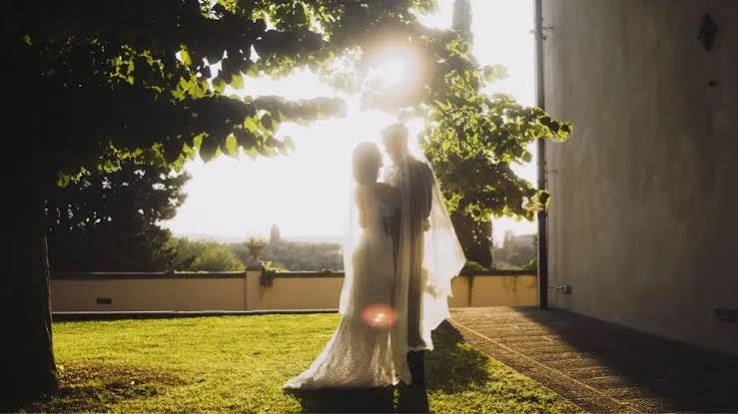
Cinematic wedding video borrows its language from filmmaking. Think deliberate framing, shallow depth of field, slow motion during a first look, a soundtrack chosen to build and release tension the way a movie score does. A cinematic wedding videographer is, in a real sense, directing — not scripting your wedding, but shaping how it's seen: which angle catches the light coming through a vineyard at golden hour, which moment gets slowed down so it lingers, which cutaway of a chandelier or a stone archway sets the scene before the ceremony begins.
The result is often a highlight film in the five-to-fifteen-minute range: a distilled, emotionally arced story rather than a record of everything that happened. It reads like a trailer for your relationship. For couples who want a film they'll want to watch, repeatedly, the way they'd rewatch a favorite movie, cinematic is usually the pull.
Where Cinematic Style Shines on a France Wedding
France gives a cinematic approach an enormous amount to work with. Limestone façades in the Luberon, the particular gold of late-afternoon light over the Dordogne, the geometry of a formal French garden — these are visual gifts that reward a videographer who is actively composing shots rather than simply pointing a camera and waiting. A cinematic edit tends to make the most of a striking venue, because composition and location become co-authors of the story.
What "Documentary" Actually Means in Wedding Videography
Documentary-style wedding video takes the opposite starting point: capture the day as it actually unfolded, in order, with as little interference as possible. The videographer becomes closer to an invisible observer than a director — present in the room but not shaping it, letting the ceremony, the toasts, and the in-between moments play out at their own pace and in their own words.
This usually means a longer film, sometimes closely following the full timeline from getting-ready through last dance, and it usually means full audio — the entire vows, the entire best man speech, not a curated snippet under a music bed. Couples drawn to documentary wedding videography tend to be less interested in a polished trailer and more interested in a faithful, rewatchable record: what your grandmother actually said in her toast, the exact words in your partner's vows, the sound of the room laughing at the same joke.
Where Documentary Style Shines on a France Wedding
Multi-day France weddings — a welcome dinner in the village square, a ceremony at a hilltop chapel, a reception under the plane trees the next evening — generate a huge amount of texture and unscripted life that a purely cinematic highlight reel simply doesn't have room for. Documentary coverage is well suited to capturing that fuller arc: the drive between venues, the aperitif hour, the guests who traveled from three continents to be there. If completeness matters as much to you as beauty, this is the instinct to trust.
The False Choice: Why Most Couples End Up Somewhere in the Middle
Ask almost any experienced wedding filmmaker and you'll hear a version of the same admission: pure documentary can feel emotionally flat, a faithful record without shape, while pure cinematic can feel so stylized that the real day gets lost underneath the aesthetics. Neither extreme tends to age particularly well. What ages well is a film that captures real, unscripted moments and then edits them with real craft — cinematic technique in service of documentary honesty, rather than instead of it.
This hybrid instinct is exactly why, when you're comparing options for destination wedding videography in France, it's worth looking past the labels on a videographer's website and instead watching full sample films, not just trailers. A studio that talks about "cinematic" storytelling but still preserves your full vows and speeches is usually the safer bet than one that only shows you highlight reels.
It also helps to understand that "hybrid" isn't a fixed formula — it's a spectrum, and different videographers land in different places on it. Some lean roughly 70/30 toward cinematic, using documentary-style candid footage mainly as connective tissue between more composed sequences. Others lean the opposite way, filming almost entirely observationally and reserving cinematic techniques — slow motion, a driving score, sweeping establishing shots of the venue — for a handful of key moments like the first look or the final exit. Neither approach is more "correct." What matters is whether the videographer can articulate where they sit on that spectrum and why, based on your priorities, rather than defaulting to a single house style regardless of the couple.
Why the Setting Changes the Math: Season by Season in France
A wedding film style decision doesn't happen in a vacuum — it interacts directly with when and where in France you're marrying. Light, weather, and the character of each region shift meaningfully across the year, and a videographer who understands those shifts will make different creative calls in April than in September.
Spring Weddings: Provence, the Loire Valley, and Soft Light
Spring in France brings long, diffused daylight and blooming gardens — wisteria in Provence, tulips along the Loire châteaux. This soft, forgiving light is genuinely cinematic terrain: it flatters skin tones, makes slow motion and drone footage feel painterly rather than harsh, and rewards a videographer who's actively chasing the golden hour. Spring is also shoulder season for many venues, which often means smaller, more intimate guest lists — a setting where documentary-style candid coverage of a close circle of family and friends can feel especially warm rather than sparse.
Summer Weddings: the Côte d'Azur and the South
Summer is peak destination wedding season across the French Riviera, and it comes with strong, high-contrast Mediterranean light and long, multi-day celebrations. A hybrid approach tends to earn its keep here: cinematic technique to handle the bright coastal light and sweeping sea-view venues, paired with documentary coverage across the welcome dinner, ceremony, and late-night reception so nothing from a multi-day celebration gets lost. Couples marrying in Cannes, Saint-Tropez, or the hill towns above Nice are often paying for the view as much as the vows — a film should reflect both.
Autumn Weddings: Burgundy, the Dordogne, and Harvest Light
Autumn brings warm, amber tones to vineyard regions like Burgundy and the wider wine country of southwest France — arguably the most cinematic light of the year, thanks to turning leaves and the low angle of the sun. Harvest-season weddings also tend to lean into local ritual and tradition — grape harvests, communal dinners — which documentary coverage captures with more nuance than a highlight reel alone.
Winter Weddings: Paris and Intimate Elopements
Winter France skews toward smaller, more intimate ceremonies — a Paris elopement film at a quiet arrondissement townhouse, or a chapel wedding in the Alps before a ski season. With fewer guests and shorter days, the balance often tips toward a more cinematic, tightly edited film, since there's less multi-day chronology to document and more emphasis on a small handful of deeply meaningful moments.
Why Local, France-Specific Experience Actually Matters
It's tempting to treat wedding videography as a portable skill — a good videographer is a good videographer, anywhere. In practice, shooting a destination wedding in France involves a set of logistical and creative variables that don't come up in a typical hometown wedding, and they affect both cinematic and documentary results.
Drone regulations differ meaningfully between France and other countries, and permitted flight zones near historic monuments, châteaux, and coastal areas are often more restrictive than couples expect — a videographer without local knowledge may simply be unable to deliver the sweeping aerial shots you've seen in their portfolio from elsewhere. Many of the country's most photogenic wedding venues, from Provençal mas to Loire Valley châteaux, also have their own house rules about where cameras and equipment can be set up, particularly during a religious or civil ceremony. And because French light behaves differently by region and season — the sharper coastal glare of the Riviera in July, the softer inland haze of Burgundy in September — a videographer who has actually worked those specific settings before will make faster, better creative decisions on the day than one encountering them for the first time.
None of this means you need a videographer based in France, but it does mean genuine, demonstrated experience filming French weddings specifically — not just European weddings in general — is a reasonable thing to ask about directly.
Practical Questions to Ask Before You Book
- How long is a typical final film, and can I see a full, unedited sample rather than only a trailer? Trailers are curated by definition; a full film tells you far more about pacing and honesty.
- Do you preserve full vows and speeches, or only excerpts? This single question often reveals more about a videographer's real style than any label on their site.
- How do you adapt your approach to light and venue? A team with genuine France experience should be able to speak specifically to how they've shot in the region you're marrying in, not just generically about "beautiful light."
- What does a second shooter or drone add to the story, and is it included? Multi-camera coverage matters more for documentary-style full-day capture; a single dramatic angle can matter more for cinematic sequences.
- How soon will I see the final film, and in what formats? A short social-ready cutdown and a full-length film serve different purposes and different audiences.
Choosing What's Right for You
There's no universally correct answer here — only the right answer for how you want to relive this particular day, in this particular part of France, for decades to come. If you're the kind of couple who'll want to watch a beautifully paced five-minute film at every anniversary, cinematic will likely resonate more. If you want your children to someday hear the actual words spoken in your vows, documentary coverage protects that. And if, like most couples, you want both — the emotional shape of cinema and the honesty of documentary — say so plainly in early conversations with any videographer you're considering, and ask to see work that proves they can deliver both at once.
A destination wedding in France is, by its nature, a once-in-a-lifetime convergence: a specific season, a specific light, a specific room full of people who flew in to be there. Whichever style you lean toward, the film is what lets you step back into that room years from now. Choosing the right partner to make it — one who understands not just wedding videography in general but how French light, venues, and traditions specifically shape a film — is worth the same care you're putting into every other part of the day. You can see examples of how that balance plays out across different regions and seasons on the Kuna Kagawa Films homepage.
Planning a wedding in France and still weighing cinematic against documentary? The honest answer is usually: watch full films, not just trailers, and ask hard questions about what gets preserved versus what gets left on the cutting room floor. Your future self — and everyone who couldn't make the trip — will thank you for it.