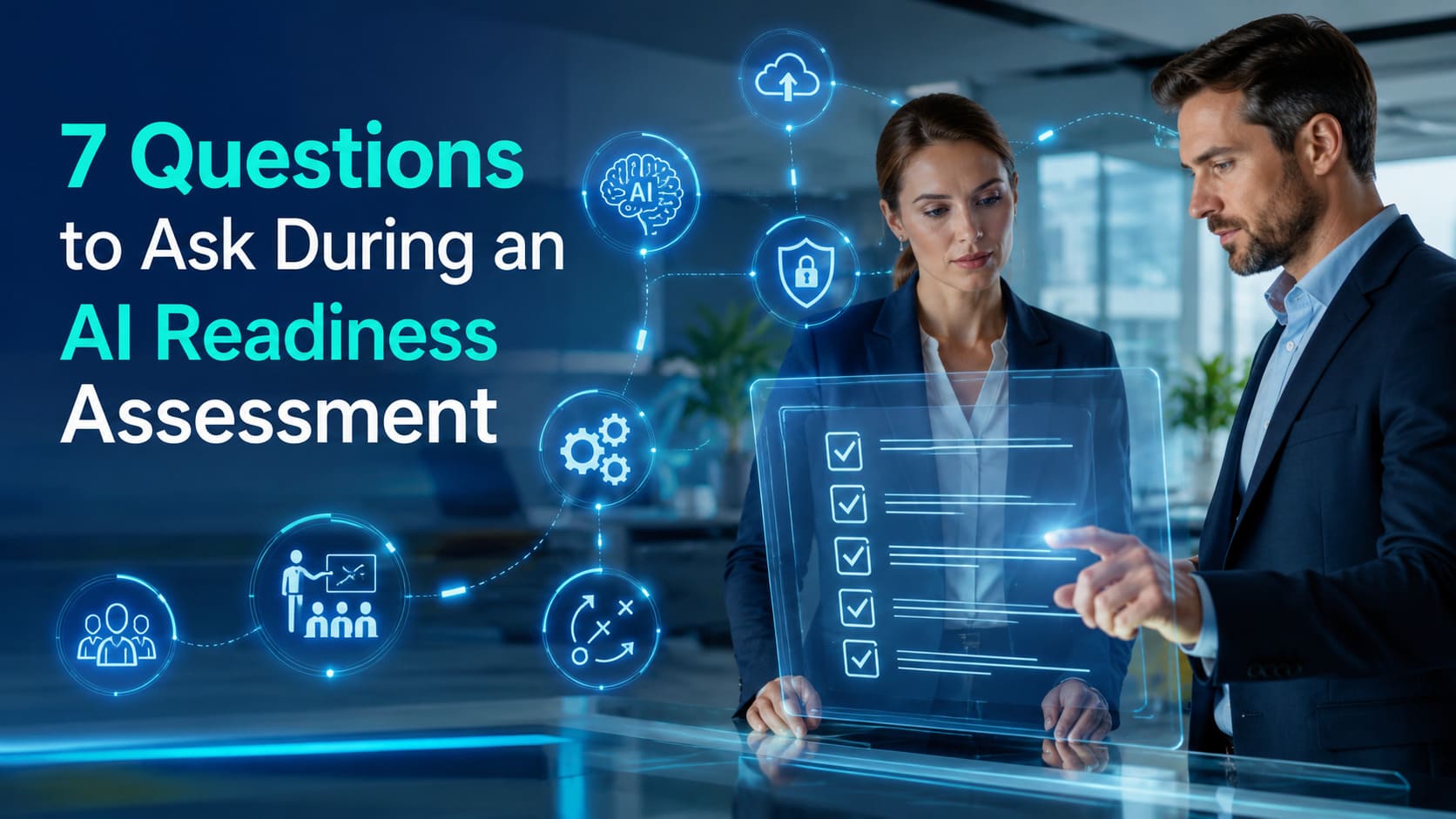
7 Questions to Ask During an AI Readiness Assessment
-

- July 22nd, 2026
- 12 views

FREE SEO Topical Map Generator: Find Your Next Content Ideas
Have you ever bought a new tool, only to realize later that your team was not ready to use it? The same thing happens with artificial intelligence. Many businesses are excited about AI, but they often skip one important step before getting started.
That is where an AI Readiness Assessment becomes valuable. It helps you understand if your people, systems, data, and security are prepared before investing time and money.
At Rubixe, businesses often discover that a few simple improvements can make their AI journey much smoother. Instead of rushing into new technology, they first learn where they stand today.
In this guide, we will explore seven important questions every business should ask before adopting AI.
Why is an AI Readiness Assessment important?
An AI Readiness Assessment helps organizations understand whether they are prepared to adopt artificial intelligence successfully.
Without proper planning, AI projects can become expensive, difficult to manage, or fail to deliver expected results. According to research from IBM and Gartner, many AI initiatives struggle because organizations underestimate challenges related to data quality, employee skills, and business processes.
Think of it like building a house. You first inspect the land before laying the foundation.
Here are the main areas an assessment reviews.
Business goals
Data quality
Technology infrastructure
Employee skills
Security and compliance
Budget and resources
Long term strategy
1. What business problem are we trying to solve?
The first question in an AI Readiness Assessment is surprisingly simple.
What problem needs solving?
AI should never be adopted simply because it is popular. Instead, it should improve something that already matters to the business.
For example, a customer service team spending hours answering repetitive questions may benefit from automation. On the other hand, if customer complaints are caused by unclear policies, AI alone will not fix the issue.
Clearly defining the problem helps measure success later.
2. Is our data accurate and organized?
Good AI depends on good data.
If information is incomplete, outdated, or inconsistent, AI systems will produce unreliable results. This is often called the "garbage in, garbage out" principle by data professionals.
A proper AI Readiness Assessment reviews data quality by asking questions such as:
Is the data complete?
Is it stored securely?
Is it updated regularly?
Can different systems share information?
Many organizations discover that improving data quality delivers benefits even before AI is introduced.
3. Do our employees have the right skills?
Technology alone is never enough.
People need to understand how AI works and how to use it responsibly. This is where AI training becomes essential.
Employees do not need to become programmers. They simply need confidence in using AI tools, understanding results, and recognizing limitations.
A small manufacturing company, for example, introduced AI powered quality checks. After providing practical AI training, workers quickly learned how to review AI recommendations instead of fearing the technology. Productivity improved because employees worked alongside AI instead of competing with it.
4. Is our technology infrastructure ready?
Your existing systems should be able to support AI.
Older software, disconnected databases, or slow networks can limit performance.
An AI Readiness Audit often reviews whether your infrastructure can support modern applications without major disruption.
Consider these areas.
Area |
What to Check |
Why It Matters |
Data storage |
Centralized and accessible |
AI needs reliable information |
Cloud capability |
Scalable resources |
Supports growing workloads |
Software integration |
Connected systems |
Reduces manual work |
Computing resources |
Enough processing power |
Improves performance |
Reviewing these areas early reduces unexpected costs later.
5. Are we prepared for AI Cybersecurity risks?
Every AI system introduces new security considerations.
Strong AI Cybersecurity practices help protect business information, customer data, and AI models from misuse.
Questions worth asking include:
Who can access AI systems?
How is sensitive data protected?
Are security policies regularly updated?
Is AI monitored for unusual behavior?
Cybersecurity experts recommend treating AI as part of the overall security strategy instead of managing it separately.
No security system is perfect, but regular monitoring and updates significantly reduce risk.
6. Do we have the right partners and strategy?
Many organizations benefit from outside expertise during implementation.
Experienced AI Consulting partners help businesses avoid common mistakes, identify realistic opportunities, and create practical roadmaps.
An effective strategy also considers future growth. AI should support long term business objectives instead of solving only short term problems.
Businesses exploring AI and ML solutions often find that careful planning produces better outcomes than rushing into multiple projects at once.
7. How will we measure success?
Every AI project needs clear success measures.
A complete AI Readiness Assessment should define measurable goals before implementation begins.
Examples include:
Faster customer response times
Lower operating costs
Higher employee productivity
Better decision making
Improved customer satisfaction
Regular reviews help organizations adjust their approach as business needs change.
What does a successful AI readiness review include?
A successful review examines several connected areas instead of focusing on technology alone.
It combines business strategy, people, data, security, and operational planning into one complete picture.
The following checklist summarizes the process.
Assessment Area |
Key Focus |
Business goals |
Clear objectives |
Data quality |
Reliable information |
Employee readiness |
Ongoing AI training |
Technology |
Modern infrastructure |
Security |
Strong AI Cybersecurity practices |
Planning |
Expert AI Consulting guidance |
Future growth |
Scalable Automation and AI and ML adoption |
Organizations that review these areas carefully often experience smoother implementation and better long term value.
Frequently Asked Questions
What is an AI Readiness Assessment?
An AI Readiness Assessment evaluates whether your organization has the people, processes, data, technology, and security needed to adopt AI successfully.
How is an AI Readiness Audit different from an AI readiness assessment?
An AI Readiness Audit usually focuses on examining existing systems and identifying gaps, while an assessment also considers business goals, employee readiness, and future planning.
Why is AI training important before adopting AI?
AI training helps employees understand how to use AI effectively, interpret results, and work confidently with new tools.
Why should businesses focus on AI Cybersecurity?
Strong AI Cybersecurity protects sensitive data, reduces security risks, and helps organizations maintain customer trust while using AI systems.
Can Automation and AI work together?
Yes. Automation handles repetitive tasks, while AI and ML add intelligence by learning patterns and supporting better decisions. Together they often improve efficiency and productivity.
Final thoughts
Artificial intelligence delivers the best results when organizations prepare before they invest.
Asking these seven questions creates a practical roadmap for smarter decisions, lower risk, and stronger outcomes. An AI Readiness Assessment is not about proving that your business is ready today. It is about understanding what needs attention so future AI projects have a better chance of success.
Whether your organization is just beginning or expanding existing AI initiatives, Rubixe can help businesses evaluate readiness, strengthen security, improve Automation strategies, and build practical AI solutions that align with long term goals.