How Companies Are Redefining Automation Using AI Agent Development to Create Self Operating Business Ecosystems
-

- July 24th, 2026
- 1,827 views

FREE SEO Topical Map Generator: Find Your Next Content Ideas
It started with a question that caught everyone in the room off guard.
A CEO of a rapidly growing enterprise looked around during a quarterly operations review and asked:
“Why do we still need so many meetings to keep automated systems running?”
The room went silent.
After all, the company had spent years investing in digital transformation.
They had:
- Modern ERP systems
- CRM platforms
- Workflow automation tools
- Reporting dashboards
- Robotic Process Automation solutions
- Cloud infrastructure
On paper, everything looked automated.
Yet managers were still chasing approvals.
Teams were still coordinating manually.
Departments were still waiting for information from each other.
And leadership was spending hours every week aligning systems that were supposedly already connected.
That was the moment they realized something important.
They had automated tasks.
They had not automated the business.
The difference may sound small, but it is exactly why organizations today are turning toward AI Agent development company expertise to build self operating business ecosystems that go far beyond traditional automation.
This is the story of how one enterprise transformed from a collection of disconnected automated processes into an intelligent ecosystem capable of operating, coordinating, and optimizing itself.
And how Yudiz Solutions helped make that transition possible.
The automation illusion
For years, businesses have measured progress by the number of processes they automate.
The company in this story was no different.
Over five years, they automated:
- Invoice processing
- Customer onboarding
- Lead management
- Inventory tracking
- HR workflows
- Reporting activities
The results were initially positive.
Productivity increased.
Processing times decreased.
Operational costs improved.
But as the company scaled, new problems emerged.
Internal audit findings
Despite extensive automation:
- 34 percent of operational delays were caused by cross department dependencies
- 28 percent of decisions required manual intervention
- 22 percent of workflows stalled waiting for approvals
- 17 percent of resources were allocated inefficiently
- 15 percent of customer requests involved multiple handoffs
One operations leader summarized the challenge perfectly.
“Every process was automated. The business itself was not.”
Why traditional automation eventually reaches a limit
Most automation systems follow rules.
When condition A happens, perform action B.
That works well for predictable tasks.
But businesses are rarely predictable.
Unexpected situations happen constantly:
- Demand spikes
- Supply chain disruptions
- Customer escalations
- Compliance changes
- Resource shortages
Traditional automation struggles because it lacks context.
It cannot understand the broader objective.
It simply follows instructions.
One technology executive explained it this way:
“Our systems could execute. They could not think.”
The turning point: building a self operating ecosystem
The transformation began during a strategic consulting engagement involving Yudiz Solutions.
Instead of asking:
“What should we automate next?”
The discussion shifted toward a much bigger question:
“What would happen if the business could coordinate itself?”
That idea introduced a completely different vision.
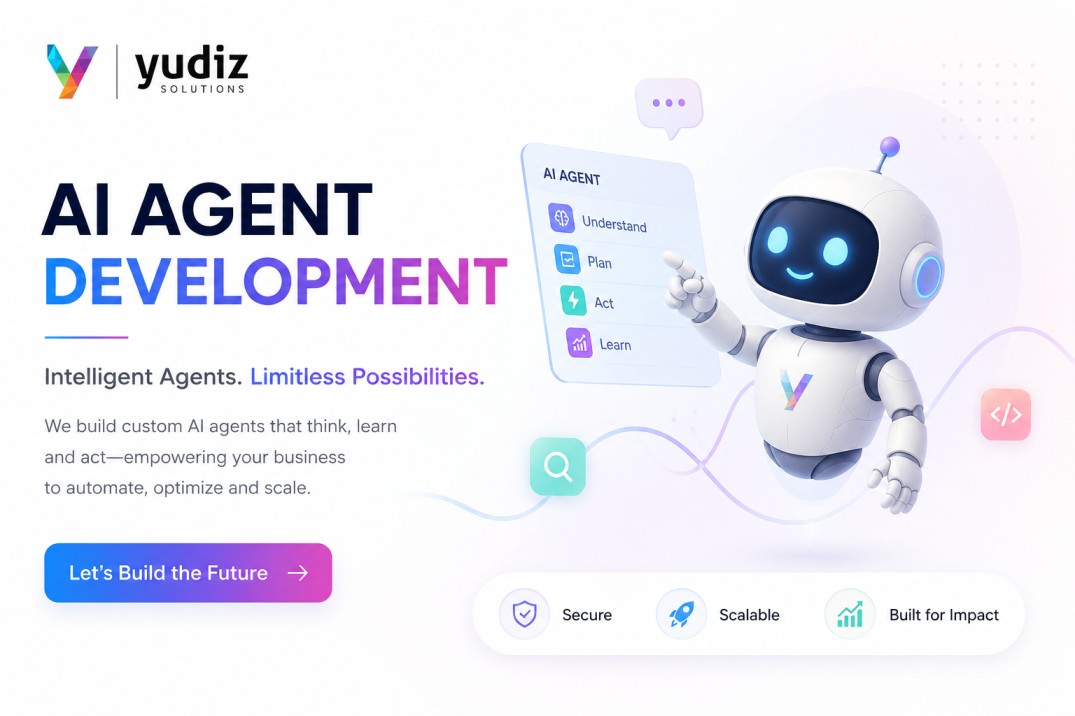
Rather than building more automation workflows, the company would build an ecosystem of intelligent agents capable of managing business operations autonomously.
This became the foundation of their AI Agent development strategy.
From automated workflows to self operating business ecosystems
A self operating ecosystem is fundamentally different from traditional automation.
Traditional automation
- Executes predefined rules
- Handles isolated tasks
- Requires human oversight
- Operates within fixed workflows
AI agent ecosystems
- Understand objectives
- Collaborate across departments
- Adapt to changing conditions
- Continuously optimize outcomes
- Make operational decisions autonomously
One executive described it perfectly.
“Automation follows instructions. Agents pursue outcomes.”
Building the business ecosystem
Rather than deploying a single AI solution, the company created a network of specialized agents.
Each agent acted like a digital employee with a defined responsibility.
Revenue growth agent
This agent monitored:
- Sales pipelines
- Lead quality
- Customer behavior
- Revenue forecasts
When opportunities emerged, it automatically coordinated with marketing and sales workflows.
Impact
- Faster lead qualification
- Improved forecasting accuracy
- Better revenue visibility
One sales director remarked:
“The system spots growth opportunities before our teams do.”
Customer experience agent
Customer service, onboarding, and retention were unified under a single intelligence layer.
The agent could:
- Resolve support requests
- Identify churn risks
- Recommend customer actions
- Trigger retention campaigns
Customer experience became proactive rather than reactive.
Operations optimization agent
This agent continuously monitored:
- Resource allocation
- Workflow bottlenecks
- Process efficiency
- Service delivery metrics
Instead of waiting for managers to identify problems, the system surfaced issues automatically.
Financial intelligence agent
Finance teams often spend significant time reconciling information.
The financial agent handled:
- Budget monitoring
- Expense tracking
- Cash flow analysis
- Invoice validation
One finance executive said:
“We moved from reviewing numbers to understanding them.”
Workforce coordination agent
This agent supported human resources and workforce planning.
Responsibilities included:
- Staffing recommendations
- Skill gap analysis
- Recruitment prioritization
- Employee workflow optimization
Hiring decisions became more strategic and data driven.
The power of multi agent collaboration
The real transformation happened when agents began collaborating.
Imagine a real business scenario.
A major client submits a large enterprise contract request.
Immediately:
Revenue agent
Evaluates opportunity value.
Finance agent
Assesses profitability and payment risk.
Operations agent
Reviews delivery capacity.
Workforce agent
Checks staffing availability.
Customer experience agent
Designs onboarding workflows.
Within seconds, multiple departments become aligned.
Traditionally, this process required days of meetings and emails.
One executive observed:
“It feels like every department is having a conversation all the time.”
Before vs after self operating ecosystems
The impact became visible within months.
| Metric | Traditional Automation | AI Agent Ecosystem |
|---|---|---|
| Decision speed | Slow | 3x faster |
| Workflow coordination | Manual | Autonomous |
| Operational visibility | Fragmented | Unified |
| Resource utilization | Moderate | Optimized |
| Customer response time | Delayed | Near real time |
| Scalability | Labor dependent | Intelligence driven |
One board member summarized the transformation clearly.
“We reduced management overhead without losing control.”
What employees experienced
One of the biggest surprises was how positively teams reacted.
Before implementation:
- Managers chased updates
- Teams attended endless coordination meetings
- Employees spent time gathering information
After implementation:
- Information surfaced automatically
- Priorities became clearer
- Decisions happened faster
- Teams focused on strategic work
A department manager said:
“I stopped managing processes and started managing outcomes.”
That shift became one of the most valuable benefits.
Why self operating ecosystems are becoming essential
Modern businesses face increasing complexity.
Organizations must manage:
- Global customers
- Hybrid workforces
- Rising customer expectations
- Rapid market changes
- Growing operational data
Traditional systems struggle because complexity increases faster than human coordination capacity.
Self operating ecosystems solve this by creating intelligence layers that continuously coordinate activities across the business.
Benefits include
- Faster adaptation
- Lower operational friction
- Improved scalability
- Better customer experiences
- Reduced manual workload
One CEO explained it simply.
“Growth became easier because coordination became automatic.”
The role of AI Agent Development
Building a self operating ecosystem is not simply an AI project.
It requires:
Business workflow understanding
Agents must understand operational objectives.
Multi agent architecture
Agents must collaborate effectively.
Data integration
Systems must share context.
Governance and security
Actions must remain compliant and traceable.
Continuous learning
Agents must improve over time.
This is why many organizations partner with an experienced AI Agent development company capable of connecting technology directly to business outcomes.
How Yudiz Solutions helped shape the transformation
One reason the implementation succeeded was the structured methodology introduced by Yudiz Solutions.
Rather than approaching the project as a technology deployment, the focus remained on business transformation.
The organization benefited from:
- 15 plus years of industry expertise
- 450 plus creative and technical professionals
- More than 6000 successful project deliveries
- Top 3 percent talent model
What stood out most was the ability to connect enterprise strategy with intelligent agent design.
The process included:
1. Business ecosystem analysis
Identifying operational dependencies.
2. Agent role definition
Assigning specialized responsibilities.
3. Workflow orchestration
Enabling collaboration between agents.
4. Agile implementation
Deploying incrementally across departments.
5. Continuous optimization
Refining outcomes using live operational data.
One executive commented:
“They helped us rethink how the business operates, not just how software works.”
Industries already embracing self operating ecosystems
The same model is being adopted across industries.
Healthcare
- Patient coordination
- Administrative automation
- Care workflow management
Manufacturing
- Production optimization
- Maintenance planning
- Supply chain coordination
FinTech
- Risk analysis
- Compliance management
- Customer onboarding
Retail
- Customer engagement
- Inventory optimization
- Personalized commerce
Human Resources
- Recruitment automation
- Workforce planning
- Employee support
Wherever complexity exists, intelligent ecosystems create efficiency.
The numbers that mattered most
After one year, the company reported:
- 46 percent reduction in operational bottlenecks
- 39 percent faster decision making
- 33 percent improvement in resource utilization
- 51 percent reduction in manual coordination effort
- 29 percent increase in customer satisfaction
- 41 percent improvement in overall operational efficiency
But one metric stood out above everything else.
The business continued scaling without requiring proportional growth in management overhead.
That changed the economics of growth completely.
A conversation that captured everything
Toward the end of the project, I asked the CEO who had originally questioned the effectiveness of automation:
“What feels different now?”
He thought for a moment and replied:
“The business no longer waits for instructions.”
That answer perfectly captured the transformation.
Final thoughts
For years, automation focused on helping businesses work faster.
The next phase is helping businesses operate smarter.
AI Agent development is enabling organizations to move beyond isolated workflows and build self operating ecosystems where intelligent agents collaborate across departments, coordinate decisions, and optimize outcomes continuously.
And when implemented through a structured, business focused approach like the one followed by Yudiz Solutions, these ecosystems become far more than automation projects.
They become scalable operating models.
Because the future belongs to organizations that do not just automate tasks.
It belongs to organizations that create intelligent systems capable of running entire business functions with minimal friction, maximum visibility, and continuous improvement.