AI Insurance Software Is Quietly Replacing the Spreadsheets That Ran This Industry for Decades
-

- July 27th, 2026
- 19 views


FREE SEO Topical Map Generator: Find Your Next Content Ideas
Walk into any insurance carrier's back office five years ago, and you'd find something that looked more like an accounting firm from the 1990s than a financial services company operating in the digital age. Rows of monitors running Excel. Shared drives full of pricing models named "FINAL_v3_USE_THIS_ONE." Actuaries manually updating tables that fed into underwriting decisions. Claims adjusters copy-pasting policy data between systems that had never been designed to talk to each other.
This wasn't a failure of talent. It was a failure of infrastructure — and the industry knew it. What's changed is that the replacement has finally arrived, and it's moving faster than most people outside the industry realize.
The Spreadsheet Problem Was Never Really About Spreadsheets
To understand what AI is replacing, it helps to understand what spreadsheets actually represented in insurance operations — and why they persisted for so long.
Insurance is fundamentally a data business. Pricing risk, reserving for future claims, detecting fraud, managing policy renewals — all of it depends on the ability to collect, analyze, and act on information at scale. For decades, Excel was the tool that made this possible at the individual level. An actuary could build a sophisticated pricing model in a spreadsheet, share it across a team, and iterate on it without waiting for an IT ticket to be processed.
The problem was governance. Spreadsheet-based workflows have no version control, no deployment infrastructure, no audit trail, and no way to enforce consistency across a team working on related models. The hyperexponential 2025 State of Pricing report surveyed 350 underwriters and pricing actuaries across the US and UK and found that nearly half — 48% — cited Excel limitations as a major barrier to optimal pricing and rating. "Lack of robust version control in Excel" was cited as the single top barrier for actuaries trying to maintain and deploy pricing models.
And yet, 99% of those same respondents said their technology needed improvement. Only 1% described their current tools as working as intended.
That figure captures something important: the frustration isn't new. What's new is that there's finally something credible to replace the spreadsheets with.
What the Transition Actually Looks Like on the Ground
The shift from spreadsheet-driven operations to AI-powered platforms isn't happening as a single dramatic transformation. It's happening function by function, team by team, as carriers identify the workflows where the gap between what they have and what's possible has become operationally unsustainable.
Underwriting was one of the first areas to move. Where underwriters once spent days — sometimes weeks — manually reviewing submissions, pulling data from multiple siloed systems, and building risk assessments in Excel, modern platforms now process those same submissions in minutes. Underwriting timelines across AI-enabled carriers have collapsed from three days to as little as three minutes, with straight-through processing rates jumping from 10–15% to 70–90% in fully deployed operations, according to Capgemini's 2026 industry analysis.
Aviva's experience with this transition illustrates what the move away from Excel actually produces. After transitioning from spreadsheet-based pricing models to a modular AI platform, the company reported a 75% reduction in model build time. That's not a marginal improvement — it's a fundamental change in how quickly pricing teams can respond to market conditions, incorporate new data, and deploy updated models across the organization.
What AI Insurance Software Does That Excel Never Could
The difference between a spreadsheet and modern AI insurance software isn't just speed. It's the category of problem each tool can handle.
Excel processes structured data that a human has already organized and entered. It can calculate, model, and display — but it cannot read an unstructured document, interpret a claim narrative written in plain language, analyze a photo for signs of damage or manipulation, or learn from the patterns in a million historical claims to make a better prediction about the next one.
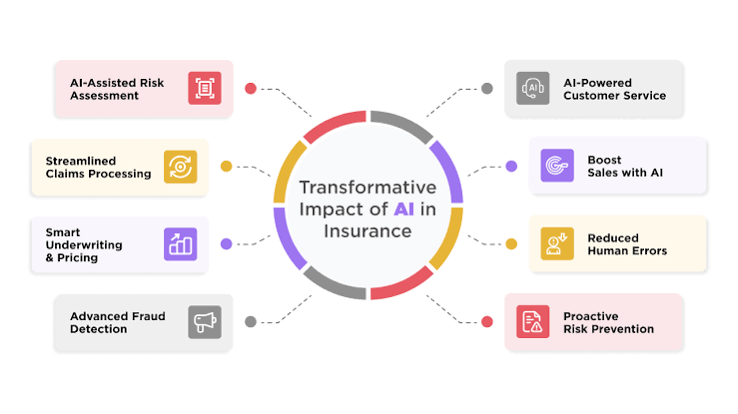
AI-powered platforms handle all of these. Natural language processing reads incoming submissions, extracts relevant risk factors from unstructured text, and flags anomalies without requiring a human to pre-process the document. Computer vision analyzes vehicle and property damage photos to produce repair estimates in minutes rather than days. Machine learning models trained on historical claims data continuously refine fraud detection, pricing accuracy, and reserve calculations in ways that static actuarial tables cannot.
The practical consequence is that AI insurance software can tackle the 93% of an insurer's workflow that was always too unstructured, too variable, or too high-volume for rules-based automation to handle. That's the gap that spreadsheets were filling — imperfectly, laboriously, and at significant operational risk.
The People Side of the Transition
One of the more significant findings from the 2025 State of Pricing report was the shift in how underwriters and actuaries feel about AI replacing their roles. In 2024, 74% of underwriters and 80% of actuaries feared being replaced by AI. By late 2025, those figures had dropped to 48% and 49% respectively — a substantial change driven by direct experience with what the tools actually do.
What experienced practitioners report is that AI software changes the nature of their work rather than eliminating it. An actuary who previously spent three weeks building, testing, and deploying a pricing model in Excel can now complete the same process in a fraction of the time — and spend the remaining capacity on the analytical judgment that the model cannot provide. An underwriter who was previously constrained by the volume of submissions they could manually review can now handle a higher book of business while spending more time on the complex cases that require contextual reasoning.
The resistance that does exist tends to come from a specific place: experienced professionals who have built deep expertise in particular systems and don't see the same depth reflected in AI outputs. That concern is legitimate. AI models are only as reliable as the data they were trained on, and in specialty lines — where historical data is thin and each risk is genuinely unique — the tools are more useful as decision support than as autonomous decision-makers.
Where the Legacy Infrastructure Is Still Winning
The honest picture of this transition includes a significant complication: most carriers are not starting from a clean slate.
According to industry data, approximately 74% of insurers were still running legacy core systems as of 2025. Most P&C carriers operate within what one industry analysis described as "a patchwork of legacy core systems — policy, billing, and claims — bolstered by spreadsheets and specialized departmental applications." These siloed environments create inconsistent definitions, incomplete records, and limited visibility across the enterprise.
The challenge for AI deployment in this context isn't the AI itself — it's the data foundation. Submission data arrives as broker emails, PDFs, spreadsheets, and phone calls. Getting all of that into a structured format that an AI model can reason over represents roughly 80% of the actual engineering effort in a real deployment. Connecting AI models to the 15–20 legacy systems that a typical carrier runs is where most transformation programs encounter their most serious friction.
A Novarica survey of large insurance providers found that only 10% had modernized more than half of their systems. That means the majority of carriers are attempting to layer AI capabilities onto infrastructure that was never designed to support them — a strategy that produces partial gains but rarely delivers the full operational change that the best deployments demonstrate.
The Gap Between Leaders and Everyone Else
The carriers that have cleared the data infrastructure hurdle are pulling ahead of the market in ways that are becoming increasingly visible in financial outcomes.
AI-enabled carriers have cut claim resolution time by 75% — from 30 days to 7.5 days on average — and reduced cost per claim by 30–40%, according to BCG Research published in December 2025. McKinsey's analysis of the broader picture finds that AI-leading insurers are generating roughly six times the total shareholder returns of their AI-laggard peers — a gap that is documented and widening.
Between 2024 and 2025, the share of insurers with full-scale AI adoption jumped from 8% to 34%. That number reflects the industry crossing the threshold from experimentation to production deployment — from pilots that proved the concept to operations that depend on it daily.
What Hasn't Changed
Technology is changing fast. The fundamental work of insurance is not.
Someone still has to make the judgment call on a complex commercial risk where the data is ambiguous and the stakes are high. Someone still has to sit with a policyholder who has just experienced a loss and help them understand what their coverage means in practice. Someone still has to identify when an AI model is producing outputs that look plausible but reflect a training bias that the system itself cannot detect.
The spreadsheet era of insurance operations is ending not because the people who built those spreadsheet models were wrong to use them, but because the tools available now can do what those models could never do — process unstructured information, learn from scale, and operate continuously without manual intervention.
What the best carriers are figuring out is how to use that capability to make their people better at the judgment-intensive work that still requires a human being, rather than simply reducing headcount in the areas where the software can now keep up.