What Happens Inside an Insurance Company After It Deploys AI Software — And What Doesn't Change
-

- July 27th, 2026
- 33 views

FREE SEO Topical Map Generator: Find Your Next Content Ideas
Walk into any mid-sized insurance carrier today and ask an adjuster what changed after the "AI rollout," and you'll rarely get a neat, tidy answer. You'll get a mix: relief that certain grunt work disappeared, frustration about new bottlenecks nobody warned them about, and a quiet worry about what happens when the software gets something wrong on a real person's claim. That mix is closer to the truth than the polished case studies suggest, and it's worth walking through what actually shifts on the ground once the software goes live.
The First Few Weeks Look Nothing Like the Sales Pitch
Every rollout starts the same way — a vendor demo, a pilot team, and a promise that first-notice-of-loss will move from hours to minutes. In practice, the first few weeks are messier. Claims teams spend a surprising amount of time cleaning up historical data so the model has something reliable to learn from. Underwriters get pulled into meetings to explain edge cases the algorithm keeps misreading. IT has to stitch the new system into policy admin platforms, document management tools, and whatever legacy mainframe has been running since the 1990s.
Employees who've lived through this describe it less as a switch flipping and more as a slow renovation while the business is still open. Claims still need to be paid, calls still need to be answered, and the new system has to earn its place alongside the old one before anyone fully trusts it.
Where the Speed Actually Shows Up
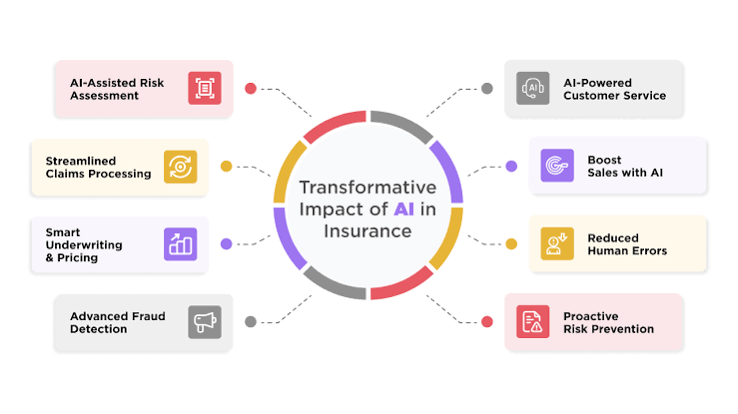
Once the dust settles, the gains are real and measurable, especially in claims. Straightforward claims — a fender bender with clear photos, a renters' theft claim under a set dollar amount — increasingly move from intake to payout without a human touching the file. Some carriers report cycle times dropping from what used to take days down to a matter of hours or even minutes for the simplest cases. Document review, which used to mean an adjuster manually reading through repair estimates and medical bills, now happens through automated extraction that flags anything unusual for a person to check.
This is the part of the story that gets the headlines. It's also the part where a lot of people confuse "faster" with "fully automatic." Even in carriers with aggressive automation targets, the bulk of claims — anything involving injury, liability disputes, large losses, or ambiguous coverage questions — still land on a human desk. The software triages and drafts; it rarely gets the final word on anything complicated.
The Underwriting Desk Changes Shape, Not Purpose
On the underwriting side, the shift is subtler but arguably bigger. Risk scoring that used to depend on static, once-a-year data now pulls from continuous streams — telematics, IoT sensors, claims history updated in near real time. This means underwriters spend less time gathering information and more time interpreting it, questioning why a model flagged a particular applicant, and deciding whether that flag actually reflects risk or just reflects a gap in the training data.
Several underwriters who've worked through these transitions describe their job becoming less about calculation and more about judgment calls the software can't make — reading between the lines on an application, weighing context a model has no way of knowing, and catching cases where an automated score is technically correct but practically unfair. Good AI insurance software speeds up the repetitive parts of underwriting, but it doesn't remove the need for someone to sanity-check the output before it becomes a decision that affects a real customer's premium or coverage.
Fraud and Compliance Teams Get Busier, Not Quieter
A common assumption is that automation shrinks headcount across the board. In fraud and compliance departments, the opposite tends to happen, at least initially. Automated systems flag far more anomalies than a manual process ever could, which means investigators now spend their time triaging alerts instead of hunting for suspicious patterns from scratch. Some of those flags are genuinely useful; a meaningful share are false positives that still need a human to close out.
Compliance teams, meanwhile, have picked up an entirely new workload: documenting how automated decisions were made, keeping audit trails for regulators, and being ready to explain — in plain language — why a model denied a claim or priced a policy a certain way. Regulators and courts have started asking pointed questions about whether automated reviews meet the same individualized-review standard that traditional insurance obligations require, and that pressure has made explainability a full-time job in itself rather than a side project.
What Customers Actually Notice
For policyholders, the visible change is usually speed, and sometimes it's dramatic — a claim that once dragged out for weeks resolved in a day. But surveys of customer sentiment tell a more complicated story than the efficiency numbers suggest: as full-scale adoption has climbed, trust in AI-driven decisions has not climbed with it. People report frustration when a denial arrives instantly with no clear explanation, or when getting a human on the phone to contest an automated decision takes longer than the original claim did. The technology solved the speed problem before it solved the trust problem, and that gap shows up in every appeals queue.
What Genuinely Doesn't Change
A few things stay stubbornly the same no matter how sophisticated the tooling gets. Complex claims — anything with injury, disputed liability, or unclear policy language — still need a human adjuster with judgment and context. Customer service still needs people who can de-escalate a frustrated caller, something no chatbot handles well when someone's house just flooded. And the legal and ethical responsibility for a decision still sits with the company, not the model. No AI insurance software, however advanced, changes who's accountable when a decision affects someone's coverage, their payout, or their trust in the company they've been paying premiums to for years.
The honest picture, then, isn't robots replacing an industry overnight. It's a slower, more uneven shift where routine work moves fast and everything that requires judgment, empathy, or accountability still runs through a person — just a person now spending more time reviewing decisions than making them from scratch.
FAQs
Does deploying AI mean insurance companies need fewer employees?
Not uniformly. Some roles focused on repetitive data entry shrink, but fraud investigation, compliance, and complex claims handling often see steady or growing headcount because automated systems generate more alerts and audit requirements than manual processes did.
Can AI deny an insurance claim without any human review?
It can flag or draft a denial, and in some narrow, low-value cases the decision closes without a person touching it. But regulators in several jurisdictions are pushing for mandatory human oversight on denials, especially for medical and liability claims.
How long does it typically take for a carrier to fully integrate AI into claims and underwriting?
Most documented rollouts take well over a year before returns clearly outweigh implementation costs, and full company-wide adoption — beyond a single department — is still uncommon across the industry as a whole.
Do customers actually prefer faster, AI-assisted claims handling?
Speed is generally welcomed, but satisfaction depends heavily on whether customers can get a clear explanation and a real person when they disagree with an automated outcome.