How AI Improves Industrial Safety Through Intelligent Surveillance
-
- August 01st, 2026
- 33 views

FREE SEO Topical Map Generator: Find Your Next Content Ideas
Industrial workplaces are becoming more complex, making it increasingly difficult for safety teams to identify every potential hazard through manual monitoring alone. Many organizations ask, "Can an AI-based surveillance system detect safety risks before they lead to accidents?" The answer is yes. Modern AI video analytics for safety and security continuously analyzes live video to identify unsafe behaviour, restricted-area violations, fire or smoke events, and other operational risks in real time. Intozi's Ikshana is one example of an AI-powered video analytics platform that helps organizations strengthen workplace safety through intelligent surveillance and proactive risk detection.
Why Intelligent Surveillance Is Changing Industrial Safety
Traditional CCTV systems are valuable for recording incidents, but they often require operators to manually review footage or respond after an event has already occurred. Intelligent surveillance adds artificial intelligence to existing camera infrastructure, enabling organizations to identify hazards while operations are still underway.
An AI-powered approach helps organizations:
Support faster emergency response
Reduce manual monitoring
Improve compliance with safety procedures
Protect employees, equipment, and facilities
By shifting from reactive surveillance to proactive monitoring, organizations can reduce risks before they become costly incidents.
How AI Video Analytics for Safety and Security Works
AI video analytics for safety and security transforms surveillance cameras into intelligent monitoring systems capable of understanding what is happening within an industrial environment. Using computer vision and machine learning, AI continuously evaluates live video streams and generates alerts whenever predefined safety events occur.
Common AI detection capabilities include:
PPE compliance monitoring
Unauthorized access detection
Fire and smoke detection
Worker fall detection
Vehicle and pedestrian interaction monitoring
Restricted-area intrusion
Unsafe equipment operation
Instead of reviewing hours of recorded footage, safety teams receive immediate notifications that enable faster action.
AI-Based Surveillance System Supports Real-Time Decision Making
An AI-based surveillance system continuously monitors multiple operational areas simultaneously, helping organizations respond to safety issues as they develop. Whether monitoring manufacturing floors, warehouses, logistics centers, construction sites, or critical infrastructure, AI provides actionable information that supports informed decision-making.
Real-time surveillance helps organizations:
Identify operational hazards quickly
Verify incidents using video evidence
Reduce false alarms
Improve security response
Enhance workplace awareness
Strengthen operational resilience
This capability enables safety teams to focus on verified events rather than continuously observing multiple camera feeds.
Video Analytics for Safety Compliance Improves Workplace Standards
Maintaining safety compliance across industrial operations requires consistent monitoring and documentation. Video analytics for safety compliance automates many routine safety observations by continuously verifying whether established procedures are being followed.
Organizations commonly use AI to monitor:
PPE usage
Entry into restricted areas
Safe machine operation
Forklift movement
Emergency exit accessibility
Housekeeping compliance
Hazardous zone access
Automated compliance monitoring reduces manual inspections while providing objective evidence that supports safety audits and continuous improvement initiatives.
AI Risk Detection System Helps Prevent Workplace Incidents
An AI risk detection system focuses on identifying conditions that may lead to accidents before they escalate. Rather than responding only after an incident occurs, AI continuously evaluates workplace activity to recognize abnormal behaviour, unsafe conditions, and operational deviations.
Examples of AI risk detection include:
Smoke and flame recognition
Worker slip or fall detection
Vehicle overspeeding
Intrusion into dangerous zones
Equipment obstruction
Crowd congestion in industrial areas
Early identification of these risks enables organizations to intervene promptly, reducing both operational disruptions and safety incidents.
How Intozi and Ikshana Support Industrial Safety
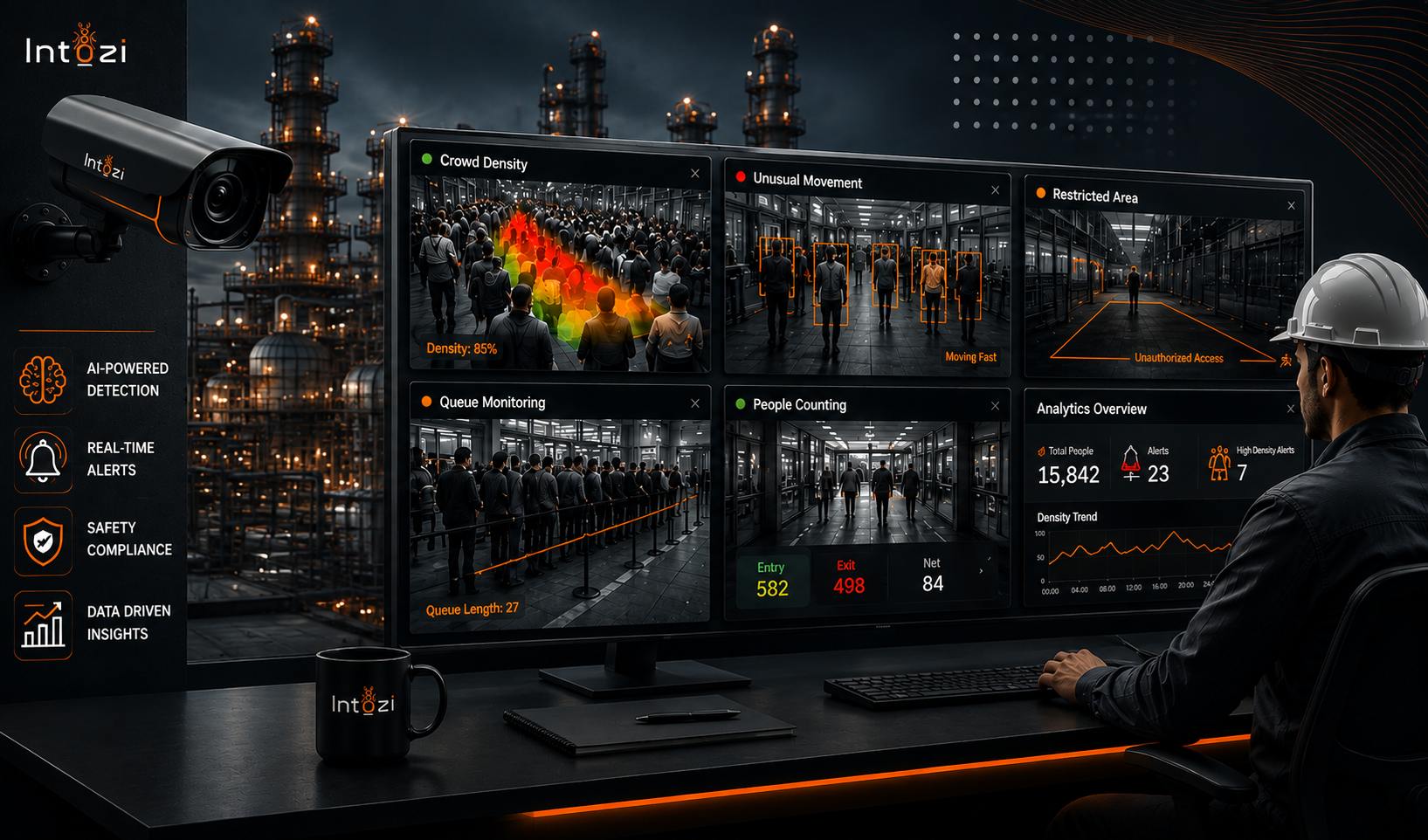
Organizations increasingly require a unified platform capable of managing multiple safety and security analytics through one interface. Intozi offers Ikshana, an AI-powered video analytics platform designed to support industrial safety, operational monitoring, and intelligent surveillance.
Ikshana can analyze live CCTV feeds to detect PPE violations, fire and smoke events, restricted-area access, worker safety risks, vehicle movement, and other operational incidents. By combining multiple AI analytics into a centralized dashboard, the platform helps organizations improve visibility, strengthen safety compliance, and accelerate incident response using compatible surveillance infrastructure.
Building Safer Workplaces with AI Video Analytics for Safety and Security
An intelligent surveillance strategy enables organizations to move beyond passive video recording and toward proactive risk management. AI video analytics for safety and security provides continuous monitoring, early hazard detection, and automated compliance verification that support safer industrial environments. As organizations continue modernizing their operations, AI-powered surveillance will play an increasingly important role in protecting people, assets, and business continuity.
Frequently Asked Questions (FAQs)
Can an AI-based surveillance system detect safety risks before accidents happen?
Yes. An AI-based surveillance system continuously analyzes live video to identify unsafe behaviour, restricted-area violations, fire, smoke, equipment hazards, and other operational risks. By generating real-time alerts, the system allows safety teams to respond before these situations develop into workplace accidents or major operational incidents.
How does AI video analytics improve workplace safety?
AI video analytics improves workplace safety by automatically monitoring safety-critical activities instead of relying solely on manual observation. It detects unsafe actions, PPE non-compliance, unauthorized access, vehicle interactions, and hazardous conditions, enabling organizations to respond more quickly while improving overall operational visibility.
What is video analytics for safety compliance?
Video analytics for safety compliance uses AI to verify whether employees and contractors follow established safety procedures. It can monitor PPE usage, restricted-area access, equipment operation, and other compliance requirements continuously, helping organizations maintain consistent workplace safety standards and simplify audit preparation.
Can AI risk detection systems work with existing CCTV cameras?
Yes. Many enterprise AI platforms are designed to integrate with compatible IP-based CCTV systems. This allows organizations to enhance their existing surveillance infrastructure with intelligent analytics, reducing deployment costs while adding real-time monitoring and automated safety detection capabilities.
Which industries benefit most from AI video analytics for safety and security?
AI video analytics is widely used across manufacturing, warehouses, logistics, construction, oil and gas, mining, utilities, transportation, airports, and critical infrastructure. Any environment where continuous monitoring, safety compliance, and rapid incident detection are important can benefit from AI-powered surveillance.