Clinical Intelligence in Healthcare: How AI Is Transforming EHR, Clinical Decision Support, and Patient Care
-

- July 31st, 2026
- 67 views

FREE SEO Topical Map Generator: Find Your Next Content Ideas
Healthcare generates enormous amounts of information through electronic health records (EHRs), clinical notes, laboratory reports, medical images, prescriptions, monitoring devices, and administrative systems. Collecting this information is no longer the only challenge. Healthcare professionals also need to find relevant data, understand its context, and use it efficiently during clinical workflows. This is where clinical intelligence is becoming increasingly valuable.
Clinical intelligence combines artificial intelligence (AI), healthcare data analytics, automation, natural language processing, and clinical workflows to transform complex healthcare data into useful insights. Instead of functioning only as a digital storage system, clinical intelligence software can organize information, summarize records, identify relevant patterns, and support professionals with timely context.
What Is Clinical Intelligence in Healthcare?
Clinical intelligence refers to technology that processes healthcare information and converts it into actionable clinical insights. It can work with structured and unstructured data, including patient demographics, diagnoses, medications, laboratory results, clinical documentation, imaging information, and patient communications.
A traditional EHR primarily stores and displays information. A clinical intelligence platform adds an intelligence layer that helps users understand information more efficiently. For example, instead of manually reviewing numerous clinical notes, a healthcare professional could receive a structured summary of relevant medical history, recent events, medications, and documented concerns.
The purpose is not to replace physicians or qualified healthcare professionals. Responsible clinical AI should reduce repetitive information-processing work and support informed human decision-making.
How Clinical Intelligence Software Works
A modern clinical intelligence platform usually includes several technology layers. The first is healthcare data integration. Organizations often use multiple applications, including EHR systems, laboratory platforms, hospital information systems, imaging solutions, and patient-monitoring tools. Connecting these sources creates a foundation for intelligent workflows.
Artificial intelligence then adds capabilities such as classification, summarization, prediction, information retrieval, and contextual analysis. Depending on the use case, organizations may use machine learning, natural language processing, large language models, knowledge graphs, retrieval-augmented generation, or rules-based clinical decision support.
Finally, the system delivers relevant insights through the healthcare professional’s workflow. Outputs may include clinical summaries, documentation assistance, risk indicators, care-gap information, alerts, or patient communication support.
Clinical Intelligence and EHR Systems
Clinical intelligence should not necessarily replace an EHR. Instead, it can operate as an intelligence layer connected to existing healthcare infrastructure.
EHR systems maintain patient records and support documentation. Clinical intelligence can analyze information across those records and present relevant context. This approach can help organizations modernize their technology without completely replacing existing systems.
Clinical Decision Support
Clinical decision support is an important application of clinical intelligence. Clinical decision support systems can provide relevant information, alerts, reminders, or recommendations within healthcare workflows.
AI can enhance these systems by processing larger amounts of information and identifying relationships that may be difficult to discover manually. However, clinical decision support must be designed carefully. Recommendations should be contextual, appropriately validated, and subject to human oversight.
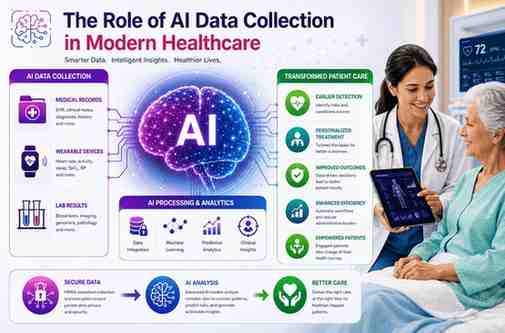
A clinical intelligence workflow can therefore connect patient data, contextual analysis, relevant information, clinical insight, and professional review. The final decision remains with the appropriately qualified healthcare professional.
Generative AI in Healthcare
Generative AI in healthcare is expanding healthcare software development. Large language models can process natural-language information such as physician notes, referral documents, discharge summaries, patient conversations, and clinical correspondence.
One practical application is AI-assisted clinical documentation. During or after a consultation, an AI system can organize information into structured documentation, reducing repetitive administrative work.
Generative AI can also support medical information retrieval, patient communication, record summarization, and workflow assistance. However, AI-generated content can contain inaccuracies or unsupported conclusions. Production healthcare systems therefore require evaluation, monitoring, privacy controls, security measures, and human review.
HL7 FHIR and Healthcare Interoperability
Interoperability is fundamental to effective clinical intelligence. Healthcare organizations often have information distributed across multiple systems. Without reliable data exchange, an AI platform may have an incomplete view of a patient or workflow.
HL7 FHIR provides standardized approaches for exchanging healthcare information through resources and APIs. FHIR can therefore play an important role in connecting clinical intelligence platforms with existing healthcare applications.
A simplified architecture can include EHR and healthcare systems, HL7 or FHIR integration, a data processing layer, AI and analytics, clinical intelligence, and the clinician workflow.
Benefits of Clinical Intelligence
Clinical intelligence can provide several potential benefits. First, it can reduce administrative workload by assisting with repetitive documentation and information-processing tasks. Second, it can improve information accessibility by presenting relevant patient context in a structured format. Third, it can support clinical decision-making by surfacing information that may require attention. Fourth, it can improve healthcare data utilization. Finally, intelligent automation can help organizations scale workflows without increasing manual effort.
These benefits depend on implementation quality. AI alone does not guarantee better healthcare outcomes.
Challenges of Implementing Clinical Intelligence
Healthcare AI implementation involves significant challenges. Data quality is one of the most important. Incomplete, inconsistent, or outdated information can reduce the reliability of generated insights.
Security and privacy are equally important because healthcare data is highly sensitive. Organizations need appropriate access controls, encryption, auditing, governance, and regulatory compliance measures.
User adoption is another critical factor. A technically advanced clinical intelligence platform will not create value if healthcare professionals find it difficult to use. Successful solutions should fit naturally into existing workflows and minimize unnecessary interruptions.
The Future of Clinical Intelligence
The future of clinical intelligence is likely to move beyond basic documentation and summarization. Healthcare organizations are exploring combinations of generative AI, predictive analytics, multimodal AI, clinical NLP, agentic workflows, knowledge graphs, and real-time data.
The long-term opportunity is to move healthcare technology from information storage toward contextual intelligence. Instead of asking only where patient information is located, professionals can increasingly expect technology to help identify which information matters for a particular workflow.
Responsible implementation will remain essential. Clinical intelligence should augment professional expertise, not remove appropriate human oversight. Organizations should define clear use cases, validate systems, monitor performance, protect sensitive data, and establish governance before deploying AI in clinical environments.
How ApplogiQ Supports Clinical Intelligence
ApplogiQ focuses on AI-powered digital products and healthcare software solutions designed around real-world business and clinical workflows. A clinical intelligence platform can combine AI models, healthcare APIs, data platforms, analytics, cloud infrastructure, and interoperability technologies to support specific organizational needs.
For healthcare organizations exploring clinical intelligence, the best starting point is not simply choosing an AI model. It is identifying a measurable workflow problem, understanding available data, defining the desired outcome, and designing technology around the people who will use it.
Conclusion
Clinical intelligence is helping redefine how healthcare organizations use digital technology. By combining healthcare data, AI, analytics, automation, EHR integration, clinical decision support, and interoperability, organizations can move beyond simply storing information toward generating useful context.
The strongest clinical intelligence solutions will be built around data quality, security, interoperability, usability, clinical validation, governance, and measurable outcomes. When implemented responsibly, clinical intelligence can help healthcare professionals manage complex information more efficiently while keeping human expertise at the center of care.
For hospitals, healthcare startups, and digital health companies, investing in clinical intelligence is not simply an investment in artificial intelligence. It is an investment in smarter, more connected, and more efficient healthcare workflows.