X-ray Baggage Scanner vs Metal Detector: What's the Difference?
-

- June 29th, 2026
- 30 views

FREE SEO Topical Map Generator: Find Your Next Content Ideas
When you walk into an airport, government facility, metro station, or huge business campus, you will see at least one of two devices at the entrance: an X-ray tunnel or a metal detector arch. Both are security screening technology, yet they serve quite distinct purposes. Mixing them up creates vulnerabilities in your security configuration that a determined attacker can exploit.
X-ray baggage scanners use radiation imaging to examine the contents of bags and luggage. Metal detectors detect electromagnetic changes produced by metallic items on or near a person. One examines inside things, and the other scans the human body for concealed metal. Understanding this key differential enables facility managers, procurement teams, and security consultants to select the best mix for their particular environment.
This article explains how each system works, what they can and cannot detect, and which businesses require both – allowing you to make an informed purchasing decision.
What Is an X-ray Baggage Scanner?
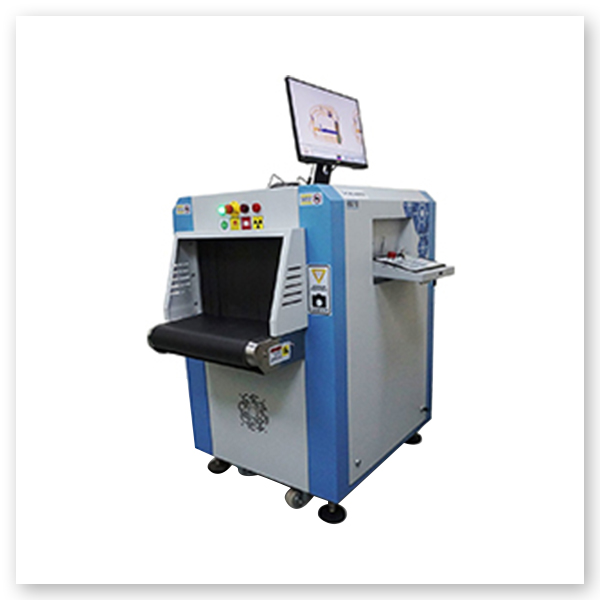
An X-ray baggage scanner is a baggage inspection system that passes luggage through a conveyor belt inside a shielded tunnel. Inside that tunnel, an X-ray source emits a narrow beam of radiation that penetrates the bag. Detectors on the other side collect the transmitted signals and convert them into a colour-coded image displayed on an operator's monitor.
How the imaging works
What X-ray scanners can detect
- Metallic weapons (knives, firearms, sharp tools)
- Plastic and ceramic weapons
- Organic threats including explosives and drugs
- Electronic devices and wiring patterns
- Liquids and their general density
- Contraband items based on shape recognitio
What Is a Metal Detector?
A metal detector operates by electromagnetic induction. A magnetic field is generated by a transmitter coil located inside the machine. When a metallic object moves through that field, it generates an opposing magnetic field (eddy currents). The detector's receiver coil detects this disturbance and sounds an alarm.
Metal detection technology is quick, non-invasive, and effective in detecting ferrous and non-ferrous metals on a person's body, making it ideal for personnel screening rather than baggage screening.Walk-through metal detectors
The walk-through metal detector (WTMD) is the enormous archway that you see at airports, courthouses, and stadium entrances. It can scan a full person in one stride, making it ideal for high-traffic areas. Modern multi-zone WTMDs can detect the approximate location of a metallic object on the body (shoulder, waist, ankle) and eliminate false positives from belt buckles or coins by modifying zone sensitivity.Handheld metal detectors
The handheld metal detector is a secondary screening device. After an alert is triggered by the walk-through unit, security professionals use it to pinpoint the exact location of a metal object on a person. It's also employed in instances where a fixed arch is impractical—open-air events, random checks, or limited areas.
What metal detectors can and cannot detect
- Can detect: ferrous metals (iron, steel), non-ferrous metals (aluminium, copper, gold), metallic weapons, metal-framed objects
- Cannot detect: plastic or ceramic weapons, explosives without metallic components, drugs, organic compounds, liquids, paper, fabric-covered things.
X-ray Baggage Scanner vs Metal Detector: Key Differences
| Criteria | X-ray Baggage Scanner | Metal Detector |
|---|---|---|
| Primary purpose | Inspect bag/luggage contents | Detect metal on persons |
| What it scans | Bags, parcels, luggage, cargo | People (body screening) |
| Technology | X-ray radiation imaging | Electromagnetic induction |
| Items detected | Metals, plastics, organics, liquids, explosives, electronics | Metallic objects only |
| Image generation | Yes – colour-coded display | No visual image |
| False alarms | Low (trained operator required) | Moderate (belt buckles, coins, implants) |
| Inspection depth | Full interior of bag | Surface/near-surface metal only |
| Ideal application | Airports, railway stations, offices with bag screening | Entry gates, stadiums, checkpoints |
| Throughput speed | Moderate (operator analysis needed) | High (instant alarm) |
| Equipment cost | Higher (₹5L–₹25L+) | Lower (₹25K–₹2L) |
| Maintenance | Periodic calibration, X-ray tube servicing | Minimal – coil and sensor checks |
What Can an X-ray Scanner Detect That a Metal Detector Cannot?
The most significant capability difference between the two systems is material variety. Metal detectors are single-material devices that exclusively respond to metal. An X-ray baggage scanner is sensitive to density and atomic number, therefore it creates a picture of everything within a bag regardless of material composition.
Here are practical examples of hazards that pass right through a metal detector but are evident to a qualified X-ray operator.
- Ceramic or plastic blades – completely nonmetallic and unnoticeable to metal detectors. On an X-ray screen, their great density against surrounding items makes them visible
- 3D-printed weapons are largely made of polymer. A metal detector may completely overlook them if no metallic component is present. X-ray imaging displays both the shape and internal structure.
- Explosive materials — Nonmetallic explosives such as PETN or TATP exhibit unique density signatures in dual-energy systems.
- Narcotics in sealed package — organic with no metallic content. Experienced operators can use X-ray colour mapping to identify odd density patterns that match drugs
- Liquid threat agents – A bottle of acid and a bottle of water both pass past a metal detector with no warning. Advanced X-ray systems can discriminate liquid densities
Key takeaway: If your security concern extends beyond metal weapons — and in most real-world environments it should — an X-ray baggage scanner is a non-negotiable part of your security checkpoint equipment.
What Can a Metal Detector Detect Better?
Metal detectors provide genuine benefits in certain instances. They are speedier, do not require a skilled picture analyzer, and are significantly more cost-effective for large-scale personnel screening.
Consider this scenario: 5,000 people attend a public event. Running every person's bag via an X-ray scanner and having a trained operator analyze each image in real time is neither realistic nor cost-effective. A walk-through metal detector arch at each gate can accommodate thousands of visitors per hour with minimal staffing.
Metal detectors are also extremely effective when the major danger profile includes concealed metallic weapons such as knives, pistols, and steel-capped tools carried directly on the body. At a courthouse, for example, the worry is a visitor walking in with a concealed weapon on their person rather than the contents of their handbag.
Handheld detectors provide pinpoint accuracy for secondary searches, which no X-ray scanner can match on a person's body without using full-body imaging technology.
Industries That Need Both Systems
Layered security is a fundamental tenet in physical security design: no single device can cover all danger vectors. Using an X-ray scanner with a metal detector at the same checkpoint results in a system in which each equipment compensates for the other's blind areas.
Airports and railway stations
These are the most obvious examples of dual-system deployment. Passengers' baggage pass through X-ray tunnels as they walk through metal detector arches. Airport security technology in major Indian airports now adheres to BCAS (Bureau of Civil Aviation Security) rules, which require both types of equipment.
Government and corporate offices
Shopping malls and hotels
Hospitals
Hospitals confront particular security issues, including agitated visitors, cash transactions, and medicine theft concerns. A metal detector at the door screens for weapons, while an X-ray scanning at restricted zones examines personnel baggage and supplies.
Educational institutions
Walk-through detectors are increasingly being used at main entrances at schools and universities. Baggage scanners at secondary entrance points are beneficial for larger campuses with dormitory facilities or high-value research labs.
Industrial facilitiesIndustrial security equipment must address dangers such as tool theft, illicit material access, and sabotage. A combination configuration assures that neither a metallic tool leaving the premises nor a non-metallic illicit item entering is undetected
Which One Should You Choose?
The answer depends on five practical factors
Conclusion
The distinction between an X-ray baggage scanner and a metal detector is not one of superiority; rather, it is one of purpose. Metal detectors excel in rapid, high-volume personnel screening for metallic dangers. X-ray baggage scanners do a thorough visual assessment of all objects inside a bag, identifying both metallic and non-metallic hazards.
For most sites with any significant amount of public interaction or asset risk, both systems combined provide the most comprehensive coverage. Deploying just one leaves the other's blind spots completely exposed.
If you need security screening equipment for your facility, whether it's an airport, railway station, hotel, hospital, or corporate campus, Krystalvision has a large selection of walk-through metal detectors, handheld detectors, and advanced x-ray baggage scanners designed specifically for Indian conditions. Krystalvision, a trusted producer of x-ray luggage scanners with significant knowledge in public and commercial security solutions, will assist you in developing a layered screening configuration adapted to your specific footfall, risk profile, and budget.