
Why UAE Industries Can't Afford to Ignore Automation Anymore
-
- July 28th, 2026
- 29 views

FREE SEO Topical Map Generator: Find Your Next Content Ideas
Industrial disruptions rarely begin with a major equipment failure or a complete system shutdown. More often, they start with small inefficiencies—a minor sensor malfunction, an unnoticed drop in equipment performance, or a delay in responding to operational changes. Left unaddressed, these seemingly insignificant issues can quickly escalate into costly downtime, safety incidents, and supply chain disruptions.
In today's rapidly evolving industrial landscape, resilience has become just as important as productivity and profitability. Across the UAE, companies are increasingly investing in advanced automation technologies to strengthen their ability to anticipate disruptions, adapt to changing conditions, and maintain continuous operations.
As industries embrace digital transformation and Industry 4.0 initiatives, automation is no longer viewed solely as a tool for improving efficiency. Instead, it has become a strategic investment that enables organizations to build smarter, safer, and more resilient operations.
Why Operational Resilience Matters More Than Ever
Modern industrial facilities operate in a highly interconnected environment. A single disruption can create ripple effects throughout the entire operation, affecting production schedules, customer commitments, and business performance.
Industrial organizations today face numerous challenges, including:
Unexpected equipment failures
Supply chain disruptions
Rising energy costs
Labor shortages
Cybersecurity threats
Increasing regulatory requirements
Market volatility and fluctuating demand
Recent global events have highlighted the vulnerability of industrial operations and emphasized the importance of building facilities that can continue functioning effectively during periods of uncertainty.
As a result, many organizations are shifting their focus from simply maximizing output to developing systems that can withstand disruptions and recover quickly when challenges arise.
Automation has become a key enabler of resilient and adaptive industrial operations.
The Evolution of Industrial Automation
Traditional automation systems were primarily designed to perform repetitive tasks with minimal human intervention. While these systems significantly improved productivity, they often lacked the intelligence required to respond to changing operational conditions.
Modern automation has evolved far beyond simple process control.
Today's intelligent automation systems provide:
Real-time performance monitoring
Continuous equipment diagnostics
Predictive maintenance capabilities
Automated responses to abnormal conditions
Data-driven decision-making support
Enhanced visibility across operations
Rather than automating isolated processes, industries are now implementing integrated automation frameworks that create a connected and resilient operational environment.
Reducing Downtime Through Predictive Monitoring
A single hour of unexpected downtime can cost manufacturers thousands—or even millions—of dollars, making prevention far more valuable than emergency repairs.
In many cases, equipment failures are preceded by subtle warning signs that can easily go unnoticed during routine inspections. Modern automation systems continuously monitor critical assets using intelligent sensors and advanced analytics.
These systems can track:
Equipment vibration levels
Bearing conditions
Compressor performance
Pump efficiency
Temperature variations
Electrical quality parameters
Overall asset health indicators
When abnormalities are detected, maintenance teams receive immediate alerts, enabling them to address potential issues before they develop into major failures.
By identifying potential issues early, organizations can prevent unexpected breakdowns, extend the lifespan of critical equipment, and reduce maintenance costs.
Enhancing Visibility Across Industrial Operations
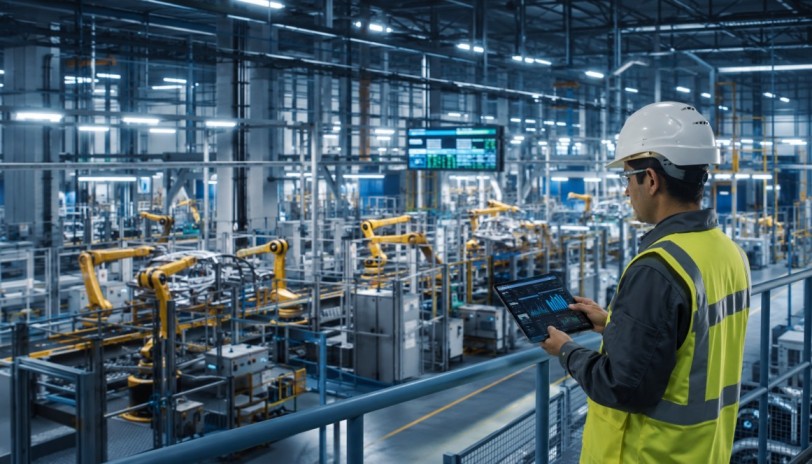
One of the most significant advantages of automation is the ability to provide complete operational visibility.
In traditional industrial environments, critical information is often scattered across multiple departments and disconnected systems. This lack of visibility can delay decision-making and increase the risk of operational inefficiencies.
Integrated automation platforms consolidate data from various sources and provide real-time insights into:
Equipment performance
Production efficiency
Resource consumption
Maintenance requirements
Process quality
Inventory levels
With access to centralized information, decision-makers can identify issues quickly, respond effectively, and make informed strategic decisions.
Improving Safety Through Intelligent Automation
Protecting personnel, assets, and critical processes has become a fundamental priority in modern industrial operations.
Many workplace incidents occur because hazards are not identified early enough or because response times are delayed. Intelligent automation systems continuously monitor critical conditions and automatically initiate protective measures when necessary.
These capabilities include:
Emergency shutdown systems
Fire and gas detection
Pressure relief activation
Hazard monitoring
Access control management
Alarm and notification systems
By responding to dangerous conditions in real time, automation significantly reduces operational risks and helps protect personnel, assets, and the environment.
This capability is particularly valuable in industries operating under challenging environmental and operational conditions.
Strengthening Business Continuity
Business continuity is an organization's ability to maintain critical operations and recover swiftly when unexpected disruptions threaten normal business activities.
Automation contributes to business continuity by enabling:
Remote Monitoring and Control
Operators can monitor and manage facilities from centralized locations, ensuring uninterrupted oversight of critical systems.
System Redundancy
Backup systems automatically activate when primary systems experience failures, minimizing operational interruptions.
Automated Reporting
Real-time information allows teams to make faster and more informed decisions during critical situations.
Faster Recovery
Automation systems provide detailed insights into operational events, helping organizations identify root causes and restore operations more efficiently.
As industrial facilities continue to adopt Industry 4.0 technologies, predictive maintenance and real-time monitoring are becoming essential components of resilience-focused strategies.
The Growing Importance of Energy Resilience
Energy efficiency has become a strategic priority across virtually every industry.
Rising energy costs, sustainability targets, and increasing demand are placing greater pressure on organizations to optimize their energy consumption.
Modern automation systems enable businesses to:
Monitor energy usage in real time
Identify inefficiencies and wastage
Optimize load balancing
Improve resource utilization
Support sustainability initiatives
Instead of relying on periodic energy assessments, organizations can continuously evaluate performance and implement improvements immediately.
This approach enables organizations to enhance operational efficiency, reduce costs, and advance their sustainability objectives simultaneously.
Building Supply Chain Stability Through Automation
Supply chain disruptions can significantly impact industrial performance and customer satisfaction.
Automation systems improve supply chain resilience by providing greater visibility and supporting proactive planning.
Organizations can monitor:
Inventory levels
Material movement
Production schedules
Equipment availability
Warehouse operations
Demand fluctuations
Access to real-time information enables companies to make faster decisions, reduce bottlenecks, and maintain operational continuity even during periods of uncertainty.
Industries Benefiting from Resilience-Focused Automation
Manufacturing
Manufacturers use automation to improve reliability, reduce downtime, and maintain consistent product quality.
Oil and Gas
Automation enhances safety, enables remote asset management, and improves operational efficiency.
Utilities
Water treatment facilities and power generation plants leverage intelligent automation to enhance operational reliability, optimize performance, and ensure uninterrupted service delivery.
Logistics and Warehousing
Distribution centers utilize automation to optimize inventory management and improve operational visibility.
Infrastructure and Smart Facilities
Automation enhances maintenance, improves energy efficiency, and optimizes system performance. Resilience has become an important performance indicator, ranking alongside productivity and growth in various industries.
The Future of Resilient Industrial Operations
Multiple emerging technologies are anticipated to further enhance industrial resilience in the coming years, including:
Artificial intelligence-powered diagnostics
Predictive analytics
Edge computing
Autonomous monitoring systems
Adaptive process control
Real-time operational intelligence
Digital twins and advanced simulation technologies
These innovations will enable industrial facilities to anticipate disruptions, respond effectively, and enhance performance. Organizations adopting intelligent automation now will be better prepared for future challenges and maintain a competitive edge.
Frequently Asked Questions
Q1. What is industrial resilience?
Industrial resilience refers to a facility's ability to withstand disruptions, maintain operations, and quickly recover from unexpected events.
Q2. How does automation improve resilience?
Automation improves resilience by enabling real-time monitoring, predictive maintenance, rapid decision-making, and faster responses to operational challenges.
Q3. Can automation reduce maintenance costs?
Yes. By identifying potential issues before failures occur, automation minimizes emergency repairs, reduces downtime, and extends equipment life.
Q4. Which industries benefit most from automation?
Manufacturing, oil and gas, utilities, logistics, food processing, warehousing, and infrastructure sectors all benefit from improved operational stability and visibility.
Is resilience the same as productivity?
No. Productivity focuses on efficiency and the amount of output produced, while resilience emphasizes stability, adaptability, and the ability to recover during disruptions.
Conclusion
In an increasingly interconnected industrial environment, resilience is becoming a defining factor in long-term competitiveness. Organizations that invest in intelligent automation gain more than operational efficiency—they build the capability to anticipate challenges, adapt to change, and maintain business continuity in uncertain conditions.
As the UAE continues its journey toward smart manufacturing and digital transformation, automation will remain a critical driver of resilient, sustainable, and future-ready industrial operations.