7 Factors That Determine Steel Rebar Price in India Today
-

- July 20th, 2026
- 46 views

FREE SEO Topical Map Generator: Find Your Next Content Ideas
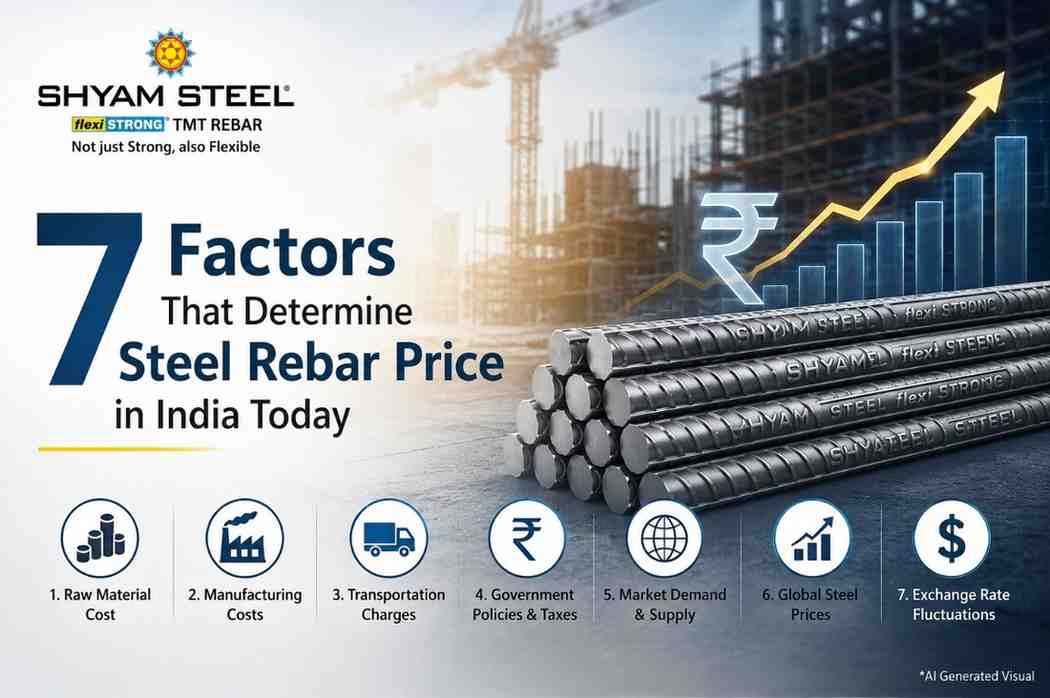
The price of steel rebar does not stay the same for long. And there are various reasons for that, like the costs of the materials used, how they are manufactured and transported, and finally, what the market demands.
If you're a homeowner and constructing your dream home, or managing an infrastructure project, understanding Shyam Steel TMT Rebar Prices will be useful in building a proper budget and making an informed purchase.
When you look up Shyam Steel TMT Rebar Prices, it is important to understand that investing in the best quality TMT rebars in India pays off over time. Lower initial costs are not always indicative of long-term performance.
Cost of Raw Materials
You need iron ore, coking coal, and scrap to produce reinforcement steel. These raw materials are traded worldwide, and the steel rebar price fluctuates depending on mining production, export demand, and global supply issues. When the price of iron ore or coking coal goes up, so does the TMT steel price per tonne.
In fact, that is the biggest factor that influences the price of steel rebar in India.
Some producers, such as Shyam Steel, have integrated plants and source their inputs internally. This allows them to control TMT steel prices per tonne to some extent, whereas smaller secondary steel producers who rely on the market are exposed to the full volatility.
Demand and Supply Cycles
Indian construction work follows a seasonal pattern. Work begins at construction sites after the monsoon season, and demand picks up. Only housing schemes by the government, expansion of highways and metro projects provide consistent demand over the year.
If steel demand exceeds the supply, the TMT steel price per tonne goes up. During the months of monsoon, site work almost comes to a stop, and prices per tonne often remain stable or sometimes fall slightly.
Government Policy and Taxation
The steel rebar price is also affected by GST rates, import duties on raw steel, anti-dumping rules, and much more. Any alteration in import policy can instantly make imported steel either cheaper or more expensive, indirectly determining how much local mills are able to charge for their products.
Furthermore, pollution and energy compliance in steel production contribute to significant expenses, which are ultimately passed on to consumers. Being up to date with these developments is useful if you are planning on purchasing steel for your major construction project.
Grade and Certification of the Rebar
There is also variation in TMT bar pricing because different TMT rebar grades, such as Fe 500, Fe 500D and Fe 550D, require different manufacturing techniques based on their elongation, strength and ductility. Shyam Steel Fe 550D TMT rebars, for instance, come with a minimum of 16.4% elongation with a UTS/YS ratio of 1.19, which means they are easier to bend and will resist seismic activity far better. Best quality TMT rebars like this demand precision in manufacturing, hence the increase in TMT steel price per tonne.
Manufacturing Process and Brand Reputation
There's a real difference between primary and secondary steel producers. Primary manufacturers like Shyam Steel use virgin iron ore, integrated plants and BIS-licensed processes, along with technologies developed by Concast AG, Zurich, and Thermex HSE, Germany. This ensures consistent chemistry, uniform microstructure, and dependable strength in every batch.
Secondary producers, working through induction furnaces without controlled chemistry, often show inconsistent quality.
This manufacturing difference justifies the Shyam Steel TMT bar price.
You're not just paying for steel; you're paying for the best quality TMT rebar in India and certified reliability that protects your structure for decades.
Logistics and Freight Costs
Steel is heavy, and moving it from plant to site isn't cheap. The distance from the manufacturing unit, transport infrastructure and fuel costs all affect the final steel rebar price.
Shyam Steel operates manufacturing units across Mejia, Angadpur, Bamunara, and Raghunathpur, with a combined production capacity of nearly 1.5 MTPA(Million tonnes per annum). This wide footprint across Eastern India, with an expanding presence in North and Central India, helps reduce freight distances for many buyers, which can lower the delivered steel rebar price compared to sourcing from elsewhere.
Order Quantity and Market Competition
Bulk orders usually attract better TMT steel pricing per tonne, since manufacturers save on dispatch and handling costs. Local market competition among dealers also plays a huge role. In cities with multiple authorised distributors, steel rebar prices tend to stay more competitive. This is another reason it pays to work with a manufacturer with an established retail and dealer network, so you're getting a fair, consistent steel rebar price rather than a marked-up rate from a local supplier.
Conclusion
The steel rebar price will always change with the market. What stays in your control is the quality of steel you choose. Choosing BIS-certified, primary-route TMT bars protects your investment even when prices fluctuate. Shyam Steel's Fe 550D rebars come with NABL-approved lab testing, GreenPro certification, and approvals from institutions like IOCL, NPCIL, BHEL, NHAI, and Metro Rail, giving you confidence that you're building with material trusted across India's biggest infrastructure projects.
Before your next purchase, check the current TMT steel price per tonne with your local Shyam Steel dealer, and ask for the mill test certificate.
A few minutes of verification today can save you years of structural worry tomorrow. For more details on Shyam Steel's TMT rebar range and pricing, visit www.shyamsteel.com.