Spray-On Bedliners: A Straight Answer on Cost, Durability, and What Actually Gets Sprayed
-

- August 03rd, 2026
- 26 views

FREE SEO Topical Map Generator: Find Your Next Content Ideas
The first scratch always stings the most. You spend a month babying a new truck, then a neighbor asks for help hauling a washing machine, and by the time you have unloaded it there is a bright silver gouge running down the middle of the bed floor. From that point on, the bed is just a tool. The question is whether you want that tool to rust out in six years or still be solid when you sell the truck.
Factory bed paint is thinner than most people assume. You are looking at somewhere around four to six mils of primer, base and clear over bare steel. That is roughly the thickness of a sheet of notebook paper. It was never engineered to survive gravel, cinder blocks, dog claws, or a snowmobile ski dragging across it in February.
Drop-In Liners Made Sense in 1995
Plastic drop-ins were the original fix, and plenty of trucks still have them. The problem is what happens underneath. Grit and water work their way between the plastic and the painted steel, and then the liner starts moving every time you hit a pothole. Now you have sandpaper trapped against your paint with no airflow to dry it out. I have pulled drop-ins off ten-year-old trucks and found rust perforation you could poke a finger through, while the outside of the truck still looked showroom clean.
They also rattle, they crack in cold weather, and cargo slides around on them like a hockey puck. That last part matters more than people admit. A sprayed liner grips a load. A drop-in launches it into the tailgate at the first hard stop.
What Actually Comes Out of the Gun
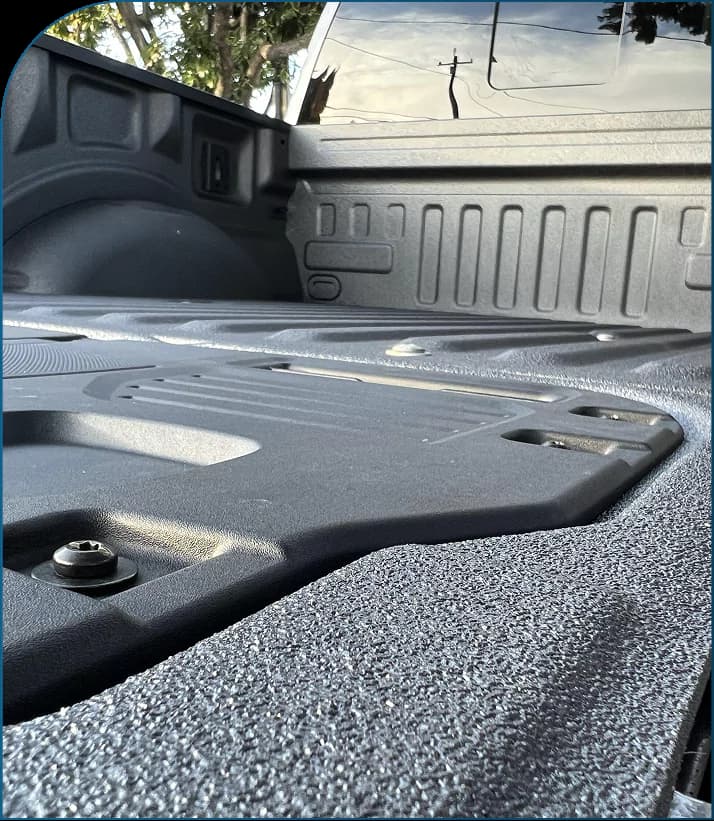
A sprayed liner is not paint and it is not truck bed roll-on from a hardware store can. It is a two-component elastomer, usually a polyurea, a polyurethane, or a hybrid blend of the two, heated to somewhere near 150 to 160 degrees and pushed through a proportioning rig at high pressure. The two sides do not meet until they hit the mixing chamber at the tip of the gun. From there you have a matter of seconds before the material gels.
That speed is exactly why a professional spray on bedliner holds up the way it does. The chemistry cross-links almost instantly, which builds a seamless membrane with real elongation to it, typically several hundred percent before tearing. Drop something heavy and the coating stretches and recovers instead of chipping. Most shops lay down 60 to 125 mils depending on the area, with the heaviest build on the floor and the tailgate top where abuse concentrates.
Polyurea cures fast and shrugs off moisture during application. Polyurethane tends to be a bit softer and better at absorbing impact. Hybrids sit in the middle, and honestly, most quality products on the market today are hybrids for exactly that reason.
Prep Work Decides Everything
Here is the part nobody photographs for the shop website, and it is the only part that predicts whether your liner is still stuck to the truck in five years.
The bed has to be sanded or ground to a dull, uniform profile. Every bit of wax, silicone, road tar and dealer sealant has to come off, then get wiped with solvent. Bolts, tie-down loops and bed lights come out. Everything else gets masked, and the masking line is the difference between a job that looks factory and one that looks like a weekend project. Many shops follow up with an adhesion promoter, particularly on aluminum beds, which behave very differently from steel and are far less forgiving of lazy prep.
Over the Rail or Under the Rail?
Over-the-rail means the coating wraps the bed caps and shows from outside the truck. It protects the rails from ladders and firewood, and it hides existing damage. Under-the-rail keeps the original painted caps visible for a cleaner factory look. Neither is wrong. If your truck works for a living, go over the rail. If it is mostly a daily driver, under the rail usually photographs better at resale.
What a Day at the Shop Looks Like
Plan on leaving the truck for most of a day. Prep and masking eat two to four hours. The actual spraying takes maybe twenty minutes for a full bed. The material is tack free within about thirty seconds and walkable in an hour. Most shops will let you drive away the same afternoon and ask you to wait a couple of days before loading anything heavy while the coating reaches full hardness.
Color, Texture, and the Sun Problem
Black is what almost everyone picks, but tinted liners in gray, tan, red and blue have gotten popular, especially on trucks with color-matched trim. Texture is adjustable too. A finer texture cleans easier and looks tidier; a coarser one gives cargo more bite.
One honest caveat: standard aromatic formulas will chalk and fade toward a lighter shade after a few seasons of direct sun. It is cosmetic, not structural. If it bothers you, ask for an aliphatic UV-stable topcoat, which holds color far longer and costs a little more. Colored liners in particular should always get one.
The Money Question
Expect roughly 450 to 750 dollars for a professionally sprayed bed, with regional variation and a bit more for extended cabs, over-the-rail coverage, custom color, or a UV topcoat. Reputable installers back the work with a lifetime warranty against peeling, cracking and bubbling, and the good ones make that warranty transferable to the next owner.
Be skeptical of a shop quoting well under that range. Cutting price usually means cutting mil thickness or cutting prep, and both failures show up the same way: a bubble near the wheel well that turns into a peeling flap by year three.
It Does Not Have to Stop at the Bed
The same material goes on rocker panels, wheel wells, bumpers, running boards, Jeep tubs, trailer decks, toolboxes, horse trailers, and boat interiors. Plenty of owners spray the lower six inches of the body on trucks that see salted winter roads. Once you have watched what this stuff survives, you start looking around the driveway for other things to coat.
Living With It
Maintenance is close to nothing. Hose it out, hit it with a degreaser when something spills, pressure wash it if you like. It handles fuel, oil, battery acid and most solvents without complaint. A UV protectant wipe-down once or twice a year keeps the black looking deep. If you ever gouge it badly, a shop can scuff and respray that section and blend it in.
So Is It Worth It?
If your bed never carries anything heavier than groceries, probably not. For everyone else, it is one of the few truck upgrades that pays you back twice: once in the years you actually use the truck without wincing, and again when a buyer looks in the bed and sees clean coating instead of rust and bare metal. Get it done before the damage starts, not after. Prep on a rusty bed is a much longer and more expensive conversation.