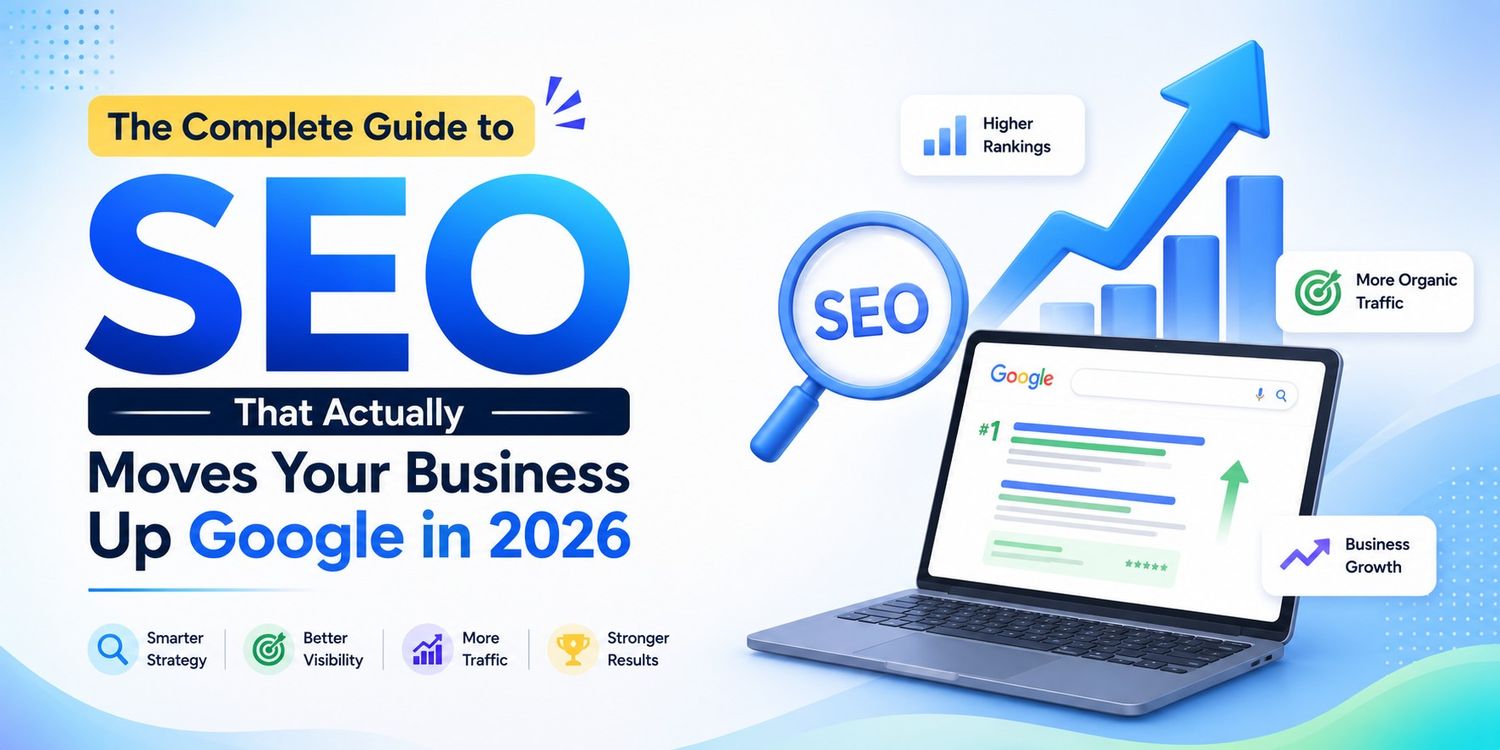
The Complete Guide to SEO That Actually Moves Your Business Up Google in 2026
-

- June 23rd, 2026
- 67 views

FREE SEO Topical Map Generator: Find Your Next Content Ideas
If you've heard that SEO takes time, that's true. However, "taking time" often becomes an excuse for slow progress, unclear strategy, and results that don't happen. The reality is that effective SEO services, when handled by skilled professionals, bring some of the most lasting and cost-effective growth for a business. The traffic it generates doesn't just stop when you cut the budget. The authority it creates builds up over time. The customers it brings in are often the most valuable ones, actively searching for exactly what you provide.
The real question isn't whether SEO works; it does. The question is whether what you're doing counts as actual SEO or if it's just a mix of tasks that seem like SEO from a distance but lack the strategy needed to improve rankings.
This guide explains what proper SEO looks like in 2026 in all key areas: technical, local, e-commerce, and organic content. If you've ever wondered why your website isn't improving despite your efforts, the answer is likely in one of these areas.
Why Most SEO Efforts Stall Before They Deliver
Businesses that struggle with SEO often share a common pattern. They do some things well on their own but lack a connected approach that brings those efforts together. They publish blog posts without a keyword strategy. They fix a few technical issues without fully auditing the site. They build some links without checking if they're the right links from the right sources. Each activity has some value, but none of it adds up as it should.
Google's algorithm in 2026 is smart enough to reward coherence. A site that shows genuine topical authority, like thorough coverage of a subject, good technical health, and strong signs of trust and relevance, will outperform one that only does isolated SEO tasks, no matter how carefully. This is why expert SEO services focus on creating that coherence instead of just performing tactics separately.
According to a 2025 BrightEdge research report, Organic search drives 53% of all website traffic across industries, surpassing paid search, social, and all other channels combined. Businesses that treat SEO as a secondary priority are leaving most of their potential traffic behind.
The Four Dimensions of SEO That All Need to Work Together
SEO involves several areas that are distinct yet deeply connected. Most businesses manage at least one of these areas reasonably well. However, very few have all four working together, and that's where the biggest improvements can be found. Here’s what each area entails and why they don’t work as effectively on their own compared to as part of a whole.
1. Technical SEO
Technical SEO is the least visible aspect of the discipline and the area that many businesses overlook. It’s not about the content your audience reads or the keywords you target. It’s the foundational structure of your website that decides whether Google can crawl, understand, and trust it. Get this wrong, and all other SEO efforts are compromised from the start.
Proper technical SEO services cover a wide range of considerations: site speed and Core Web Vitals performance, crawl budget management for large sites, canonicalization to prevent duplicate content from diluting ranking signals, structured data markup that helps Google understand what's on each page, mobile usability, HTTPS security, internal linking architecture, and XML sitemap health. None of these individually are glamorous. Together, they form the infrastructure that allows a site to compete.
The businesses that invest in technical SEO services consistently find issues they didn't know existed, pages that were accidentally blocked from Google, redirect chains slowing the site down, duplicate content created by faceted navigation, or Core Web Vitals scores low enough to trigger ranking penalties. Fixing these doesn't just improve SEO; it improves the experience for every visitor who lands on the site, which compounds the benefit further.
2. Organic SEO
Organic SEO is what most people picture when they think about search engine optimization, the strategy of creating content that ranks for the terms your audience is searching for, earning links from credible sources, and building the kind of topical authority that makes Google increasingly confident in surfacing your site for relevant queries.
The organic SEO experts who deliver consistent results in 2026 are not the ones producing the most content; they're the ones producing the most strategically considered content. That means starting with rigorous keyword and intent research: understanding not just what terms people search for, but what they're actually trying to accomplish when they search. A search for "best project management software" signals a very different intent from "how to manage a remote team," and the content that ranks for each needs to be built accordingly.
It also means building links with the same level of intentionality. Not volume for its own sake, but relevance and authority, links from sites that Google already trusts, in contexts that are genuinely related to your subject matter. A single link from a respected industry publication does more for rankings than fifty links from directories nobody reads. This is a distinction that separates organic SEO experts from those who are simply executing link-building activities at volume.
3. Local SEO
For businesses that serve a specific geographic area (whether that's a single city, a region, or a network of physical locations), local SEO is its own discipline with its own ranking signals and its own opportunities. Appearing at the top of Google when someone nearby searches for what you offer is one of the highest-value positions in digital marketing, and it's one that a good local SEO company can help you achieve more reliably than most businesses manage on their own.
Local SEO in 2026 centers on a few key areas. Google Business Profile optimization is the most immediate lever; a well-maintained profile with accurate information, regular posts, consistent review management, and properly categorized services has a direct and measurable impact on local pack rankings. Beyond that, local citation consistency (ensuring your business name, address, and phone number are consistent across every directory and platform where you appear), locally relevant content, and location-specific landing pages all contribute to the signals Google uses to determine which businesses to show for local searches.
The stakes here are significant. A 2024 Google Consumer Insights study found that 76% of people who search for something nearby on their smartphone visit a related business within a day, and 28% of those searches result in a purchase. For any business with a physical presence or a local service area, that conversion pathway is too valuable to leave to chance.
4. Ecommerce SEO
For businesses selling products online, SEO isn't just a traffic strategy; it's a revenue channel with a directly traceable return. And ecommerce SEO services are a genuinely distinct specialization, because the challenges of ranking an online store are meaningfully different from those of ranking a service business or a content site.
Ecommerce sites face a specific set of SEO obstacles. Large product catalogues create crawl budget challenges and duplicate content risks. Category pages (which are often the highest-value ranking targets) are frequently under-optimized because the focus goes entirely to product pages. Faceted navigation (the filters that allow customers to sort by size, color, price, and so on) can generate thousands of thin, near-duplicate URLs that confuse search engines and dilute ranking signals. And seasonal inventory changes mean that pages appear and disappear in ways that need to be managed carefully to preserve any SEO equity they've built.
Proper ecommerce SEO services address all of this systematically, building category page content strategies that target high-intent commercial queries, managing technical infrastructure to ensure crawl efficiency, developing product page optimization frameworks that scale across large catalogs, and building the kind of authoritative backlink profiles that help category pages compete in crowded markets. For online retailers operating in competitive niches, the difference between page one and page two on a high-volume product category search is the difference between a thriving channel and an invisible one.
What to look for in an SEO partner
The SEO industry has a transparency problem. It's easier to sell SEO than almost any other marketing service because the results take time to materialize and the work is largely invisible to the client. This creates conditions where a lot of activity can be presented as progress without any genuine movement in rankings, traffic, or revenue.
Expert SEO services are distinguished from average ones by a few consistent characteristics. They start with a thorough audit before making any recommendations, not a template report generated in ten minutes, but a genuine investigation into the specific issues and opportunities on your site. They set realistic timelines and explain the reasoning behind them. They report on metrics that connect to business outcomes (organic traffic, keyword ranking improvements, conversion rates from organic search) rather than vanity metrics that sound impressive but don't mean much.
They also communicate clearly about what they're doing and why. SEO is not a black box, and any provider who treats it as one (who is vague about their methods, resistant to explaining their strategy, or unable to show you what work was done each month) should give you pause. The best SEO partners are educators as much as executors. They want you to understand what's happening with your site and why, because an informed client makes better decisions and a better long-term partner.
How Long Does SEO Actually Take?
This is the question every business asks, and the honest answer is: it depends, but not as much as you might think. For sites with significant technical issues, the first few months of work are largely about fixing foundations, and those fixes can produce relatively quick improvements once Google re-crawls and re-evaluates the site. For newer sites in competitive niches, building the authority needed to rank for high-value terms takes longer, typically six to twelve months before significant organic traffic materializes.
What doesn't vary is the compounding nature of the return. Paid advertising stops delivering the moment you stop paying. Organic rankings, built properly, persist and strengthen over time. A well-optimized page that earns strong rankings and quality backlinks can generate traffic for years with relatively modest ongoing maintenance. That long-term ROI profile is exactly why expert SEO services represent one of the highest-value marketing investments a business can make, not despite the time it takes, but in part because of it. The businesses that commit early and stay consistent are the ones that end up in positions their competitors find very difficult to displace.
Final Thoughts
SEO in 2026 is more sophisticated than it has ever been, which means the gap between businesses doing it properly and those doing it halfway has never been wider. Google's ability to evaluate content quality, technical health, topical authority, and user experience signals has improved dramatically, and it rewards the businesses that take all of those dimensions seriously.
Whether you need to fix the technical foundations, build local visibility, grow organic authority, or unlock the full potential of an e-commerce catalog, partnering with a local SEO company like WebGuruz that understands all of these dimensions (not just one) is the decision that tends to make everything else click into place. Strategy, consistency, and genuine expertise applied over time. That's what moves businesses up Google. Everything else is just noise.