
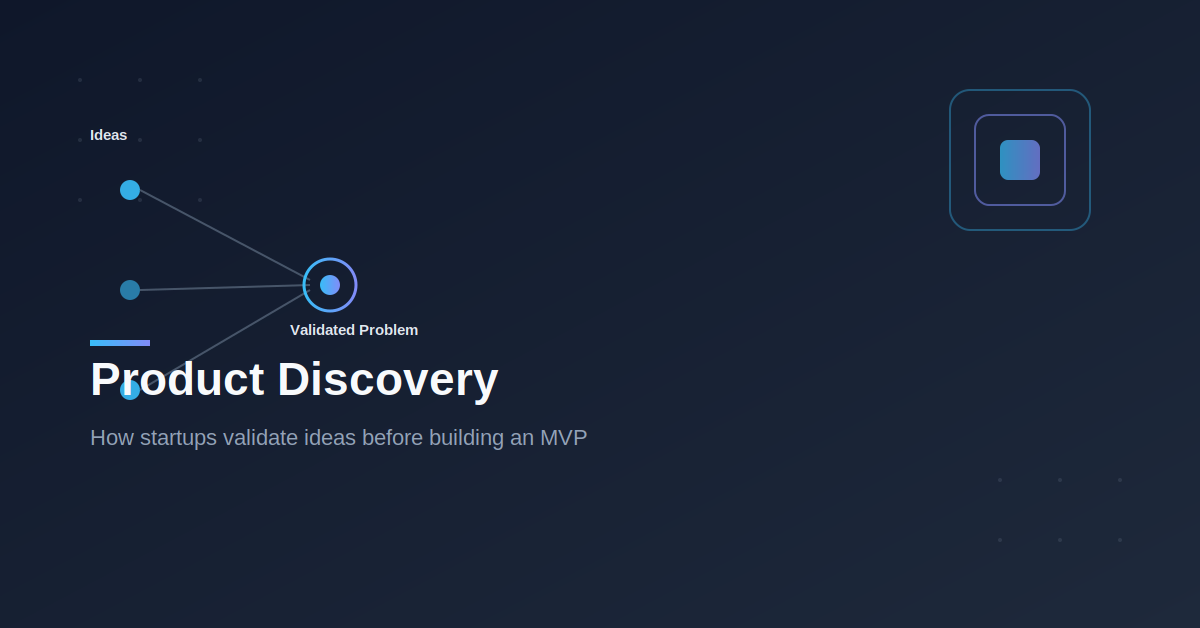
Product Discovery: How Startups Validate Ideas Before Building an MVP
-
- August 03rd, 2026
- 39 views

FREE SEO Topical Map Generator: Find Your Next Content Ideas
Most startups don't fail because they built the wrong product. They fail because they built before they understood the problem. That gap, between having an idea and actually knowing it's worth building, is where product discovery comes in.
If you're a founder planning your first MVP development sprint, skipping discovery is one of the costliest mistakes you can make. This guide breaks down what product discovery actually means, why it has to happen before you write any code, and the practical methods founders use to validate ideas cheaply.
What Is Product Discovery?
Product discovery is the process of testing whether an idea is worth building, before you spend a dollar on development. It answers three core questions:
Is this a real problem people have?
Will they pay to solve it?
Can we build a solution that actually works for them, in a way they'll adopt?
Skip these questions, and you're betting your runway on assumptions instead of evidence. That's the single biggest reason early-stage startups burn through their budget with nothing usable to show for it.
Why Product Discovery Happens Before the MVP, Not After
Founders often confuse product discovery with building an MVP. They are not the same thing, and mixing them up is where a lot of wasted development time comes from.
An MVP tests your solution. Product discovery tests your problem.
If you jump straight into building without discovery, you're assuming you already know what users want. Product discovery replaces that assumption with real evidence, before development costs start piling up. It's far cheaper to learn you're solving the wrong problem in week two of interviews than in month three of development.
Core Product Discovery Methods
Customer interviews. Talk to 15-20 people in your target market. Ask about their current workarounds and daily frustrations, not your solution idea directly. Let them describe the problem in their own words, without leading them toward the answer you want to hear.
Landing page tests. Build a simple page describing your proposed solution, then run a small ad budget to see if people actually sign up or click through. Real intent, measured by action, beats hypothetical interest measured by opinion.
Concierge testing. Manually deliver your solution to a handful of users before building any software at all. If a spreadsheet, a phone call, or a manual process can solve the problem for a small group, you've validated real demand without writing a single line of code.
Prototype testing. Use clickable mockups in tools like Figma to walk users through your proposed solution. Watch closely where they hesitate, get confused, or ask questions you didn't expect. This tells you exactly what to simplify or fix before development begins.
Competitive and workaround analysis. Look at how people currently solve this problem, whether through a competitor's tool, a spreadsheet, or a manual process. Understanding the existing alternative tells you what bar your solution actually needs to clear.
How to Know When Discovery Is Done
Discovery isn't a fixed-length phase with a set deadline. It's done when you can confidently answer:
Who exactly has this problem, and how badly do they feel it?
How are they solving it today, and what's frustrating about that solution?
What would actually make them switch to something new?
What's the smallest version of your solution that solves their core problem?
Once you can answer these with real evidence instead of guesses, you're ready to scope your MVP with confidence.
A Common Mistake: Treating Discovery as a Delay
Founders under pressure to ship often treat discovery as something slowing them down. In practice, it's the opposite. Every week spent validating a real problem saves months spent fixing a product built on the wrong assumption.
The startups that move fastest over the long run are usually the ones that spent a few focused weeks in discovery before writing any code, not the ones that skipped straight to development.
Discovery Doesn't Stop at Launch
Product discovery isn't a phase you complete once and forget about. It continues well into your MVP stage and beyond, as you keep testing assumptions against real user behavior, usage data, and feedback.
Get the discovery phase right, and your entire development process becomes dramatically more focused. You stop guessing what to build, and start building what you already know people want, need, and will actually use, which is ultimately what separates products that gain traction from ones that quietly fade out after launch.