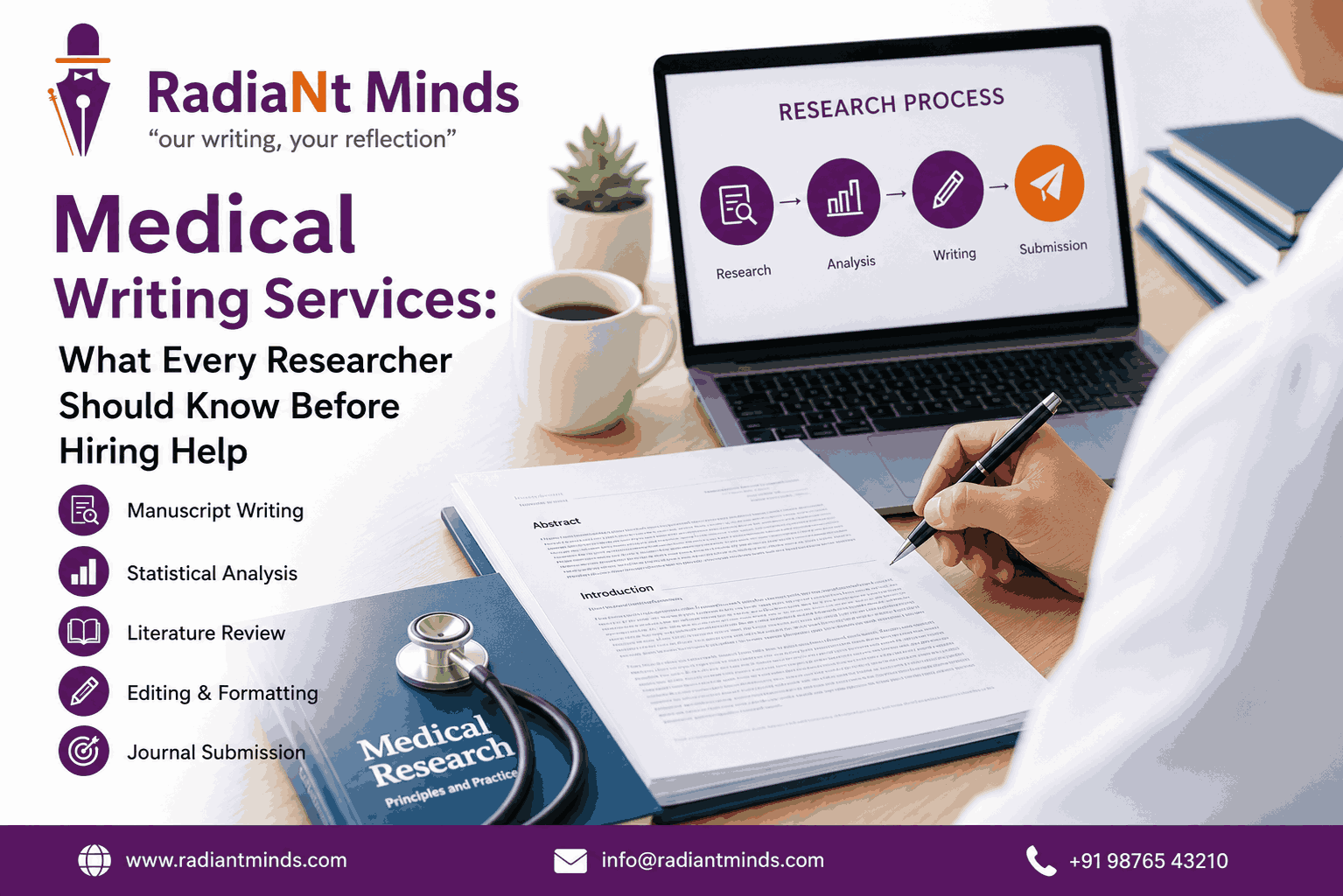
Medical Writing Services: What Every Researcher Should Know Before Hiring Help
-

- July 06th, 2026
- 31 views

FREE SEO Topical Map Generator: Find Your Next Content Ideas
Writing a research paper is rarely the hard part for most doctors and scholars. Explaining it clearly is. Every year, thousands of well-designed studies get rejected by journals not because the science was weak, but because the manuscript failed to communicate it properly. That's the exact gap that medical writing services are built to close. Whether it's a thesis chapter, a manuscript, or a statistical report, professional support turns raw research into publication-ready work. Agencies such as Radiant Minds have built their entire practice around solving this one problem for researchers who'd rather focus on their data than their grammar.
What Medical Writing Services Actually Cover
The term sounds narrow, but the scope is wide. It typically includes:
Manuscript and article writing: structuring findings into the IMRaD format journals expect
Thesis and dissertation support: for MD, MS, and PhD candidates working under tight academic deadlines
Statistical analysis: running and interpreting tests like ANOVA, regression, or chi-square where needed
Literature reviews: summarizing existing research without drifting into plagiarism
Journal selection and submission guidance: matching a paper to journals where it has a real chance of acceptance
Language and technical editing: fixing clarity, tone, and formatting to match journal style guides
A good provider doesn't just polish sentences. They understand how reviewers think, which is why rejection rates drop noticeably once a manuscript passes through experienced hands.
Why This Isn't Just "Editing"
There's a common misconception that hiring outside help means someone else writes your research for you. In practice, ethical medical writing services work the opposite way. They take a researcher's raw data, notes, and conclusions, and shape them into a document that meets academic and journal standards without changing the underlying science. The researcher remains the author and the intellectual owner; the writer is simply translating findings into the language journals recognize.
This distinction matters for another reason: publication ethics. Reputable agencies follow ICMJE authorship guidelines and disclose writing assistance where required, rather than ghostwriting content that misrepresents who did the work.
The Real Cost of Doing It Alone
Clinicians and PhD scholars are trained to conduct research, not necessarily to write for an international audience under a 3,500-word limit with a specific citation style. Left alone, many strong studies end up:
Rejected on formatting or clarity grounds before a reviewer even reaches the methodology
Delayed by months due to repeated revision cycles
Weakened by statistical errors that a trained analyst would have caught early
This is where medical writing services add measurable value, not by inflating the research, but by removing the communication barrier between good data and a published paper.
What to Look for Before Hiring a Provider
Not every writing service is equal, and the medical field leaves little room for error. A few checks worth doing before signing up:
1. Subject-matter background. Ask whether writers assigned to your paper have a medical or life-sciences background, not a generic content-writing one.
2. Statistical competence. If your paper needs analysis, confirm the team can run and explain the tests themselves, not just format existing numbers.
3. Journal-specific experience. A provider familiar with target journals' submission norms saves rounds of desk rejection.
4. Transparent revision policy. Look for services offering revisions without hidden charges, since first drafts rarely match every reviewer's expectations.
5. Confidentiality practices. Unpublished data is sensitive; a credible provider should have clear data-handling and non-disclosure practices in place.
Teams like Radiant Minds, based in Ahmedabad, structure their process around these exact checkpoints: a review team, a dedicated writing team, and a separate editing team. That way, no single person handles a paper from start to finish without a second set of eyes checking it.
A Quick Example
Consider a resident submitting their first case report. The clinical observation is genuinely novel, but the draft runs long, lacks a structured discussion section, and misses the target journal's referencing style. A medical writing service wouldn't rewrite the clinical finding. It would restructure the discussion around existing literature, tighten the language, and align formatting with the journal's author guidelines. The science stays exactly the same; the odds of acceptance improve because the presentation finally matches what reviewers expect to see.
Final Thoughts
Medical writing services exist because research and writing are two different skills, and few people are equally strong at both. For researchers juggling clinical duties, coursework, or lab work, outsourcing the writing and formatting side isn't a shortcut. It's a practical way to make sure good research actually reaches publication. Providers like Radiant Minds have built dedicated teams around exactly this need, helping researchers move from raw findings to a submission-ready manuscript without compromising the integrity of the work itself.
If you're a researcher weighing whether to seek this kind of support, the questions above are a reasonable starting point: ask about subject expertise, statistical skill, and transparency before committing to any provider.