Most LinkedIn Advice Focuses on the Wrong Section
-

- July 23rd, 2026
- 25 views

FREE SEO Topical Map Generator: Find Your Next Content Ideas
Search for LinkedIn tips and most of what comes back focuses on the profile photo, the banner image, or writing a punchier headline. These aren't wrong to fix, but they're rarely what actually determines whether a profile surfaces in a recruiter's search in the first place. This is the gap a linkedin profile optimization service tends to focus on instead — the structural, searchable elements that get far less attention than the cosmetic ones.
Why Cosmetic Fixes Get Disproportionate Attention
A better photo or a catchier headline is easy to evaluate at a glance, which makes it an easy piece of advice to give and to act on. Whether a profile's skills section actually aligns with the roles a recruiter is searching for is a much less visible problem, and harder to diagnose without understanding how LinkedIn's search and filtering actually works behind the scenes. It's simply easier to advise "use a better photo" than to explain keyword alignment, even though the latter tends to matter more for actual visibility.
This isn't unique to LinkedIn advice specifically — it's a common pattern anywhere feedback is easy to give quickly. A photo can be judged in half a second; a search-visibility problem requires understanding how filtering algorithms actually behave, which takes more effort to explain and more effort to diagnose. The quick, visible fix tends to crowd out the slower, less visible one, even when the slower fix matters more.
What Actually Drives Search Visibility
Recruiters filter LinkedIn using keywords tied to skills, titles, and industry terms, in a process that has more in common with a resume passing through an applicant tracking system than with a human casually browsing profiles. A profile with an appealing photo and a weak, generic skills section can still be functionally invisible to the exact searches it should be surfacing in. Conversely, a profile with a plain photo but tightly aligned skills, headline, and summary language will often surface in far more relevant searches, regardless of how polished it looks cosmetically.
This distinction matters because it reframes what "optimization" should actually mean. A profile isn't primarily being judged on appearance by an algorithm — it's being matched against search terms. Appearance only becomes relevant once a human has already found the profile through that matching process, which means visibility has to come first, structurally, before appearance has any chance to matter at all.
Where the Real Optimization Work Happens
Meaningful LinkedIn optimization tends to focus on less visible, more structural elements: aligning the skills section with actual target roles, ensuring the headline and summary use the specific language recruiters search for rather than generic self-description, and keeping experience descriptions detailed enough to match relevant search terms. None of this shows up as clearly in a two-second glance at a profile, which is exactly why it gets less attention in casual advice, despite mattering more for actual outcomes.
This kind of work also requires a level of specificity that generic advice rarely provides. "Use relevant keywords" is technically correct but not actionable on its own — the real work is identifying which specific keywords matter for a given role and industry, then making sure they appear naturally and consistently throughout the profile rather than as an afterthought.
Why Cosmetic and Structural Fixes Aren't Interchangeable
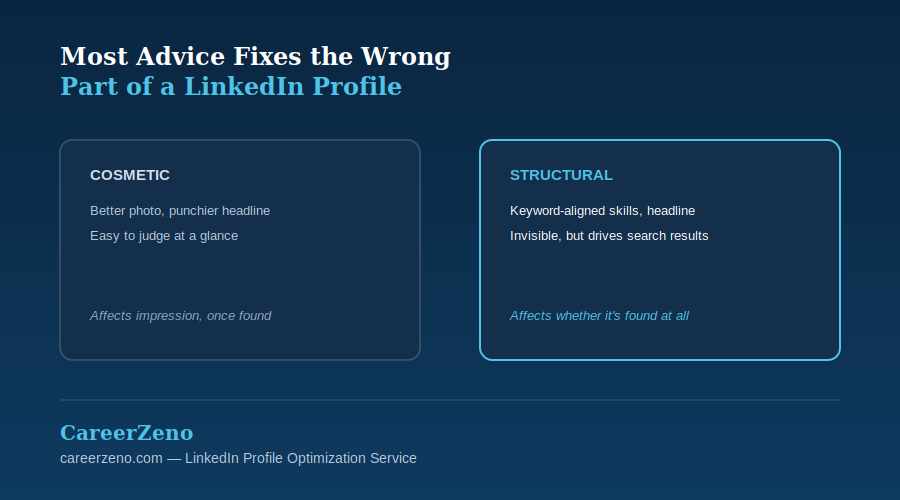
A polished photo and a well-aligned skills section solve two entirely different problems, and neither substitutes for the other. Cosmetic elements affect how a profile is perceived once a person is already looking at it. Structural elements affect whether that person ever lands on the profile at all. A profile can look excellent and still be functionally absent from the searches that matter most, simply because the underlying language was never built with those searches in mind.
This is why cosmetic-only advice, however well-intentioned, tends to plateau. Improving a photo or headline might make a profile more appealing to whoever happens to view it, but it does nothing to increase how often that viewing actually happens in the first place. Both layers matter, but only one of them determines whether the other ever gets seen. Treating them as interchangeable — fixing only the visible layer and assuming visibility will follow — is one of the more common and costly mistakes in how people approach their own profiles.
CareerZeno focuses specifically on these less visible, higher-impact elements — the parts of a profile that actually determine whether it gets found, not just how it looks once someone lands on it.
A great photo helps a profile look good to someone already viewing it. Search-aligned language is what gets a profile viewed in the first place.