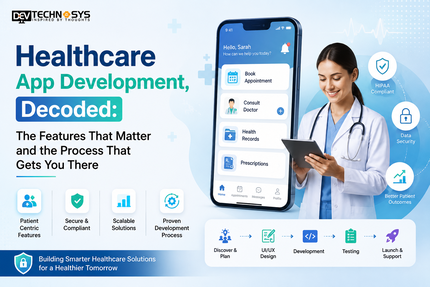
Healthcare App Development, Decoded: The Features That Matter and the Process That Gets You There
-

- July 28th, 2026
- 35 views

FREE SEO Topical Map Generator: Find Your Next Content Ideas
Most healthcare app ideas start the same way: a clear picture of the finished product and almost no picture of what it takes to get there safely. That gap is where most projects either stall, blow their budget, or launch something that technically works but can't legally scale. Healthcare app development isn't hard because the features are complicated — most of them aren't. It's hard because every feature sits on top of regulatory, security, and clinical constraints that don't show up until you're already building.
Here's what the actual process looks like, and which features genuinely earn their place in a first build.
The Process, Stage by Stage
Discovery and regulatory scoping. Before a single screen gets designed, the real first step is figuring out what kind of healthcare app this actually is, legally. A symptom tracker, a telehealth platform, and a full EMR system all carry wildly different compliance burdens — HIPAA in the US, GDPR in Europe, or country-specific health data regulations elsewhere. Skipping this step doesn't save time; it just moves the cost to later, when it's more expensive to fix.
Data architecture design. Healthcare apps live or die on how patient data is structured, stored, and secured — and this needs to happen before development starts, not as an afterthought. Decisions about encryption, access control, and audit logging shape the entire technical foundation, and retrofitting them into a half-built app is far more expensive than designing around them from day one.
Core build and integration. This is the stage most people picture when they think "development" — but in healthcare, a huge portion of it is integration work, not new feature-building. Connecting to EHR systems, lab data providers, pharmacy networks, or wearable device APIs often takes longer than the app's own core functionality, because each integration comes with its own data format, authentication method, and reliability quirks.
Clinical and compliance testing. Beyond standard QA, healthcare apps need testing against real regulatory requirements — does the audit trail actually capture what's required, does the consent flow meet legal standards, does the data retention policy hold up. This stage catches the kind of gaps that don't show up in a normal bug hunt but absolutely show up in an audit.
Launch and post-launch monitoring. Healthcare apps don't get to treat launch as the finish line. Regulations shift, security threats evolve, and clinical guidelines change — a launched app needs ongoing monitoring and maintenance built into the plan from the start, not bolted on once something breaks.
Features That Actually Matter
Secure user authentication and access control. Multi-factor authentication and role-based access aren't optional extras — they're foundational, especially for apps handling any clinical data. A patient's login shouldn't have the same access level as a clinician's.
Data encryption, in transit and at rest. This is table stakes for any healthcare app, not a differentiator. What matters more is whether the encryption approach was designed into the architecture from the start or added later — the difference shows up during audits and breach investigations.
Appointment scheduling and reminders. Simple on paper, but the real complexity is in handling time zones, provider availability syncing, and reliable notification delivery — the parts that quietly determine whether patients actually show up.
Secure messaging between patients and providers. This needs to be genuinely secure, not just password-protected — encrypted, logged, and compliant with whatever regulatory framework applies to the app's region.
Telehealth/video consultation capability. Where relevant, this needs to handle real-world conditions — spotty connections, older devices, and varying bandwidth — gracefully, not just work in ideal test conditions.
Health record access and data portability. Patients increasingly expect to see and export their own data. Building this in from the start avoids a much harder retrofit later, and in some regions, it's becoming a legal expectation rather than a nice-to-have.
Prescription and medication management. For apps that touch this space, drug-interaction checking and refill reminders add real clinical value — but they also raise the compliance bar significantly, since incorrect medication guidance carries real patient-safety risk.
Features Worth Holding Off On
Not every healthcare app needs AI-driven diagnostics, wearable integration, or predictive risk scoring in its first version. These are genuinely valuable additions once there's real usage data to build on, but adding them before the core product is stable and compliant tends to slow everything down without proportional benefit. A healthcare app with five solid, secure, well-tested features beats one with fifteen half-finished ones every time — and in this category specifically, "half-finished" can mean a real compliance gap, not just a rough edge.
The Hidden Costs That Show Up After Launch
A few line items rarely make it into the initial planning conversation but reliably show up later.
Ongoing compliance monitoring. Regulations don't stay static, and a healthcare app that was compliant at launch can quietly drift out of compliance as rules change. Budgeting for periodic compliance review, not just a one-time certification, avoids an unpleasant surprise down the line.
Third-party API costs at scale. Lab data providers, pharmacy networks, and telehealth infrastructure often charge per-use or per-integration, and those costs scale with adoption in ways that are easy to underestimate during initial planning.
App store review friction. Health-related apps face stricter review on both major app stores than typical consumer apps, particularly around data handling disclosures. Building in buffer time for review cycles — and possible rejections requiring documentation fixes — keeps launch dates realistic.
Where Healthcare App Development Timelines Actually Go Wrong
The most common planning mistake isn't underestimating the engineering work — it's underestimating the regulatory and integration timelines running alongside it. Teams that treat compliance review, data architecture decisions, and third-party integrations as sequential steps after the "real" development work end up with a technically finished app that still can't legally launch. Building these tracks in parallel from day one is what actually keeps a realistic timeline realistic.
The Bottom Line
Healthcare app development isn't harder because the feature list is long — it's harder because every feature on that list touches something regulated, something clinical, or something a patient is trusting the app to get right. The process that actually works treats compliance and security as part of the architecture from day one, not a review step at the end, and the feature set that actually works starts small, solid, and genuinely secure — everything else can come later, once the foundation has already proven it can hold real patient trust.