National Handloom Day 2026 What 50+ Artisan Families Want You to Know About Your Bedsheet
-

- July 03rd, 2026
- 19 views

FREE SEO Topical Map Generator: Find Your Next Content Ideas
August 7 is National Handloom Day in India. It was declared in 2015 to mark the launch of the Swadeshi Movement in 1905 the same movement that put handloom weaving at the centre of India's identity and economic independence.
In 2026, the date matters for a different reason. Handloom weaving is still alive, still producing some of the best fabric made anywhere in India but the families doing the work are smaller in number every year, and the reasons are straightforward enough that anyone can understand them.
TheIndiGlobal works with over 50 artisan families across Rajasthan, Uttar Pradesh, South India, and Maharashtra. This is what those families want buyers to know not as a marketing pitch, but as a practical reality that affects every bedsheet purchase.
The Bedsheet You Buy Either Supports a Weaver or It Doesn't There Is No Middle Ground
Most bedsheets sold online in India today are machine-made. The listing might say "cotton" or even "handloom cotton" but unless the seller can tell you which weaving cluster made it, which state it came from, and what the GSM is, it was almost certainly made on a power loom or jacquard machine.
This matters because the money from a machine-made bedsheet goes to a factory, not a weaver. And the weaver's family who has spent decades learning a skill that takes years to master earns nothing from that sale.
When you buy a genuine handloom bedsheet, the math is different. The money moves directly toward the person who made it. Not entirely there are costs at every step but meaningfully more than what happens with a factory-made product.
That's the first thing artisan families want buyers to understand. The purchase decision is not neutral. It goes somewhere specific.
What Handloom Weaving Actually Involves Most People Have No Idea
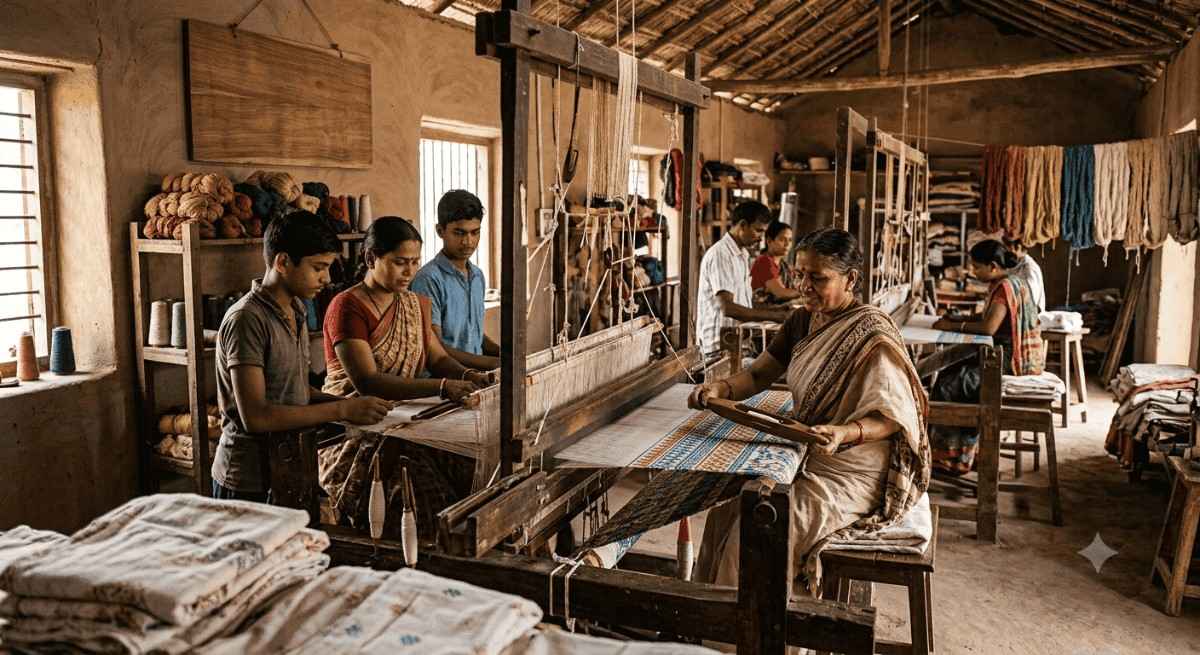
A handloom pit loom is a manually operated wooden frame. The weaver sits at it sometimes in a pit below floor level, sometimes at ground level depending on the loom type and passes thread across the warp by hand, one line at a time, using a shuttle.
A single double bedsheet takes 6–8 hours to weave this way.
That's one person, one loom, one full working day, for one bedsheet.
The thread has to be set up first a process called warping that can take hours by itself. The colour, if it's a dyed yarn, was prepared separately. If it's hand block printed, that's a separate artisan with a separate process applying colour using carved wooden blocks, one colour at a time, some of those blocks over 150 years old and passed down through families.
What comes out the other end is not just a piece of fabric. It's the output of multiple skilled people, each doing something that takes years to learn well.
Compare that to a power loom which produces the same size fabric in under 10 minutes.
This is why genuine handloom costs more. Not because of a brand margin. Because of time.
Why the Next Generation Is Walking Away The Real Problem
Here's the honest version of what's happening in weaving families across India right now.
A son or daughter grows up watching their parent weave. They learn the basics. By the time they're in their late teens, they understand the craft well enough to do it. But they also understand the economics.
A skilled weaver producing handloom bedsheets earns from their output. If demand is low which it is when buyers choose machine-made alternatives the income is inconsistent and often lower than what a factory job or a basic city job pays for less skilled work.
So the choice becomes: stay and weave for uncertain income, or leave and take a job that pays more reliably.
Most of them leave. Not because they don't value the craft. Because the math doesn't work.
This is happening in weaving clusters across Rajasthan, UP, South India, and Maharashtra not as an abstract trend, but in specific families that TheIndiGlobal works with directly.
The craft doesn't disappear overnight. It disappears one family at a time, one generation at a time, quietly.
What's Different About Handloom Fabric The Part That Actually Affects You
This is not just a social impact story. There are real, practical reasons why a handloom cotton bedsheet is a better product than a machine-made alternative at the same price point.
Breathability
Manual weaving creates natural air pockets between threads because each thread is placed under individual hand tension. These air pockets allow heat to escape and air to circulate. Machine weaving compresses threads under mechanical tension the pockets don't form the same way. This is why a 245 GSM handloom cotton sheet sleeps cooler than a machine-woven cotton sheet at the same GSM, particularly in Indian summers.
Durability
The tighter, more consistent interlacing of hand-woven fabric holds up better under repeated washing. A handloom cotton bedsheet washed correctly lasts 4–6 years. Most machine-made cotton bedsheets at comparable price points last 18–24 months before thinning or pilling noticeably.
What happens with washing
Machine-made bedsheets often feel soft when new because of chemical finishing agents applied during manufacturing. This finish washes out usually within 5–10 washes and the sheet underneath is rougher than it appeared. Handloom cotton has no such finish. It starts slightly textured and softens gradually with every wash, permanently, because the softness comes from the fibre relaxing, not from a coating wearing off.
The Difference Between Real Handloom and Fake Handloom
This is something artisan families are particularly frustrated by products marketed as "handloom" that are not.
Here's how to tell:
Sign |
Real Handloom |
Machine-Made Fake |
Texture |
Slightly uneven, natural variation |
Perfectly uniform |
Selvedge (fabric edge) |
Slight unevenness, visible knots |
Perfectly straight, heat-sealed |
Reverse side |
Pattern identical on both sides |
Print faded or absent on reverse |
GSM listed |
Yes, clearly stated |
Often missing or vague |
Seller information |
Artisan cluster or state named |
No sourcing information |
Price |
Cannot be genuine below ₹600–800 for a double sheet |
Often ₹299–₹499 for "handloom" |
Handloom Mark |
Present Ministry of Textiles certification |
Absent |
The Handloom Mark is a government certification issued by India's Ministry of Textiles. It guarantees the product was woven on a handloom by a registered weaver. If a product claims to be handloom and has no Handloom Mark it is not verified handloom.
TheIndiGlobal What We Make and Where It Comes From
TheIndiGlobal was started in 2023 by Kanika Khulbe specifically because of the problem described above genuine handloom work was not reaching buyers who would value it, and artisan families were losing income to machine-made products that looked similar on a listing page.
Every product sold through TheIndiGlobal is made by one of 50+ artisan families across four states:
Rajasthan hand block printing using carved wooden blocks and natural dyes
Uttar Pradesh handloom weaving
South India handloom cotton weaving
Maharashtra handloom textile production
The products:
Handloom cotton bedsheets woven at 245 GSM, available in solid, stripe, and check
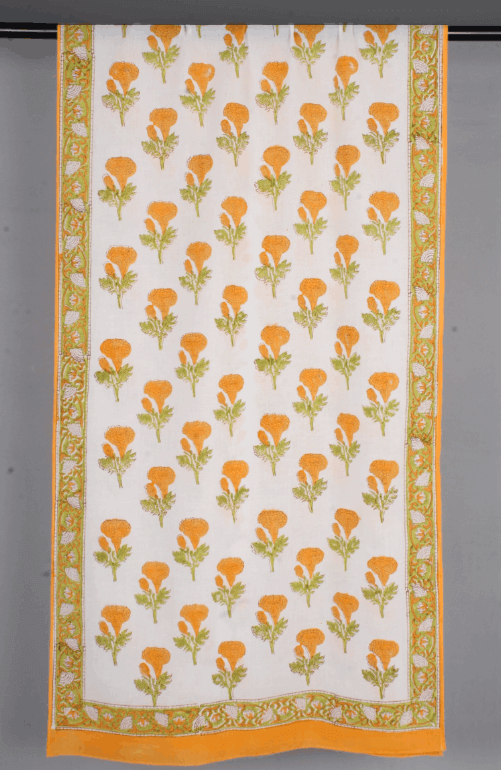
Hand block printed bedsheets 400 TC percale cotton, block printed by hand
Bedsheets with pillow covers complete sets, single to super king
Cotton pillow covers matching or contrast options
Double bed dohars lightweight cotton layering
Handloom cotton tote bags daily carry, same handloom cotton
Cotton travel pouches hand block printed, compact organiser
Bath towels 100% cotton, hand block printed options
Everything is 100% pure cotton. No synthetic blend. No chemical finishing.
What You Can Actually Do This National Handloom Day
Three things none of them require spending a lot of money or making a dramatic gesture.
1. Check what's on your bed right now
Is it handloom cotton? Do you know? If the answer is no that's the starting point. Not guilt, just information.
2. Next bedsheet purchase buy from a verified source
Look for GSM listed, artisan or cluster information mentioned, and a Handloom Mark on the product. If none of these are present, it's not verified handloom regardless of what the listing says.
3. Tell someone
The awareness gap is real. Most people don't know the difference between handloom and machine-made because nobody explained it to them. Passing this on costs nothing and does something.
On National Handloom Day One Purchase Does More Than One Post
Social media posts on August 7 are good. Buying a genuine handloom product on August 7 or any day is better. The families making this fabric don't need awareness. They need orders.
If you've been thinking about replacing an old bedsheet or adding a new one this is a reasonable moment to do it with a product that goes somewhere specific when you pay for it.
Browse handloom cotton bedsheets from ₹999, hand block printed bedsheets in 400 TC percale, or the full pure cotton bedsheet collection across all sizes single, double, king, and super king.