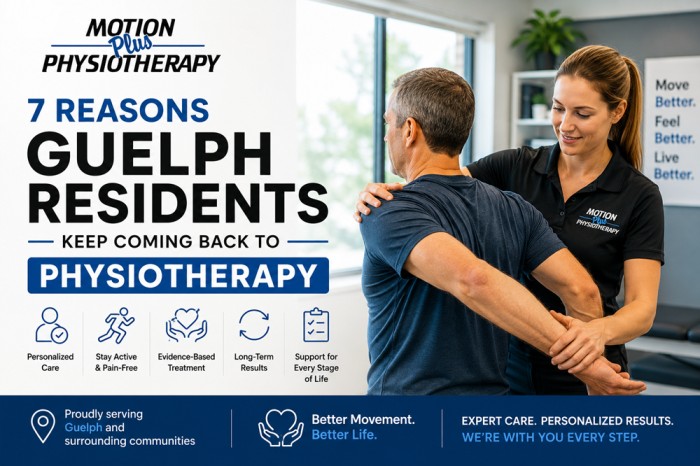
7 Reasons Guelph Residents Keep Coming Back to Physiotherapy
-

- June 23rd, 2026
- 95 views

FREE SEO Topical Map Generator: Find Your Next Content Ideas
I had a patient last spring who came in after his second shoulder injury in three years. Same shoulder, similar mechanism, same frustrated look on his face when he sat down across from me. The first time around he had done a few sessions, the pain settled, and he stopped coming. He thought he was done. He was not.
That story plays out more often than I would like in physiotherapy clinics across Guelph. Someone gets hurt, they come in, things improve, and they leave before the work is actually finished. Then life happens again and they are back at square one.
What I want to do in this piece is talk honestly about why physiotherapy in Guelph matters beyond the acute phase, who it is actually for, what good care looks like, and why so many people in this city keep returning to it not just when something goes wrong, but as a regular part of how they take care of themselves.
1. Guelph Is an Active City, and Active Bodies Need Active Care
Walk the trails at Riverside Park on a Saturday morning and you will see exactly what I mean. Runners. Cyclists. Dog walkers moving at a pace that puts most people to shame. Families with strollers navigating the paths along the Speed River. Head over to Kortright Hills or Preservation Park and you will find trail runners and mountain bikers logging serious kilometers.
This is not a city of sedentary people. Guelph has a culture of physical activity that is genuinely woven into how people live here. And that is a wonderful thing. But it also means there is a steady population of people asking real demands of their bodies on a regular basis, and those demands eventually create wear, strain, and injury.
Physiotherapy in Guelph is not just for people who have been in accidents or had surgery. It is for the runner who has been ignoring Achilles tightness for three months. The hockey player whose groin has been a problem all season. The cyclist who has developed lateral knee pain on longer rides. The recreational tennis player dealing with an elbow that has stopped being a minor annoyance and become a genuine problem.
Getting ahead of these issues, rather than waiting until they force you off the field or the trail, is one of the most practical things an active person in Guelph can do.
What to expect: An initial assessment that goes beyond where your pain is to look at how you are moving, what your loading patterns look like, and what is likely contributing to the problem. A treatment plan that addresses both the symptom and the underlying cause.
2. Evidence-Based Care Has Replaced the Old Passive Model
There was a time when physiotherapy meant lying on a table while someone applied heat, ultrasound, or electrical stimulation to a sore area, and then going home with a sheet of generic exercises. That model still exists in some places, but it is increasingly out of step with what the research tells us works.
Modern physiotherapy is active. It involves a thorough assessment of how you move, not just where it hurts. It involves exercise prescription that is specific to your presentation and progresses based on how you respond. It involves education, because understanding your condition changes how you relate to your pain and how effectively you rehabilitate. It involves manual therapy where the evidence supports it, not as a passive treatment that things are done to you but as a tool that complements your active participation.
The physiotherapists who practice this way, and there are excellent ones in Guelph, treat you as an intelligent adult who is capable of understanding your own body. They explain what they are finding, why they are recommending what they are recommending, and what you can do outside of appointments to support your own recovery.
That partnership is what good physiotherapy feels like. And it produces better outcomes than the passive model does, consistently, across the research literature.
3. You Do Not Need a Referral to Access Physiotherapy in Ontario
This is one of the most underused pieces of information in healthcare in this province. In Ontario, physiotherapists are primary care providers. You do not need a referral from a physician or any other healthcare provider to book an appointment. You can call a physiotherapy clinic in Guelph today, describe what is going on, and get yourself assessed.
For a lot of people, this changes the timeline of their recovery significantly. Instead of waiting for a physician appointment, then waiting for a referral to be processed, then waiting for an appointment at a clinic, you can start getting care within days of when the problem begins.
Early intervention matters in physiotherapy. Acute injuries that are assessed and treated promptly tend to resolve faster and with less risk of developing into chronic problems. Getting into a physiotherapist quickly after a muscle strain, a ligament sprain, or a flare of a recurring issue shortens the overall recovery arc.
The caveat here is that there are situations where a medical assessment should come first, particularly if there is significant trauma involved, if symptoms are progressing in a neurological direction, or if there are signs of something more serious going on. A good physiotherapist will recognize these situations and refer you appropriately. But for the majority of the musculoskeletal problems that bring people through clinic doors in Guelph, you can start with physiotherapy directly.
4. Direct Billing Takes the Friction Out of Using Your Benefits
If you have extended health benefits through your employer, there is a reasonable chance they include physiotherapy coverage. Many people in Guelph do, whether through large employers, the University of Guelph, the trades, the service sector, or their own private coverage.
But having coverage and actually using it are two different things when the claims process feels like work. Paying out of pocket, holding receipts, logging into an insurance portal, submitting a claim, and waiting for reimbursement creates enough friction that people delay appointments, reduce frequency, or skip follow-up sessions they actually need.
Direct billing removes that friction entirely. When a clinic bills your insurer directly, you pay only your portion at the time of the appointment and the administrative work is handled for you. You focus on your recovery. The paperwork takes care of itself.
Many physiotherapy clinics in Guelph offer direct billing to a wide range of insurers. Confirming this before you book your first appointment is worth one phone call. It can meaningfully change how consistently you access care over the course of a treatment program.
Best for: Anyone with extended health benefits who has been delaying care because of the claims process, or who has been spacing appointments further apart than their physiotherapist has recommended.
5. Physiotherapy After Surgery Is Not Optional, It Is the Point
I want to say this as clearly as I can. Surgery creates the conditions for recovery. Physiotherapy is what actually produces it.
After a knee replacement, a rotator cuff repair, an ACL reconstruction, a hip replacement, or a spinal fusion, the surgical procedure addresses the structural problem. But restoring strength, range of motion, movement quality, proprioception, and the confidence to load the repaired area again, that is rehabilitation work. And rehabilitation work requires guidance, progression, and expertise.
I regularly see people in Guelph who completed their hospital physiotherapy after surgery, which is typically focused on early recovery milestones and safe discharge, and then assumed the work was done. They are often missing significant function months later and are surprised to learn how much is still possible with continued rehabilitation.
Post-surgical physiotherapy in the community, beyond what the hospital provides, is where the full return to function happens. It is where you go from walking without a limp to hiking the trails at Guelph Lake Conservation Area again. From being able to reach overhead without restriction to throwing a ball with your kids again. From being medically cleared to being genuinely recovered.
If you have had surgery and feel like you have plateaued, or if you were not connected with post-surgical physiotherapy at all, it is not too late to start.
6. Physiotherapy Manages Chronic Conditions, Not Just Acute Injuries
A significant portion of the people seeking physiotherapy in Guelph are not dealing with acute injuries at all. They are managing conditions that have been present for months or years. Osteoarthritis. Chronic low back pain. Fibromyalgia. Persistent neck pain. Recurring headaches. Degenerative disc disease. These are conditions that do not have a clear endpoint the way a sprained ankle does.
For these people, physiotherapy plays a different but equally important role. It is not about fixing a problem that will then stay fixed. It is about learning how to manage a condition well, maintaining function over time, reducing flare-up frequency and severity, and building the physical capacity that makes daily life more manageable.
The physiotherapy approach for chronic conditions is grounded in pain science, exercise physiology, and behavioral change. It involves understanding how chronic pain actually works, which is different from acute pain in important ways. It involves graded activity and exercise programs that build tolerance without triggering setbacks. It involves practical strategies for managing flares and maintaining gains between clinic visits.
Guelph has a population that skews toward both younger active adults and older residents managing chronic conditions. Both groups have a genuine place in physiotherapy, and the care they receive looks appropriately different from each other.
7. The Right Physiotherapist Makes a Measurable Difference
Physiotherapy is not a commodity where one provider is interchangeable with another. The clinical reasoning, the communication style, the ability to identify what is actually driving your problem rather than just treating the location of your pain, and the quality of the therapeutic relationship all matter enormously to outcomes.
Good physiotherapy in Guelph involves a practitioner who takes a thorough history before touching you. Who asks about your goals, not just your symptoms. Who explains what they are finding and why they are recommending what they are recommending. Who sets measurable goals and tracks your progress against them. Who adjusts the plan when something is not working instead of repeating the same approach indefinitely.
It also involves a clinic environment where you feel comfortable asking questions, where your time is respected, and where the administrative experience, from booking to billing, is handled with care.
When you find that combination, physiotherapy stops feeling like something you endure and starts feeling like something you actively invest in. The results tend to reflect that shift.
Guelph has a range of physiotherapy options. If you have had an experience that did not live up to what I have described here, it is worth trying again with a different provider before concluding that physiotherapy is not for you. The quality of care varies, and finding the right fit is worth the effort.
Physiotherapy in Guelph has evolved considerably over the years. What was once largely a passive, treatment-focused discipline has become a dynamic, evidence-driven field that meets people where they are, whether they are an injured athlete, a post-surgical patient, someone managing a chronic condition, or simply a person who wants to move better and stay active longer.
If you are in Guelph and have been putting off addressing something that has been bothering you, or if you have finished a course of treatment but feel like you did not quite get all the way there, the care you need is available here. You just need to make the call.
The best time to start is always sooner than later. Your body will thank you for not waiting.