Fuel Dispenser Installation Projects: Hidden Risks That Delay Commissioning and Increase Lifecycle Costs
-

- July 02nd, 2026
- 49 views

FREE SEO Topical Map Generator: Find Your Next Content Ideas
Selecting a fuel dispenser installation partner is often treated as a procurement decision based on price and delivery timelines. However, in practice, project success depends far more on engineering capability, documentation discipline, marine expertise, and long-term operational support.
In both marine and land-based fuel infrastructure projects, the real risks are rarely visible during the proposal stage.
The Hidden Engineering Variables That Decide Project Success
While most clients evaluate cost, timeline, and brand reputation, experienced facility managers focus on execution behavior under real site conditions.
Critical evaluation questions include:
How does the contractor respond when unexpected site conditions emerge during installation?
What is the ratio of senior engineers to general labor on active projects?
Are testing tools and calibration equipment owned in-house or outsourced?
What is the process used to record design modifications and update as-built drawings throughout the execution phase?
A contractor’s ability to manage uncertainty often determines whether a project is delivered smoothly or becomes delay-prone and cost-intensive.
Scope Gaps: Where Most Installation Projects Fail
Fuel dispenser installation scopes often appear comprehensive on paper but leave operational gaps that surface during commissioning.
Commonly overlooked responsibilities include:
Site foundation leveling before equipment arrival
Integration with tank gauging and monitoring systems
Payment terminal network configuration and connectivity testing
Civil defense and safety inspection readiness
When these elements are not explicitly included in scope definitions, clients often face delays during the final commissioning and regulatory approval stages.
A reliable contractor clearly defines both:
What is included—and what is not.
Real-World Project Risk: Marine Fuel Station Installation Delay
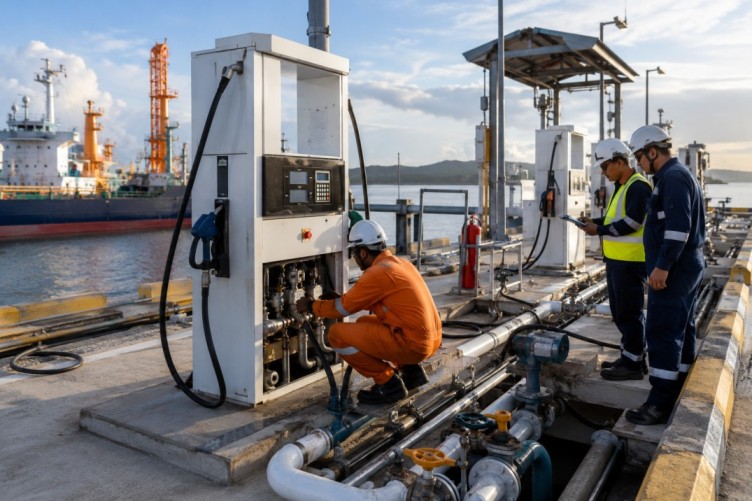
In a coastal fuel station project, installation was delayed by nearly 18 days due to an unaccounted tidal variation mismatch during the civil foundation stage. Although the contractor had submitted a standard execution plan, site conditions changed during execution, requiring redesign of pipe routing and gangway alignment.
The delay was not caused by equipment failure but by insufficient site adaptability planning and a lack of real-time engineering revision control.
Industry Standards That Influence Fuel Dispenser Installations
Depending on the project location and operational environment, fuel dispensing systems may need to comply with internationally recognized standards covering fire safety, electrical protection, environmental controls, and fuel handling practices. Early alignment with applicable standards helps reduce redesign requirements, streamline approvals, and improve long-term system reliability.
Typical considerations may include:
Fire protection requirements for fuel handling facilities
Hazardous area electrical classification and equipment selection
Fuel storage and piping integrity standards
Environmental protection and spill prevention requirements
Marine safety regulations for waterfront fueling facilities
Compliance Documentation: The Most Underestimated Risk Factor
Regulatory compliance is not a post-installation formality—it is a continuous requirement throughout the project lifecycle.
Key documentation risks include:
Omitting pre-construction photographic evidence can lead to non-compliance during audits and may require costly rework or on-site verification to validate completed stages.
Incomplete pressure and electrical test certification records
Late submission of mandatory regulatory documentation can trigger administrative hold-ups, repeated inspection cycles, and delays in granting final operational authorization.
In many jurisdictions, fuel system approvals depend heavily on traceable installation evidence, not just system functionality.
Experienced installers implement structured documentation protocols that include:
Step-by-step photographic records
Signed inspection checklists at each milestone
Full as-built drawing revisions with field validation
Marine Fuel Station Installations: A Higher Engineering Standard
Marine fuel dispensing systems operate in a dynamic environment where structural movement, saltwater exposure, and tidal variations continuously impact system integrity.
Key engineering challenges include:
Constant wave action and vessel-induced movement place sustained dynamic stress on mechanical joints, increasing the risk of loosening, fatigue, and long-term structural wear.
Accelerated corrosion due to salt exposure and humidity
Variable tidal levels require flexible mechanical and electrical configurations
Critical design considerations include:
Marine-grade sealants resistant to vibration fatigue
Fully protected cable entry points to prevent moisture ingress
Flexible piping and electrical slack for tidal movement
Visibility-optimized emergency shut-off systems across dock zones
Inadequate adherence to marine-grade design requirements can accelerate structural degradation and increase long-term operational and maintenance costs due to exposure to saltwater and constant environmental stress.
Post-Installation Support: The Long-Term Performance Gap
System commissioning is not the end of responsibility—it is the beginning of operational dependency.
Before selecting a contractor, it is essential to assess the following critical criteria:
Average response time for non-critical maintenance issues
Availability of spare parts and local inventory support
Emergency support coverage outside working hours
Training programs are provided to operational staff
Lower installation cost often correlates with limited post-project support capability, which can significantly increase lifecycle costs.
Material Selection: Balancing Cost, Durability, and Environment
Material selection plays a decisive role in system longevity, especially in marine and high-humidity environments.
Common options include:
Glass Fiber Reinforced Plastic (GFRP):
High corrosion resistance and long service life, but higher initial investment.Coated Steel Systems:
Cost-effective initially, but highly dependent on coating integrity during installation and maintenance.
The correct choice depends on:
Environmental exposure level
Maintenance capability
Expected lifecycle duration
Installation handling quality
Poor handling during installation can compromise even high-grade materials.
Why Reference Verification Matters More Than Proposals
Every contractor presents successful project references. The real value lies in how those references are verified.
Best practices include:
Visiting operational fuel stations in person
Engaging with on-site maintenance technicians offers more accurate insights into daily operations and system reliability than relying solely on project management feedback.
Reviewing real maintenance history and operational challenges
Understanding how installation issues were resolved in practice
This provides deeper insight than proposal documents or marketing presentations.
Predictive Maintenance and Digital Monitoring
Modern fuel dispensing infrastructure increasingly incorporates remote monitoring technologies that provide real-time visibility into equipment performance.
Benefits include:
Early leak detection
Remote alarm management
Fuel inventory tracking
Predictive maintenance planning
Reduced emergency downtime
Integrating monitoring systems during installation can significantly improve operational efficiency and reduce lifecycle maintenance costs.
Frequently Asked Questions (FAQ)
Q1. How long does marine fuel station installation take compared to land-based systems?
Marine installations typically require 30–50% more time due to tidal constraints, specialized lifting operations, and corrosion protection requirements.
Q2. What documentation is required after installation?
Essential deliverables include:
As-built engineering drawings
Pressure and electrical test certificates
Equipment serial number tracking
Installation photographic records
Compliance inspection approvals
Q3. How does tidal variation impact installation design?
High tidal variation requires:
Extended gangway structures
Flexible piping systems
Adjustable electrical connections
Allowance for extreme low-tide positioning
Q4. What defines a qualified marine fuel system installer?
A qualified marine installer demonstrates the following:
Experience in dynamic load environments
Corrosion control engineering expertise
Marine safety compliance knowledge
Emergency response readiness
Q5. What is the recommended inspection frequency for fuel system maintenance and safety compliance?
Industry practice recommends:
Quarterly visual inspections
Annual full system inspection
Increased frequency in high-corrosion marine zones
Conclusion
Successful fuel dispenser installation projects are built on more than equipment selection and construction schedules. Long-term reliability depends on engineering adaptability, rigorous documentation management, regulatory readiness, and ongoing technical support.
Organizations that evaluate contractors based on lifecycle performance rather than installation cost alone are better positioned to reduce operational risk, improve compliance outcomes, and maximize infrastructure longevity. In both marine and land-based environments, proactive planning remains the most effective strategy for preventing costly disruptions after commissioning.