Fischer Dealer in India Offering Premium Fasteners and Anchoring Systems
-

- July 20th, 2026
- 33 views

FREE SEO Topical Map Generator: Find Your Next Content Ideas
A structural frame is ready for installation, the concrete has cured, the equipment has arrived and the project team is working against a tight schedule. At this stage, a fastener may look like one of the smallest items on the site. Yet that small component will carry loads, hold fixtures in position and influence the long term reliability of the entire installation.
This is where fixing selection becomes more than a routine purchase.
India’s construction and manufacturing sectors continue to expand, creating demand for safer, faster, and more dependable installation methods. India’s Index of Industrial Production grew by 4.1 % in March 2026, while manufacturing output increased by 4.3 % during the same period. This industrial activity raises the need for reliable Industrial Fixing Solutions across factories, warehouses, energy projects, infrastructure and commercial construction.
However, the result depends on more than choosing a well known product. Contractors and procurement teams must select the right fixing for the material, load, environment, and installation conditions. A knowledgeable Fischer Dealer in India can make that decision clearer and more practical.
Small Fixings Can Carry Major Responsibilities
Fasteners rarely receive the same attention as structural steel, concrete, machinery or architectural finishes. Most of them remain hidden after installation. Still, their role stays active throughout the life of the structure.
An anchor transfers the load of a fixture into a base material such as concrete, masonry, aerated concrete, or another construction surface. If the selected fixing does not suit the application, the installation may loosen, crack the base material, corrode, or fail to carry the expected load.
The risk does not always appear immediately. A fixture may look stable after installation but develop movement later because of vibration, changing loads, moisture, temperature or incorrect embedment. This makes the initial decision critical.
Let us consider a few practical examples, a railing anchor must resist regular human pressure. A machine fixing may face continuous vibration A façade system must deal with wind and outdoor exposure. A solar mounting structure must remain secure through changing weather conditions. Each application demands a different assessment.
This leads to an important question. Can one anchor solve every fixing problem?
It cannot.
The correct choice depends on several factors
The type and condition of the base material
The weight and nature of the fixture
The direction and level of the load
Indoor or outdoor exposure
Moisture and corrosion conditions
Anchor spacing and edge distance
Installation depth
Fire, seismic or approval requirements
This is why Premium Fasteners should never be viewed as individual pieces of hardware. They form part of a complete fixing system that includes the anchor, accessories, installation tools, cleaning process, technical information and correct site procedure.
A Complete Fixing System Goes Beyond the Anchor
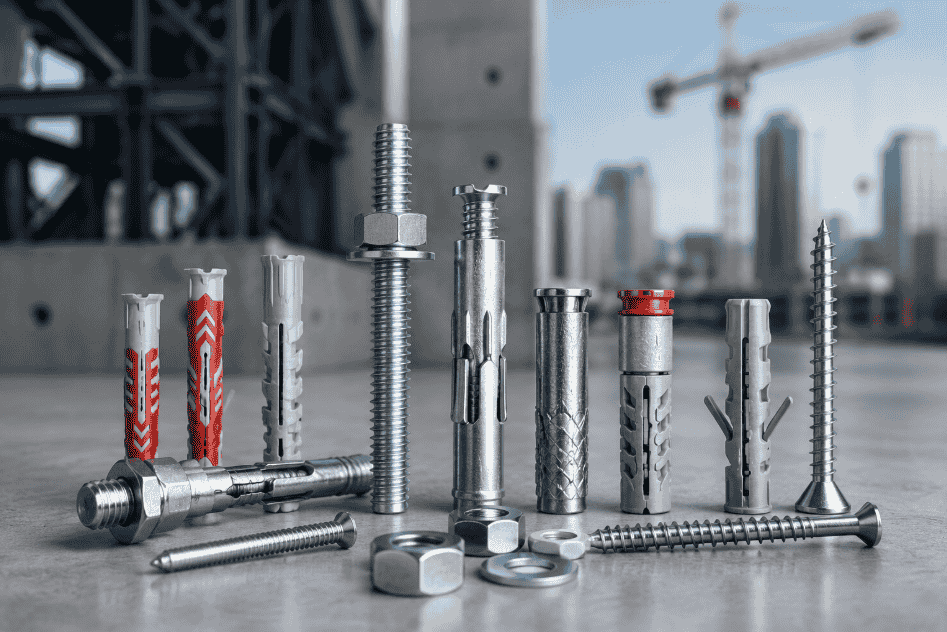
A reliable installation begins with the right product category. The official Fischer India product range includes steel fixings, chemical fixings, standard fixings, frame fixings, installation systems, façade systems, cavity fixings, electrical fixings, window frame fixings, insulation fixings, construction chemicals, strengthening products, power tools, and passive fire protection solutions.
This wide range matters because construction sites rarely face only one type of fixing challenge.
A contractor may need steel anchors to secure heavy equipment into concrete. The same project may also require frame fixings for doors and windows, lightweight anchors for interior installations, chemical systems for reinforcement connections, and electrical fixings for cable support.
Selecting products from the correct category reduces improvisation on site. It also helps teams follow a more consistent installation process.
For instance, a contractor installing a structural bracket into concrete may require a mechanical bolt anchor. Fischer describes its bolt anchor range as suitable for high performance requirements in cracked and non cracked concrete, depending on the selected product and its stated application.
Another application may involve high loads, limited spacing, or a need to avoid expansion forces. In that case, the project team may consider a chemical fixing system. Fischer states that its chemical fixings transfer loads in concrete, aerated concrete, or masonry without expansion, subject to the product and application.
Neither option is automatically better. The right system is the one that matches the actual site conditions.
Why the Dealer’s Role Matters More Than Many Buyers Realise
Many buyers approach a supplier by asking for a heavy duty anchor, a chemical cartridge, or a fastener of a particular diameter. This may sound like enough information, but it often leaves out the details that determine whether the product will work.
A dependable Fischer Dealer in India should ask questions before recommending a product.
What material will receive the fixing? Is the concrete cracked or non cracked? Will the anchor remain indoors or face rain, humidity, chemicals, or coastal exposure? What load will it carry? How close will the fixing sit to the edge? Does the application require technical approval?
These questions protect the project. They prevent buyers from choosing a product only because it looks similar to one they have used earlier.
A dealer also helps procurement teams identify exact article numbers, pack sizes, compatible accessories, and installation requirements. This becomes especially important when the order includes chemical mortar, anchor rods, mesh sleeves, dispensers, cleaning brushes, or blowout pumps.
For example, Fischer describes the RG M anchor rod as a system component that works with specific resin capsules and injection mortars. The range includes diameters from M8 to M30 and several steel grades for different applications.
This shows why compatibility matters. A chemical anchor is not simply a cartridge and a threaded rod selected separately. The components must work as an approved or specified system where the application requires it.
A responsible dealer does not replace engineering design However, the dealer can help buyers avoid basic mismatches and direct them towards the correct technical information.
Authenticity and Traceability Protect More Than the Purchase
Fasteners can look similar even when their materials, coatings, load capacities and intended applications differ. That makes authenticity and traceability important for contractors, engineers and procurement heads.
Buying through an established source helps customers confirm the product identity and obtain the correct documents. Before placing an order buyers should check
The exact product name and article number
Original manufacturer packaging
Dimensions and material grade
Batch or identification details where applicable
Current technical data
Installation instructions
Compatible accessories
Storage conditions and expiry details for chemical products
Supplier invoice and contact information
This process may appear detailed, but it can prevent far more expensive problems later.
Imagine that a contractor substitutes one anchor for another because both share the same diameter. The replacement may require a different embedment depth, torque, hole cleaning method or base material condition. That small substitution can affect installation quality and inspection approval.
When project teams source Fischer Fasteners India through a knowledgeable supply channel, they gain access to a broader support system. Fischer’s Indian platform provides product information, Building Information Modelling resources, FiXperience design tools and technical support options.
Digital tools can support planning and product comparison. Still, engineers and installers must use them with accurate project inputs and follow product specific instructions.
Mechanical Anchors for Concrete Applications
Mechanical anchors offer a practical solution for many concrete fixing requirements. Installers place the anchor into a drilled hole and activate it through the specified installation method which may involve tightening, expansion, or setting.
These anchors often support applications such as
Structural brackets
Handrails and safety barriers
Steel columns and supports
Machinery and equipment
Cable trays
Pipe supports
Storage systems
Façade substructures
The application determines the product. Cracked concrete may require a different anchor from non cracked concrete. Outdoor conditions may demand greater corrosion resistance. A fixture exposed to vibration may need a solution designed and verified for that type of load.
Edge distance also matters. Placing an anchor too close to the edge of a concrete member can increase the risk of cracking or breakout. The same applies when several anchors sit too close together.
This is why installers should follow the stated hole diameter, embedment depth, spacing, edge distance, and tightening torque. Guesswork has no place in a load carrying installation.
A good supplier can help the buyer locate these requirements, but the project engineer must make the final selection for structural and safety critical applications.
Chemical Anchors for Flexible and Demanding Fixings
Chemical anchoring systems use resin mortar to bond an anchor rod or reinforcement bar inside a drilled hole. They offer useful flexibility for applications that involve high loads, close spacing, restricted edge distances, reinforcement connections, hollow masonry, or complex installation conditions.
Fischer lists chemical fixing products for concrete, aerated concrete, and masonry. Its range includes injection mortars, resin capsules, anchor rods, internal threaded anchors, dispensers, blowout pumps and cleaning brushes.
The installation process plays a major role in performance.
The installer must drill the correct hole, clean it as instructed, inject the required amount of mortar, insert the anchor component properly and allow enough curing time before applying the load. Temperature can also affect working and curing times.
Skipping the cleaning stage can leave dust inside the hole which may reduce the bond between the mortar and the base material. Loading the anchor before the resin cures can also compromise the result.
Consider a contractor fixing a tall storage rack, heavy steel frame, or shear connector. Fischer describes its FIS EM Plus epoxy mortar as suitable for high load bearing applications in cracked and non cracked concrete, including shear connectors, tall shelving, and heavy steel structures. The official product information also lists seismic applications in performance categories C1 and C2.
This does not mean one mortar suits every job. It shows how product selection must connect directly to the stated use, load, material, and approval conditions.
Fixing Solutions Extend Far Beyond Heavy Anchors
Heavy structural anchors attract attention because they carry visible loads. Yet, everyday installation work also depends on reliable frames, nylon, cavity, façade, electrical and insulation fixings.
A window frame needs secure positioning without unnecessary stress. Electrical cables require organised support Insulation systems need compatible fasteners. Sanitary installations must remain stable under repeated use Interior fixtures may need anchors designed for hollow walls rather than concrete.
This is where a broad range of Industrial Fixing Solutions helps contractors choose products based on the substrate and purpose instead of relying on general purpose plugs for every task.
Application specific products can also improve productivity. Installers spend less time correcting loose fixings, changing drill sizes or creating improvised solutions. Procurement teams can standardise commonly used products, while site supervisors gain a clearer installation process.
The benefits extend across industries. Manufacturing units use fixings for machinery, trays, pipes, platforms and storage. Solar projects require dependable support for mounting systems and electrical services. Commercial buildings need fixing solutions for façades, interiors, fire protection systems and mechanical services.
As India’s industrial base grows, these applications will continue to demand more organised product selection. Fischer reported global sales of €1.05 billion for 2025, while its fixing systems division recorded 3 % currency adjusted growth. The group employed about 4,800 people at the end of 2025 and operated through subsidiaries or sales partners in around 120 countries.
These figures show the scale behind the product range, but the project result still depends on correct local selection and installation.
How to Select the Right Fischer Dealer in India
Price and stock availability matter, particularly when a project is moving quickly. Yet they should not become the only selection criteria.
A reliable dealer should understand that the buyer may need help with the application, not merely a quotation. Before requesting a product, share as much information as possible
Base material and its condition
Fixture type, size and material
Expected load
Indoor or outdoor location
Moisture or chemical exposure
Hole depth and edge restrictions
Required quantity
Project schedule
Technical approval or inspection needs
Then evaluate the supplier’s response. Does the dealer ask useful questions? Can the dealer provide exact product references? Are technical documents available? Can the supplier arrange compatible accessories? Is support available for bulk, planned or phased orders?
Be cautious when a supplier suggests an immediate substitute without reviewing the application. Two anchors may appear similar but perform differently.
Early consultation can also prevent delays. Project teams should discuss major fixing requirements before installation begins, especially for structural loads, reinforcement connections, façades, fire rated systems and difficult base materials.
A Practical Checklist Before You Place an Order
Before ordering Premium Fasteners or Fischer Anchoring Systems, take a few practical steps
Identify the base material correctly.
Confirm the load and fixture details.
Check environmental exposure.
Use exact product names and article numbers.
Ask for current technical documents.
Confirm the required installation accessories.
Review storage and expiry details for chemical mortar.
Check the curing time before planning the work.
Avoid unverified product substitutions.
Train installers to follow the stated procedure.
Involve a qualified engineer in safety critical applications.
Choose a dealer who supports selection as well as supply.
These steps take little time compared with the cost of rework, failed inspections, or installation delays.
Stronger Projects Begin With Better Fixing Decisions
Fasteners may represent a small part of a project’s visible scope, but they hold essential systems together. A bracket, façade frame, machine, railing, solar structure, or cable support can only perform as intended when the selected fixing suits the load and base material.
The value of Premium Fasteners does not come from the product name alone. It comes from correct selection, authentic supply, compatible components, proper installation and technical understanding.
A capable Fischer Dealer in India helps connect these elements. The dealer can support product identification, documentation, accessory selection and planned procurement while directing technical questions to the appropriate specialists.
As construction and industrial projects become more demanding, fixing decisions deserve greater attention. Buying whatever is available may save a few hours at the ordering stage but it can create days of rework later.
When a small anchor carries the responsibility of a much larger system, should it remain an ordinary line item on a purchase order or should it receive the same careful thought as every other critical project component?