Eco-Tourism in Rajasthan: Why Chokhiwadi Leads the Way
-

- August 03rd, 2026
- 19 views

FREE SEO Topical Map Generator: Find Your Next Content Ideas
Rajasthan has always drawn travellers. But for most of its tourism history, the draw was palaces, forts, and desert — a landscape experienced from the outside, photographed, and left behind.
Eco-tourism in Rajasthan is changing that relationship entirely. Instead of passing through a landscape, you stay inside it. Instead of consuming a destination, you contribute to it. And in the Aravalli hills near Sariska Tiger Reserve, one property is demonstrating what that actually looks like in practice — not as a concept, but as a functioning, verifiable reality.
What Eco-Tourism Actually Means — and What It Does Not
The word eco-tourism has been stretched so thin that a hotel with solar fairy lights now uses it in its tagline.
Real eco-tourism meets three criteria simultaneously. It minimises environmental impact — not just offsets it with a tree-planting donation. It benefits local communities directly and measurably. And it educates guests about the natural environment they are staying in, building awareness that extends beyond the checkout date.
Most properties in Rajasthan calling themselves eco-resorts satisfy one of these, occasionally two. Chokhiwadi satisfies all three — and the evidence is specific enough to verify.
How Chokhiwadi Practises Eco-Tourism in the Aravallis
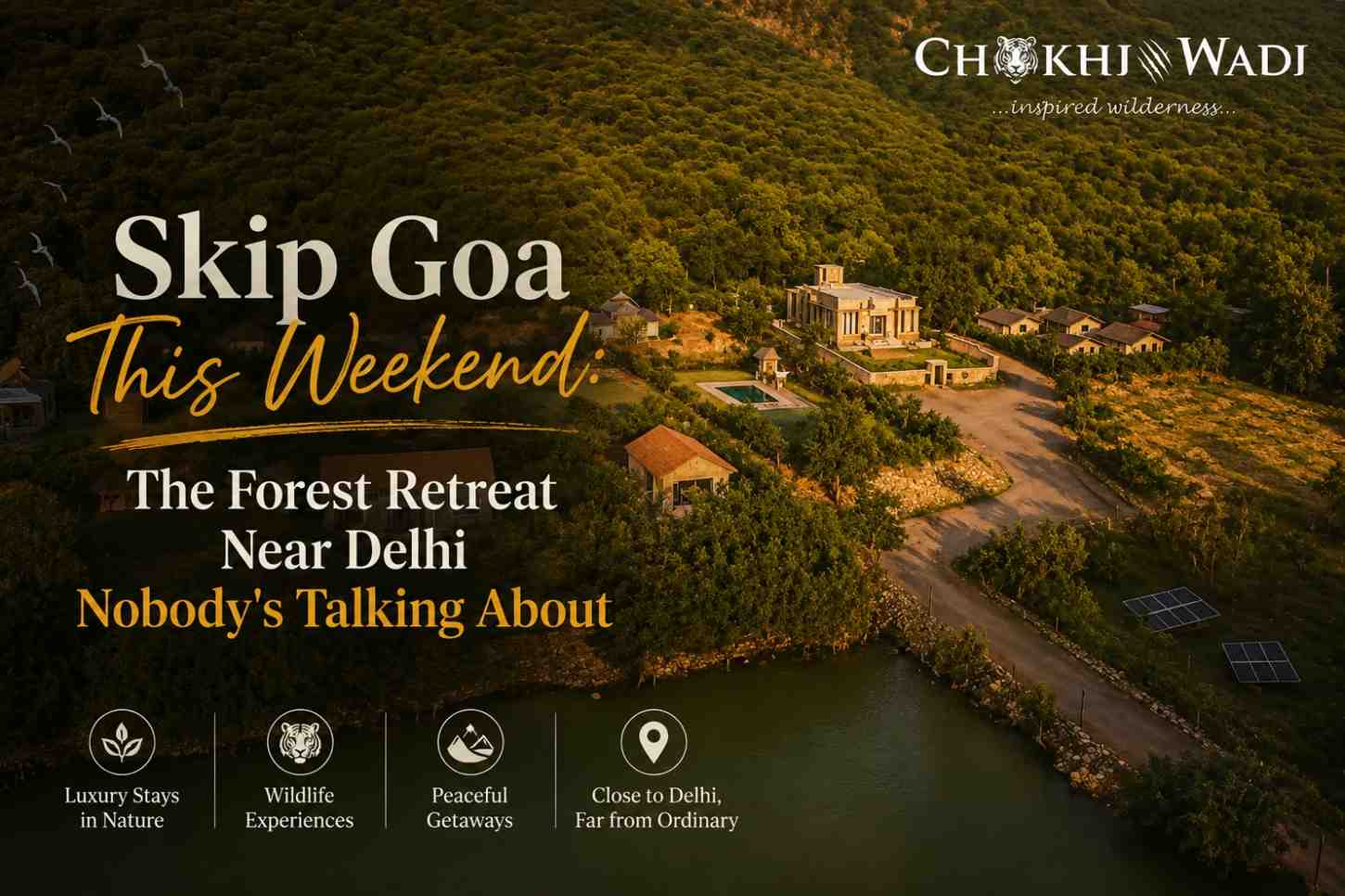
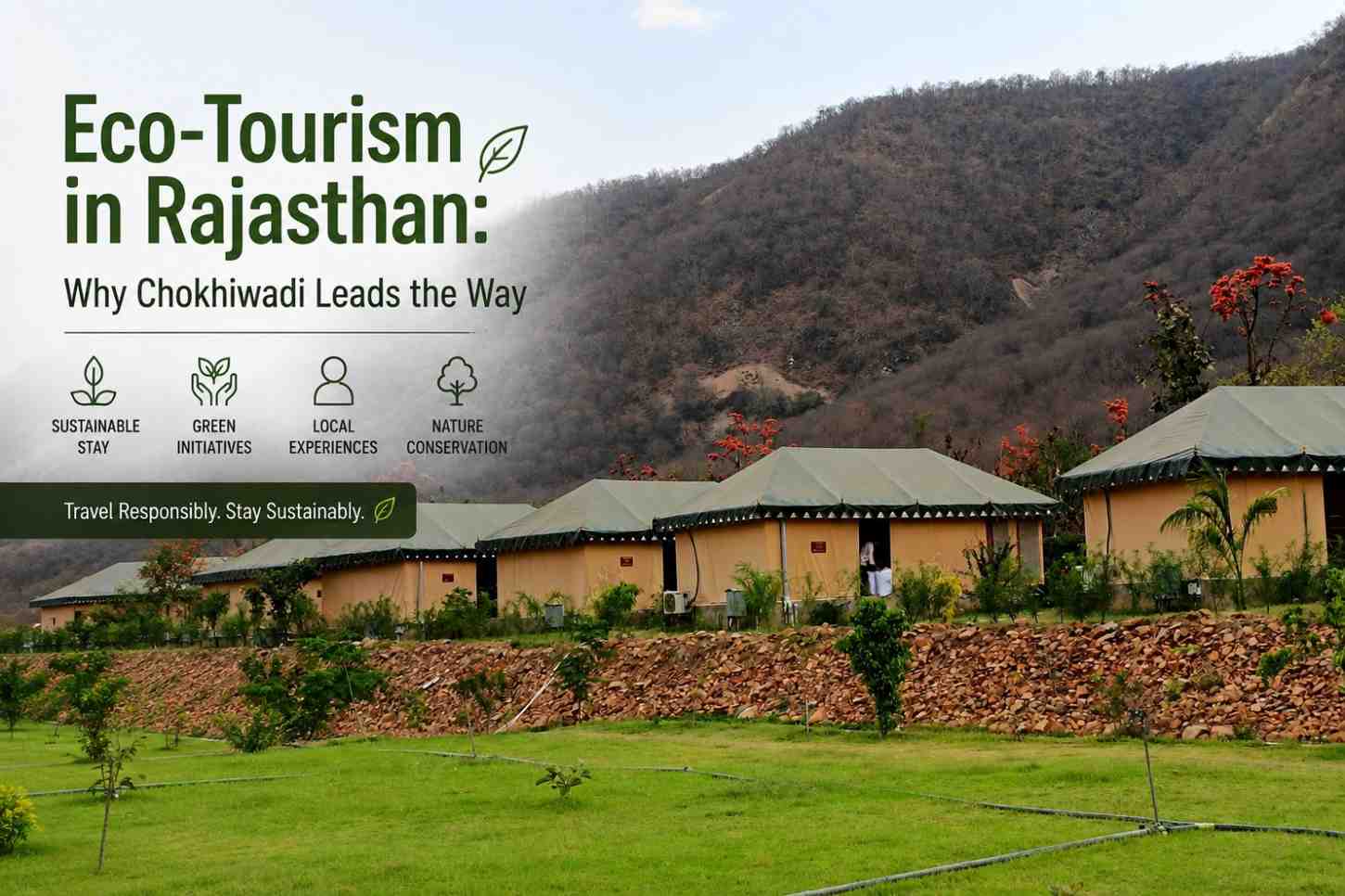
Chokhiwadi Forest Retreat a resort in Sariska sits on 9.5 acres in Guwara Dulawa, Ajabgarh, Thanagazi — on the edge of Sariska National Park in Alwar, Rajasthan. The founders made a foundational decision before the property opened: plant the forest first.
Over 20,000 native Aravalli trees were in the ground before the first guest arrived. Today, more than 90% of the property is living forest, organic food garden, and native farmland. The built footprint is deliberately small. The green footprint grows every season.
Energy: The property runs entirely on solar power. Grid dependency is minimal. Diesel generators are not the backup plan.
Water: A rainwater harvesting system manages all water use on the property. In the semi-arid Aravalli landscape, where water is not abundant, this is not a marketing feature — it is responsible land stewardship.
Food: Spice Aangan, the resort’s dining space, serves food grown in the property’s own organic kitchen garden. Dal baati churma made from ingredients that grew fifty metres from your table is farm-to-table in the most literal sense available.
Community: Every staff member at Chokhiwadi is hired from a village within 5 km of the property. The resort is one of the largest employers in its immediate area. Tourism revenue stays in the community that lives alongside the forest — not in a corporate office three cities away.
Conservation: The Baori — a handmade stepwell at the centre of the property — serves dual purpose: it is the most atmospheric space on the grounds and a functioning water conservation structure built using traditional local techniques.
The Guest Experience as an Eco-Education
Chokhiwadi does not lecture guests about sustainability. It lets the property teach.
Walking the Food Forest — 7,000+ native trees where guests pick pomegranates and papayas in season — makes organic farming tangible rather than theoretical. Sitting at the Baori on a clear winter night with an AQI under 50, watching planets appear without a telescope, makes air quality visceral rather than statistical.
The morning safari at Sariska Tiger Reserve connects guests to one of India’s most significant wildlife conservation stories — tigers that were wiped out and brought back through sustained, costly, imperfect effort. Understanding that story changes how people think about wildlife corridors, land use, and the relationship between tourism and conservation.
This is eco-tourism working at its best. Not signage about recycling. An experience that shifts perspective.
Why Rajasthan Needs This Model to Spread
Rajasthan receives millions of tourists annually. The majority of that tourism concentrates in Jaipur, Jodhpur, and Udaipur — cities that are increasingly showing the strain of overcrowding, water depletion, and heritage site degradation.
Dispersed eco-tourism — spreading visitor traffic to natural landscapes that benefit from managed, sustainable footfall — is the model that relieves pressure on overcrowded heritage cities while generating income for rural communities that currently see little of Rajasthan’s tourism revenue.
The Aravalli corridor near Sariska is one of the most ecologically significant landscapes in northern India. It is also one of the most economically underserved. A model where visitors come, stay, eat locally, employ locally, and leave the land better than they found it is not idealistic. Chokhiwadi is proof it is operational.
Stay Options at Chokhiwadi Forest Retreat
Luxury Glamping Tents — open porticos facing the Aravallis. From ₹5,999/night. Mud Villas — Mandana folk art, handbuilt by local women. From ₹7,999/night. Stone Cottages — full luxury, most dramatic hill views. From ₹12,999/night.
All rooms include AC, hot water, in-room dining, and 24×7 assistance. Fully pet-friendly. 3 to 3.5 hours from Delhi. Just over 1 hour from Jaipur.
Frequently Asked Questions
Q: What makes Chokhiwadi a genuine eco-tourism destination in Rajasthan?
Chokhiwadi meets all three criteria of authentic eco-tourism — minimal environmental impact (solar power, rainwater harvesting, organic farming), direct community benefit (all staff hired from villages within 5 km), and guest education through immersive natural experiences rather than informational signage.
Q: Is eco-tourism in Rajasthan worth choosing over heritage tourism?
Both have value. Eco-tourism near Sariska specifically offers something heritage tourism cannot — a direct relationship with a living landscape. The Aravalli hills, the forest, the wildlife corridor, and the communities who live alongside them are experienced differently when you stay inside them rather than passing through.
Q: How far is Chokhiwadi Forest Retreat from Jaipur and Delhi?
Chokhiwadi is just over 1 hour from Jaipur and 3 to 3.5 hours from Delhi via NH48. It is one of the most accessible genuine eco-tourism destinations in northern India from both cities.
Q: Does staying at Chokhiwadi contribute to local conservation?
Yes. The resort employs local village staff, sources food from its own organic farm, and operates within the Sariska buffer zone in a way that supports rather than degrades the wildlife corridor. Guest revenue directly funds the ongoing planting and maintenance of 20,000+ native trees on the property.
Book your eco-tourism stay in Rajasthan: chokhiwadi.com | +91 9588903155 / +91 8287612664
Chokhiwadi Forest Retreat | Guwara Dulawa, Ajabgarh, Thanagazi, Rajasthan 301027 Eco-Tourism Rajasthan | Sustainable Resort Near Sariska | Weekend Getaway from Delhi & Jaipur