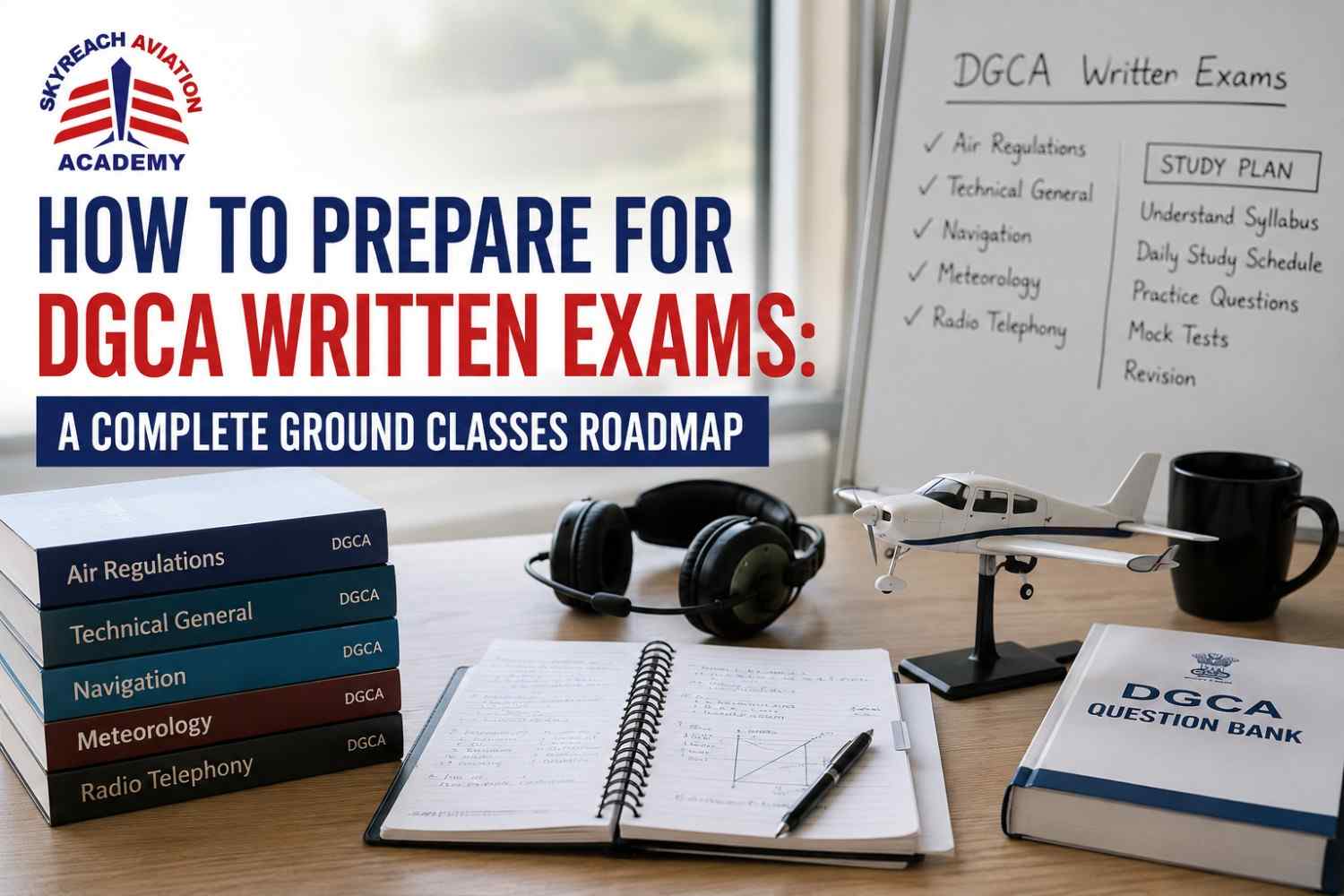
How to Prepare for DGCA Written Exams: A Complete Ground Classes Roadmap
-
- July 04th, 2026
- 29 views

FREE SEO Topical Map Generator: Find Your Next Content Ideas
Most pilot trainees underestimate the DGCA written exams.
They spend months logging flying hours, clear their medical, sort their documents — and then sit down with the DGCA syllabus and realise the written exams are a different challenge entirely. Eight papers. Dense technical content. A pass mark of 70% in each subject. No shortcuts.
The ones who clear all eight on the first attempt almost always have one thing in common: structured ground classes with a good institute, started early, taken seriously. This guide lays out exactly what the DGCA written exams require, how to prepare for each subject, and what to look for when choosing DGCA ground classes in Jaipur or anywhere in India.
What Are the DGCA Written Exams?
To obtain a Commercial Pilot License (CPL) in India, every candidate must pass eight theory examinations conducted by the Directorate General of Civil Aviation. These are written papers — not practical tests — that assess your understanding of aviation science, regulations, operations, and human factors.
All eight papers must be cleared with a minimum score of 70% each. There is no partial passing. If you clear seven and fail one, you reappear for that paper alone, but your overall timeline extends.
The exams can be attempted before, during, or after flying hours — most candidates choose to complete ground training alongside or just before their flying phase.
The 8 DGCA Exam Subjects: What Each One Covers
1. Air Navigation
The most mathematically demanding paper. Covers principles of navigation, plotting, air routes, radio navigation aids, and all major navigational instruments. Expect calculation-heavy questions on wind correction angles, time-distance problems, and map reading.
Preparation tip: Practice numerical problems daily. Concepts are learnable — calculation speed and accuracy under exam conditions take deliberate repetition.
2. Aviation Meteorology
Covers the study of weather as it affects aviation — atmospheric pressure, temperature gradients, cloud types, weather charts, forecasting, and interpretation of meteorological data. Also covers hazardous weather phenomena: thunderstorms, turbulence, icing, and wind shear.
Preparation tip: This is a conceptual subject. Once you understand how the atmosphere behaves, the questions follow logically. Focus on understanding, not memorisation.
3. Air Regulation
Covers the rules and regulations set by DGCA regarding air traffic, aviation strategy, licensing procedures, and international aviation law under ICAO frameworks. This paper tests your knowledge of what pilots are legally required to know and follow.
Preparation tip: Read the actual DGCA regulations, not summaries. Questions are specific. A one-word misread can change your answer.
4. Airframe and Engine (Technical General)
One of the most content-heavy papers. Covers the fabrication and construction of aircraft, engine types (piston and turbine), fuel systems, hydraulics, electrical systems, ice protection, and maintenance principles.
Preparation tip: Captain Gunjan Dua’s book Aircraft Technical & General — authored specifically for this paper — is widely used by Skyreach Aviation Academy students. It strips away academic jargon and connects each system to real operational context. Available on Amazon.
5. Flight Planning and Performance (Technical Specific)
Covers how a flight is planned from departure to destination — performance calculations, weight and balance, fuel planning, aircraft performance charts, and alternate planning. Requires accurate reading of performance manuals.
Preparation tip: This paper rewards candidates who have spent time with actual aircraft performance charts. Do not study this theoretically alone — work through problems using sample charts under timed conditions.
6. Human Performance and Limitations
Covers the physical and mental factors that affect a pilot’s performance — hypoxia, spatial disorientation, stress, fatigue, circadian rhythms, vision limitations, and decision-making under pressure.
Preparation tip: This is a relatively straightforward paper if studied with focus. Most candidates underestimate it and overprepare for others. Dedicate consistent time to it rather than treating it as revision material.
7. Operational Procedures
Covers the standard operating procedures for flight — pre-flight checks, take-off procedures, cruise management, landing, emergency drills, and abnormal situations. Tests procedural knowledge against DGCA and ICAO standards.
Preparation tip: This paper tests precision of knowledge. Vague answers lose marks. Study each procedure as a sequence, not as a concept.
8. Radio Telephony (RTF)
Covers communication between pilots and ground stations using radio. Includes standard phraseology, communication procedures, distress and urgency signals, and coordination with ATC. The RTF practical is a separate assessment alongside the written component.
Preparation tip: Practice speaking and writing standard RTF phraseology out loud, not just reading it. The practical element rewards candidates who have internalised the language, not just memorised it.
A Realistic Study Roadmap for DGCA Ground Classes
Most candidates who enrol in a structured 6-month DGCA ground program follow a phased approach:
Months 1–2: Foundation subjects — Air Regulation, Human Performance, Operational Procedures. These three are conceptual and build your regulatory and operational thinking before the technical subjects begin.
Months 3–4: Technical subjects — Airframe and Engine, Flight Planning and Performance. These require more time and practice. Start problem sets early.
Months 5–6: Navigation, Meteorology, and Radio Telephony. Navigation needs the most practice time. Meteorology benefits from the foundational understanding built earlier. RTF practical preparation should begin at least 4 weeks before your exam date.
Throughout: Mock papers. DGCA past papers are available and essential. Attempt at least two full mock exams per subject before the actual paper.
What to Look For in DGCA Ground Classes in Jaipur
Not all ground school programs are equal. Here is what actually matters:
Faculty with operational experience — Theory taught by people who have flown the systems they are explaining is fundamentally different from theory taught from a textbook. The difference shows in how questions are framed and how answers are remembered.
Updated DGCA syllabus — DGCA revises its question banks periodically. An institute using outdated material is a liability, not an asset.
Small batches — Ground classes with 30+ students per batch cannot offer the pace adjustment, doubt resolution, and individual attention that DGCA exams require. The papers are too specific.
Structured schedule with mock exams — Ground school without regular mock testing is incomplete preparation. Mock exams under timed conditions reveal gaps that revision alone cannot identify.
Skyreach Aviation Academy in Jaipur runs DGCA ground classes with only 6 seats per batch — the smallest batch size available at any aviation institute in Rajasthan. Classes run for 6 months, with new batches starting on the 15th of every month. Fees range from ₹1,00,000 to ₹1,75,000 depending on the program track.
The ground program at Skyreach uses Captain Gunjan Dua’s Aircraft Technical & General as the primary reference for the technical papers — a book written specifically for DGCA exam preparation by the academy’s own faculty.
Eligibility for DGCA Ground Classes
To enrol in ground staff training or DGCA ground classes in Jaipur, candidates must have completed Class 12 with Physics and Mathematics as core subjects, with a minimum aggregate of 50% as per DGCA standards.
Age minimum is 18 years for CPL-track candidates. Ground classes can be started earlier in some cases — check directly with the institute for your specific situation.
Common Mistakes That Cause Candidates to Fail
Starting ground classes too late — The most common mistake. Candidates begin flying, realise the written exams are harder than expected, and are forced to delay their CPL timeline. Ground classes should begin at the same time as or slightly before flying training starts.
Skipping mock exams — Knowing content is not the same as performing under exam conditions. Students who skip mock papers consistently underperform against their own preparation level.
Treating all eight papers the same — Navigation and Airframe are not the same difficulty level as Human Performance. Allocate study time proportionally, not equally.
Relying only on memory for calculations — Navigation and Flight Planning require fluency with a calculator and charts. Speed matters. Accuracy under pressure matters more. Both require practice, not just understanding.
Frequently Asked Questions
What are DGCA ground classes?
DGCA ground classes are structured theory training programs that prepare CPL aspirants for the eight written examinations required by India’s Directorate General of Civil Aviation before a Commercial Pilot License is issued.
How many subjects are in the DGCA written exam?
There are eight subjects: Air Navigation, Aviation Meteorology, Air Regulation, Airframe and Engine, Flight Planning and Performance, Human Performance and Limitations, Operational Procedures, and Radio Telephony.
What is the passing mark for DGCA written exams?
A minimum of 70% is required in each paper. All eight must be cleared individually.
How long does DGCA ground training take?
A structured ground school program typically runs for 6 months. Skyreach Aviation Academy’s program covers all eight subjects in this duration, with new batches beginning on the 15th of every month.
What is the fee for DGCA ground classes in Jaipur?
At Skyreach Aviation Academy, fees for DGCA ground classes range from ₹1,00,000 to ₹1,75,000 depending on the program track.
Can I take DGCA ground classes without starting flying hours?
Yes. Many candidates complete ground classes before or alongside flying training. The written exams can be cleared independently of flying hours.
Which is the best institute for DGCA ground classes in Jaipur?
Skyreach Aviation Academy is consistently rated among the top DGCA ground class institutes in Jaipur — with only 6 seats per batch, updated DGCA syllabus, and faculty with operational aviation experience.