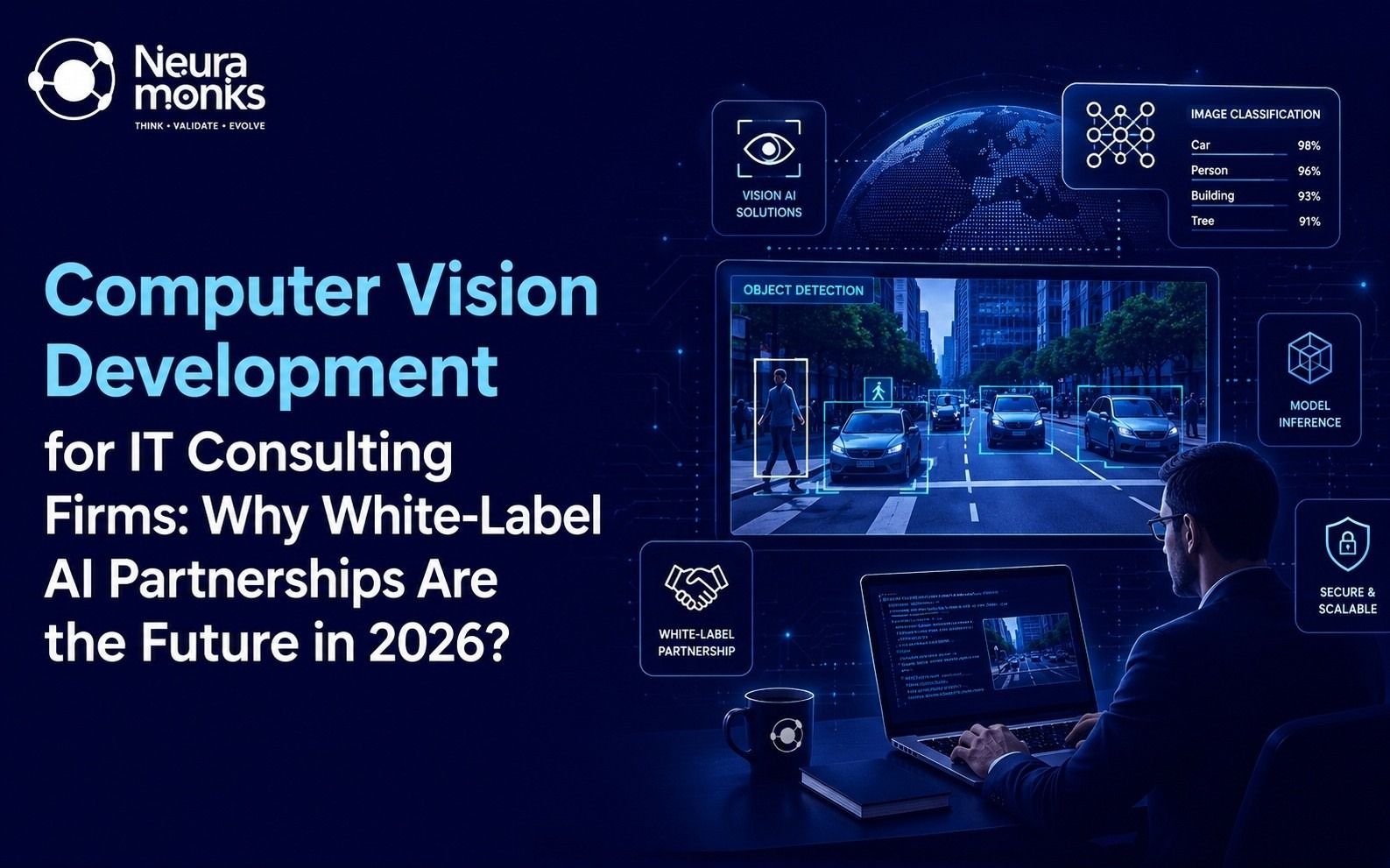
Computer Vision Development for IT Consulting Firms: Why White-Label AI Partnerships Are the Future in 2026?
-
- July 17th, 2026
- 39 views

FREE SEO Topical Map Generator: Find Your Next Content Ideas
Enterprise clients expect AI delivered faster than ever. Neuramonks helps IT consulting firms meet demand with expert Computer Vision Development, enabling quality inspection, document automation, and real-world AI solutions without building an in-house vision team.
The Real Cost of Saying "We'll Look Into It"
When IT consulting firms delay AI or vision requests, clients quickly look elsewhere. Freelancers or AI boutiques may win the project, weakening long-term client relationships and reducing future revenue opportunities for the consulting firm.
Building an in-house computer vision practice is a major investment that many mid-market IT consulting firms struggle to justify. Hiring a senior computer vision engineer can cost $200K–$300K annually, before accounting for GPU infrastructure, AI tools, training, and months of onboarding. For firms handling only a few vision projects each year, this approach creates high financial risk with no guarantee of consistent billable work.
Factor |
Hiring In-House |
White-Label Partnership |
Time to first delivery |
3–6 months to hire, plus 1–2 months ramp-up |
Days to scope, weeks to first deployment |
Upfront cost |
$200K–$300K+ fully loaded before any billable work |
Tied to actual client engagements |
Utilization risk |
Engineer sits idle between vision projects |
No cost when there's no active project |
Client-facing brand |
Your firm's engineer, your firm's risk |
Your firm's brand delivery stays invisible |
Best fit |
Firms with 3+ confirmed vision projects a year |
Firms testing demand or handling 1–2 projects |
A Different Model: White-Label Computer Vision Development
A white-label engineering partner helps IT consulting firms deliver AI Solutions through production-grade Computer Vision Development under their own brand, eliminating the need to build an in-house vision team while keeping client relationships fully intact.
This is the model we've built at neuramonks. We work as an embedded engineering extension for IT consulting firms not as a subcontractor the client meets, but as the team that makes the consulting firm's CTO look like they've had a computer vision practice all along. When a client needs object detection for quality control, OCR pipelines for document-heavy workflows, or real-time video analytics for physical security, our team designs and ships the architecture, and the consulting firm's engineers stay in the loop on the technical decisions the whole way through.
What a Production-Grade Vision Engagement Actually Requires?
It's worth being specific here, because CTOs evaluating a partner want technical depth, not marketing language. A serious Computer Vision Development engagement typically involves:
Data pipeline design - collecting, labeling, and versioning image or video data in a way that supports retraining as the client's environment changes.
Model selection and fine-tuning - choosing between architectures like YOLO-family detectors, vision transformers, or segmentation models based on latency, accuracy, and hardware constraints, then fine-tuning on the client's actual data rather than shipping an off-the-shelf model.
Edge vs. cloud deployment decisions - a factory floor camera system has very different latency and connectivity constraints than a cloud-based document processing pipeline, and the architecture has to reflect that from day one.
Monitoring and drift detection - vision models degrade quietly as lighting conditions, camera angles, or product designs change, and a production system needs instrumentation to catch that before the client does.
Integration with existing systems - the vision model is rarely the whole deliverable; it usually needs to plug into an ERP, a manufacturing execution system, a document management platform, or a custom application the consulting firm already built for that client.
This is the kind of engineering conversation we have directly with a consulting firm's engineering leadership before any client work starts architecture reviews, code walkthroughs, and honest conversations about trade-offs, not a sales deck.
Beyond Vision: Agentic AI and Machine Learning as a Natural Extension
Once a consulting firm has a reliable partner for vision work, the same relationship almost always expands. Clients who ask for a defect-detection system this quarter often come back asking for Agentic AI Services, next autonomous workflows that can make decisions and take action based on what a vision model or a document pipeline detects, not just flag it for a human to review. Others want broader Machine Learning Solutions built on top of the data they're already collecting, from demand forecasting to predictive maintenance. And increasingly, clients simply want a single AI Solutions partner behind their consulting firm who can be trusted with whatever comes next, rather than a new vendor relationship for every new AI request.
Why Does This Matters More in 2026 Than It Did Two Years Ago?
The competitive landscape has shifted. Clients particularly funded startups and mid-market enterprises have gotten more sophisticated about what "good AI" looks like, and they're less forgiving of consulting firms that treat it as an experimental side project. At the same time, procurement teams at larger prospects are starting to ask pointed questions about AI delivery capability during vendor selection. A consulting firm that can point to real, production-deployed computer vision work with its own engineers able to speak to the architecture closes deals faster and at higher margins than one that's still figuring out how to answer the question.
What to Ask Before You Commit to Any Vision Partner?
Not every partner claiming AI expertise can back it up under technical scrutiny, and a bad partnership is often worse than no partnership at all it burns client trust exactly once, and that's usually enough. Before your engineering leadership commits to any outside team, it's worth pushing on a few specific questions:
Can they show a real architecture diagram for a use case close to yours, not a generic slide? Vague answers about "cutting-edge AI" without specifics on model choice, data handling, or deployment target are a warning sign.
Who owns the model after deployment? Ask directly whether retraining, drift monitoring, and ongoing support are part of the engagement or a separate, undefined cost that shows up six months later.
What happens when the client's environment changes? Lighting, camera hardware, product SKUs, and document formats all shift over time, and a partner that hasn't planned for that from day one will leave your firm holding a support burden it didn't budget for.
Will your engineers actually talk to their engineers? If the partner insists on keeping all technical conversations behind a sales layer, that's usually a sign there isn't much technical depth behind the pitch.
A partner worth trusting with your client relationships should welcome all four of these questions and answer them specifically, in writing, before a single line of code gets written.
How the Partnership Actually Works?
For firms that haven't worked with a white-label technical partner before, the model is simpler than it sounds. The consulting firm owns the client relationship, the contract, the pricing, and the margin. The partner in this case, Neuramonks works quietly in the background, often with a shared Slack channel and joint architecture reviews, delivering production-grade Computer Vision Development and Machine Learning Solutions.
The consulting firm's account team presents the work as its own because, in every way that matters to the client, the consulting firm remains accountable, provides ongoing support, and owns the long-term relationship. This structure removes risk for both sides. The CTO doesn't have to rely on an unproven freelancer, the CRO can confidently pursue AI opportunities instead of turning them away, and the client receives a team capable of delivering production-ready solutions.
Getting Started
If your consulting firm has had to say "let us check on that" to a client asking for AI or vision capabilities in the last six months, that's usually the clearest signal that it's time to have this conversation. It doesn't require restructuring your team or making a long-term hiring bet it requires a short technical conversation between your engineering leadership and ours to see if the fit is real.
Ready to stop turning away computer vision projects? Reach out to the neuramonks team for a technical scoping call. We'll walk through a real architecture for a use case relevant to your pipeline, engineer to engineer, so you can decide for yourself whether this is a partnership worth pursuing no sales deck required.
👉https://www.neuramonks.com/contact