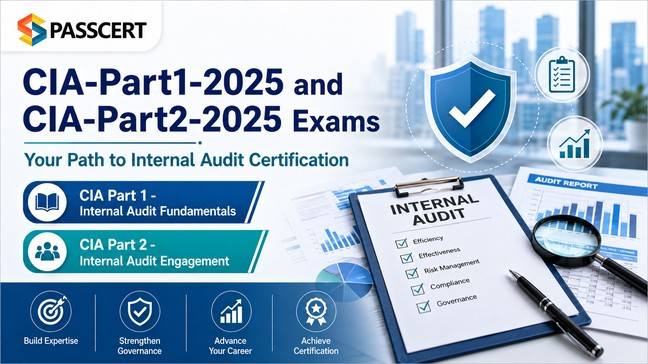
CIA-Part1-2025 and CIA-Part2-2025 Exams: Your Path to Internal Audit Certification
-

- July 07th, 2026
- 35 views

FREE SEO Topical Map Generator: Find Your Next Content Ideas
The Certified Internal Auditor certification remains one of the most recognized credentials for professionals who want to build a career in internal auditing, governance, risk management, compliance, and assurance. For candidates preparing under the updated 2025 CIA exam structure, CIA-Part1-2025 CIA Part 1 - Internal Audit Fundamentals and CIA-Part2-2025 CIA Part 2 - Internal Audit Engagement are two important exam parts that form the foundation of the CIA certification journey. The IIA describes the CIA as a globally recognized internal audit certification and notes that the traditional CIA pathway includes three exam parts covering internal audit fundamentals, internal audit engagement, and the internal audit function.

Overview of CIA-Part1-2025 and CIA-Part2-2025
| Exam Code | Official Exam Name | Main Focus | Exam Format | Best Suited For |
|---|---|---|---|---|
| CIA-Part1-2025 | CIA Part 1 - Internal Audit Fundamentals | Internal audit foundations, ethics, governance, risk management, control, and fraud risks | 125 questions, 150 minutes | Entry-level internal auditors, audit assistants, compliance professionals, and candidates beginning the CIA path |
| CIA-Part2-2025 | CIA Part 2 - Internal Audit Engagement | Engagement planning, evidence gathering, analysis, evaluation, supervision, and communication | 100 questions, 120 minutes | Candidates with basic audit knowledge who want to strengthen practical engagement execution skills |
The IIA lists CIA Part 1 as a 125-question, 150-minute exam and CIA Part 2 as a 100-question, 120-minute exam.
CIA-Part1-2025: Building the Foundation of Internal Auditing
CIA-Part1-2025 focuses on the essential principles every internal auditor should understand before moving into more advanced engagement and management topics. The exam evaluates a candidate’s understanding of the purpose of internal auditing, the internal audit mandate, the role of the board and chief audit executive, internal audit charter requirements, assurance and advisory services, independence, ethics, objectivity, due professional care, governance, risk management, internal control, and fraud risk. The official 2025 Part 1 syllabus includes four major areas: Foundations of Internal Auditing (35%), Ethics and Professionalism (20%), Governance, Risk Management, and Control (30%), and Fraud Risks (15%).
This exam is especially important because it establishes the professional mindset required for internal audit work. Candidates must understand how internal audit supports organizational objectives, how auditors maintain independence and objectivity, and how risk and control concepts are applied in real business environments. It is a strong starting point for students, new auditors, compliance staff, finance professionals, and anyone planning to enter the internal audit profession.
CIA-Part2-2025: Developing Practical Engagement Skills
CIA-Part2-2025 moves from foundational knowledge to the practical work of conducting internal audit engagements. It focuses on how auditors plan an engagement, assess risks and controls, determine procedures, gather and evaluate evidence, use analytical methods, prepare workpapers, develop conclusions, supervise work, and communicate with stakeholders. The official 2025 Part 2 syllabus is divided into Engagement Planning (50%), Information Gathering, Analysis, and Evaluation (40%), and Engagement Supervision and Communication (10%).
This exam is particularly valuable for candidates who want to demonstrate practical audit execution capability. It covers real engagement activities such as defining objectives and scope, identifying criteria, assessing key risks, evaluating evidence quality, using data analytics, applying process mapping, and preparing documentation that supports audit conclusions. These skills are essential for auditors who participate in or lead audit assignments.
Key Differences Between CIA Part 1 and CIA Part 2
| Area | CIA-Part1-2025 | CIA-Part2-2025 |
|---|---|---|
| Knowledge Level | Foundational | Practical and engagement-focused |
| Main Purpose | Understand internal audit principles and professional standards | Apply audit methods during engagements |
| Core Topics | Ethics, governance, risk, control, fraud, independence | Planning, evidence, analysis, workpapers, supervision, communication |
| Exam Weight Emphasis | Broad internal audit fundamentals | Engagement planning and execution |
| Recommended Order | Usually studied first | Usually studied after Part 1 |
In simple terms, CIA Part 1 teaches candidates what internal auditing is and why it matters, while CIA Part 2 teaches candidates how internal audit engagements are planned, performed, documented, and communicated.
Eligibility and Certification Pathway
The traditional CIA certification pathway requires candidates to complete three exam parts. Candidates with a master’s degree generally need one year of internal audit experience, while candidates with a bachelor’s degree generally need two years of internal audit experience. The IIA also provides an entry-level Internal Audit Practitioner pathway, and active IAP holders may receive a waiver for CIA Part 1 when pursuing the full CIA certification.
| Pathway | Who It Is For | Notes |
|---|---|---|
| Traditional CIA Pathway | Candidates pursuing the full CIA certification | Requires completion of all three CIA exam parts |
| IAP Entry-Level Pathway | Students, beginners, or professionals without a degree | Covers internal audit fundamentals and may support future CIA progression |
| CIA Challenge Exam Pathway | Qualified CPA, CA, CISA holders, or experienced professionals | One-part accelerated pathway for eligible candidates |
Exam Cost Information
For candidates planning their budget, The IIA lists the CIA application fee as $120 for members and $240 for non-members. CIA Part 1 exam registration is listed as $310 for members and $445 for non-members, while CIA Part 2 exam registration is listed as $280 for members and $415 for non-members. Pricing may vary by region, tax rules, and National Institute arrangements.
How Candidates Should Prepare
Candidates preparing for CIA-Part1-2025 should begin by studying the Global Internal Audit Standards, internal audit purpose and mandate, ethics, governance, risk management, controls, and fraud-related concepts. Since Part 1 is concept-heavy, candidates should focus on understanding definitions, principles, and professional responsibilities rather than memorizing isolated facts.
For CIA-Part2-2025, candidates should spend more time on scenario-based preparation. They need to understand how to plan an engagement, identify risks and controls, evaluate evidence, use analytical procedures, document findings, and communicate results. Practice questions from Passcert are especially useful because Part 2 often requires candidates to apply audit judgment to realistic engagement situations.
Career Value of CIA-Part1-2025 and CIA-Part2-2025
Passing CIA-Part1-2025 and CIA-Part2-2025 can help candidates build credibility in the internal audit field and prepare for more advanced responsibilities. These exams are relevant for professionals working in internal audit, risk management, compliance, external audit, internal control, governance, finance, and assurance roles. They also provide a strong knowledge base for candidates who want to advance toward senior auditor, audit manager, risk consultant, compliance manager, or internal audit leadership positions.
Final Thoughts
The 2025 CIA exam structure gives candidates a more modern and practical route to proving their internal audit knowledge. CIA-Part1-2025 CIA Part 1 - Internal Audit Fundamentals helps candidates master the essential principles of internal auditing, while CIA-Part2-2025 CIA Part 2 - Internal Audit Engagement focuses on the practical skills needed to perform audit engagements effectively. For anyone interested in pursuing a respected internal audit credential, these two exams are important steps toward earning the full CIA certification and building a stronger professional future in assurance, risk, and governance.