
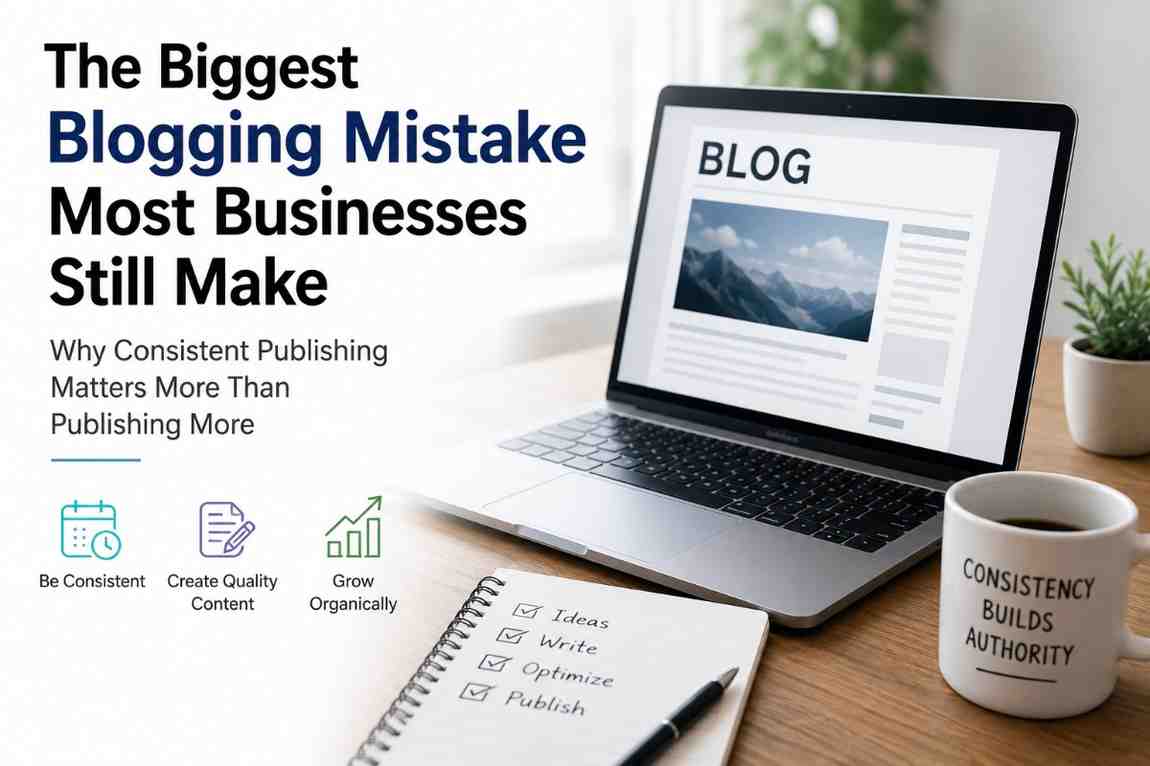
The Biggest Blogging Mistake Most Businesses Still Make
-

- July 24th, 2026
- 29 views

FREE SEO Topical Map Generator: Find Your Next Content Ideas
If you ask ten business owners whether blogging is important, almost all of them will say yes.
They understand that blogs help websites rank higher, attract organic traffic, educate potential customers, build trust, and establish long-term authority within their industry. Yet, despite knowing all these benefits, many businesses struggle to maintain a consistent publishing schedule.
The problem isn't a lack of ideas.
The real problem is inconsistency.
Many companies begin their blogging journey with enthusiasm. They publish a handful of articles, see some encouraging traffic, and then daily responsibilities start taking over. Client work, meetings, product development, customer support, and countless operational tasks become higher priorities. Weeks turn into months, and the blog quietly stops growing.
Unfortunately, search engines notice that inconsistency just as much as readers do, making it harder for businesses to build lasting organic visibility and sustainable long-term growth.
Blogging Isn't About Publishing More
One of the biggest myths in content marketing is that success comes from publishing as many articles as possible.
In reality, successful blogs aren't built by volume alone.
They're built through consistency, quality, relevance, and a clear understanding of what readers are searching for.
Publishing one valuable article every week for an entire year often delivers better long-term SEO results than publishing twenty articles in a single month and then abandoning the blog altogether.
Every article should answer a real question, solve a genuine problem, or provide useful insights. When businesses consistently publish valuable content, they gradually build authority within their industry.
That's exactly what search engines are designed to reward.
Why Businesses Stop Blogging
Businesses rarely stop blogging because they run out of topics.
More often, they stop because content creation becomes overwhelming.
A single blog post usually requires:
Topic research
Keyword research
Competitor analysis
Writing
Editing
Formatting
Adding images
Publishing
Sharing across different channels
Each task seems manageable by itself.
Combined, however, they demand several hours for every article.
As workloads increase, blogging becomes "something we'll do later."
Eventually, later never comes.
Systems Always Beat Motivation
Motivation is temporary.
Systems are sustainable.
Businesses that treat blogging as a repeatable process instead of a creative event are much more likely to stay consistent.
Instead of waiting until someone has free time to write an article, successful teams create workflows that simplify research, writing, editing, and publishing.
This makes content production predictable rather than stressful.
Consistency becomes part of the business instead of an occasional marketing activity.
Automation Makes Consistency Possible
Automation doesn't replace creativity.
It removes repetitive work.
Tasks like organizing content calendars, formatting articles, scheduling publication, and managing publishing workflows can all be streamlined, allowing marketers to spend more time creating genuinely useful content.
This shift is becoming increasingly common among modern businesses. Platforms like theStacc focus on simplifying SEO content workflows by helping businesses automate repetitive publishing tasks while allowing teams to concentrate on creating valuable content instead of managing manual processes.
When repetitive work is reduced, consistency becomes much easier to achieve.
Think Beyond Individual Articles
One article rarely transforms a website.
A library of helpful content does.
Every quality article creates another opportunity to answer customer questions, rank for new keywords, and build authority in your niche.
Instead of treating every blog post as an isolated project, think of your content as a connected knowledge base where one article naturally supports another.
Over time, this creates stronger topical authority and improves the overall user experience.
Readers discover more useful information.
Search engines gain a better understanding of your expertise.
Both outcomes contribute to long-term organic growth.
Consistency Creates Competitive Advantage
Many businesses believe their competitors are winning because they publish better content.
Often, that's not the case.
They're winning because they publish consistently.
The businesses that steadily produce valuable content month after month build momentum that becomes difficult to catch.
Each article adds another entry point for potential customers.
Each article strengthens domain authority.
Each article increases the chances of earning backlinks, shares, and search visibility.
Consistency compounds over time.
Final Thoughts
The biggest blogging mistake isn't writing too little.
It's depending on motivation instead of building a reliable publishing system.
Businesses that invest in better content processes, smarter workflows, and consistent publishing create long-term digital assets that continue generating traffic for years.
This is one reason why many modern marketing teams are moving toward workflow-driven content strategies instead of relying entirely on manual publishing. Solutions such as theStacc reflect this shift by helping businesses maintain consistent SEO content operations without adding unnecessary complexity.
In content marketing, consistency will almost always outperform occasional bursts of activity.
The businesses that build sustainable publishing systems today will be the ones enjoying stronger search visibility, greater authority, and more organic growth tomorrow.