AI Use in Coursework Has Gone Mainstream — Here's What Turnitin's Data Actually Shows
-

- July 22nd, 2026
- 31 views

FREE SEO Topical Map Generator: Find Your Next Content Ideas
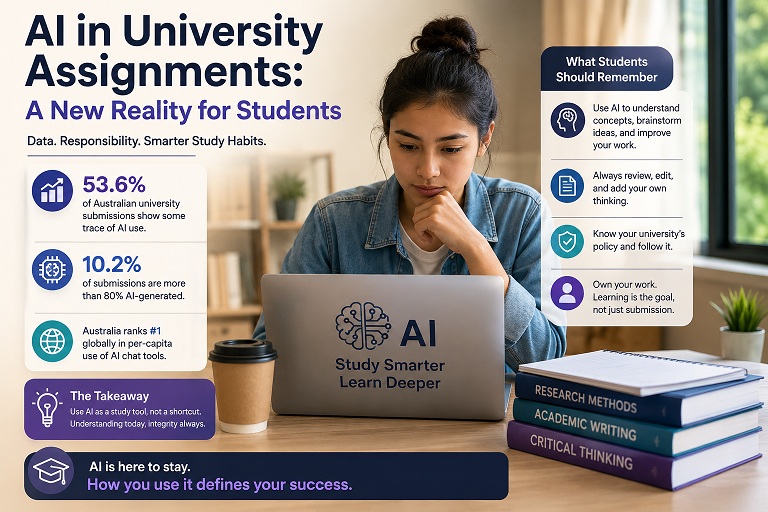
More than half of Australian university assignments run through Turnitin now show some trace of AI. Not a pilot group. Not an outlier cohort. The mainstream.
Turnitin's own numbers, covering submissions from October 2025 through April 2026, put the figure at 53.6% of Australian tertiary submissions showing some form of AI use. Ten percent of those submissions were flagged as more than 80% AI-written. That second number is the one worth sitting with — it's not "used a grammar tool" territory, it's "AI wrote most of this" territory.
For years, AI use in coursework was framed as a fringe problem: a handful of students gaming the system, a cat-and-mouse game between detection software and paraphrasing tools. That framing doesn't hold anymore. When a number crosses 50%, it stops being a discipline problem and becomes a description of how students actually work. The question universities, students, and platforms that support students now face isn't "how do we stop this" — it's "how do we tell the difference between AI as a study aid and AI as a substitute for learning."
The Numbers Behind the Headline
Turnitin's detection tools scanned roughly 3.1 million higher education submissions from Australian institutions in the six-month window. The 53.6% figure captures any detectable AI involvement — everything from a sentence restructured with a grammar assistant to a full essay generated in one prompt. That's a wide net, and it's worth being precise about what it does and doesn't say.
The more revealing figure sits at the extreme end: 10.2% of Australian submissions scored above 80% AI-written, meaning the bulk of the actual content was machine-generated rather than student-authored. For context, the same Turnitin report found US higher education students hitting that threshold at nearly double the rate — 19.4% — while UK students sat close to the Australian figure at 9.8%. Australia isn't an outlier internationally; if anything, it's tracking the middle of the pack.
Separately, usage data on AI chatbots has shown Australia leading globally in per-capita use of conversational AI tools, with coursework making up a meaningful share of that activity. Put the two data sets together and the picture is consistent: Australian students are reaching for AI tools constantly, and a meaningful minority are leaning on them heavily enough to raise real academic integrity questions.
What the data can't do is tell you intent. A submission flagged for AI involvement might be a student who ran a final draft through a paraphrasing pass, or a student who typed a prompt and submitted the output unedited. Turnitin and researchers in the field have been explicit about this limitation — detection scores estimate the likelihood that AI assistance was present, not whether a university's academic integrity policy was actually breached.
Where the Line Actually Sits
This is where most of the confusion — and most of the anxiety — comes from. Universities have spent the past three years writing AI policies, and by 2026 nearly every major Australian institution has a published framework. But "published" doesn't mean "consistent." Broadly, the policies fall into three camps:
Prohibited use — some institutions, particularly a number of Go8 universities, still require that assessed work represent entirely the student's own writing, with AI treated the same as any other form of unauthorized assistance.
Permitted with disclosure — a growing number of institutions allow AI for specific tasks — brainstorming, structuring an argument, checking grammar — provided the student declares how it was used.
AI-integrated assessment — a smaller but expanding group of institutions are redesigning assessment itself around the assumption that students will use AI, shifting weight toward oral defenses, in-class writing, and process documentation rather than trying to police the final product.
The practical effect is that the exact same use of AI can be entirely fine at one Australian university and a misconduct case at another. A student who paraphrases an AI draft, lightly edits it, and submits it might assume they're in safe territory. Detection research suggests otherwise: light editing of AI-generated text is still flagged in the majority of cases, and "asking the AI to sound more human" tends to lower detection scores only marginally while doing nothing to change whether the work represents genuine understanding.
What This Means for Students Trying to Do the Right Thing
Here's the part that gets lost in the headline stat: most students aren't trying to cheat. They're trying to survive a workload with tools that are genuinely useful, without a clear sense of where the institutional line actually falls — because that line moves depending on which faculty, which unit coordinator, and sometimes which specific assignment they're looking at.
The safest approach right now is treating AI the way you'd treat a tutor or a study group — useful for understanding a concept, structuring an argument, or checking your own reasoning, but not a substitute for producing the final piece of work yourself. Platforms like Expertsmindhave become a go-to resource for students navigating exactly this ambiguity, offering subject-specific academic support across disciplines from engineering to business management where a student can get guided help understanding material rather than a finished answer to submit. That distinction — help that builds understanding versus content that replaces it — is close to the line most universities are actually trying to draw, even where their written policy hasn't caught up.
A few habits reduce risk regardless of which policy camp your university falls into:
- Keep drafts and version history. If AI use is ever questioned, being able to show your own drafting process is the strongest evidence you have.
- Use AI for structure and feedback, not first-draft generation. Outlining an argument or asking "what am I missing" is a different category of use than "write this section for me."
- Read your unit-level guidelines, not just the university-wide policy. The gap between institutional policy and what an individual lecturer actually expects is often where students get caught out.
- When disclosure is permitted, over-disclose rather than under-disclose. A short note on how AI assisted the process rarely hurts and can matter significantly if the submission is flagged.
Where This Is Heading
The direction of travel is fairly clear, even if the destination isn't fixed yet. Detection technology keeps improving — Turnitin's current tools claim close to 98% accuracy on raw, unedited AI output — but accuracy drops sharply once text has been edited or paraphrased, and independent research has found real-world detection performance sitting closer to 60–85% on edited submissions. Non-native English speakers have also been shown to be flagged as false positives at meaningfully higher rates, which is a serious equity problem for Australia's large international student population specifically.
That combination — imperfect detection plus uneven policy plus a genuinely useful technology students aren't going to stop using — is why the more forward-looking Australian universities are moving away from a pure detection-and-punishment model. The report noted a clear shift toward institutions demanding education-specific AI tools rather than generic assistants, and toward educators taking direct ownership of how AI shows up in their own classrooms rather than leaving it to a university-wide policy document. Expect assessment design itself to keep changing — more process-based grading, more in-person components, less reliance on a single submitted document as the entire measure of learning.
For students, the practical takeaway isn't "avoid AI." At this point that's neither realistic nor necessary. It's understanding that the technology is now mainstream enough that universities are redesigning around it — and that using it to learn rather than to outsource is what will keep you on the right side of a line that's still being drawn.
Frequently Asked Questions
Is using AI for coursework considered cheating in Australia? It depends entirely on the individual university and, often, the individual unit or assignment. Some institutions prohibit any AI use in assessed work, others permit it with disclosure, and a growing number are redesigning assessment around AI use in coursework being normal. Always check your specific unit guidelines rather than assuming a blanket rule.
How accurate is Turnitin's AI detection in 2026? Turnitin claims close to 98% accuracy on raw AI-generated text with a false positive rate under 1% for documents containing significant AI content. Accuracy drops meaningfully — down to an estimated 60–85% — once text has been edited or paraphrased, so detection is far from foolproof in either direction.
Can Turnitin flag human-written work as AI-generated by mistake? Yes. False positives remain a real risk, and research has shown non-native English speakers are disproportionately misflagged. If you're wrongly flagged, most universities have an appeals or review process — keeping draft history is the strongest way to defend genuine work.
What percentage of Australian university submissions show AI use? Turnitin's data for October 2025–April 2026 found 53.6% of Australian tertiary submissions showed some detectable AI involvement, with 10.2% scoring above 80% AI-written.
Does paraphrasing AI text avoid detection? Not reliably. Light editing of AI-generated text is still detected in most cases, and independent studies suggest detection only drops meaningfully after substantial rewriting — at which point the work arguably reflects genuine student effort anyway.
What's the difference between AI-assisted study help and academic misconduct? Broadly, using AI to understand a concept, structure an argument, or get feedback on your own work is treated very differently from submitting AI-generated content as your own. The safest practice is using AI the way you'd use a tutor — for guidance and understanding, not as the author of your final submission.