
The State of AI Adoption Among New York Small Businesses: 2026 Data and What It Means
-

- July 22nd, 2026
- 16 views

FREE SEO Topical Map Generator: Find Your Next Content Ideas
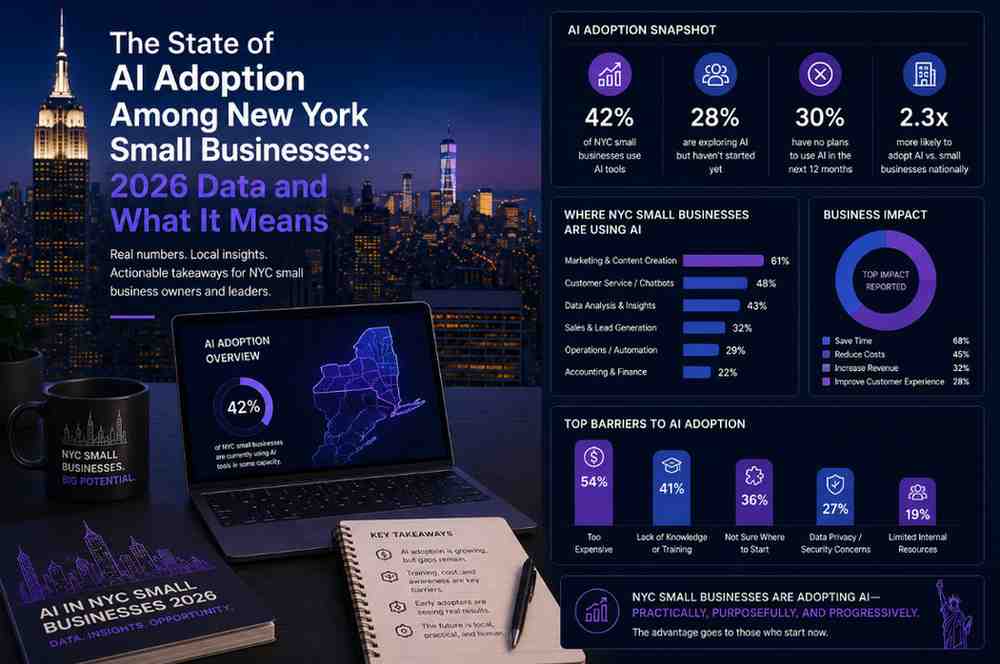
Ask ten different sources what percentage of small businesses use AI, and you'll get ten different numbers, anywhere from 17% to 89%. That's not bad research. It's a sign that "AI adoption" gets measured very differently depending on what counts as "using AI." This piece breaks down what the numbers actually show, why they conflict, and what it genuinely means if you run a business in New York.
Why the Numbers Don't Match (And Which Ones to Trust)
The high end (68–89%) comes from broad self-reported surveys, like the U.S. Chamber of Commerce's 2026 report, which found 89% of small businesses now use AI in some capacity, up from 36% in 2023. These numbers count anyone who's used a free AI tool even once, including a single ChatGPT session to draft an email.
The low end (17–20%) comes from more conservative, transaction-based research. The JPMorgan Chase Institute, analyzing actual small business spending data, put AI-related spending adoption at 17.7% as of December 2025, using real financial behavior rather than self-reporting. U.S. Census Bureau data from mid-2026 lands in a similar range.
Both numbers are technically accurate. They're just measuring different things: "has anyone at this business ever touched an AI tool" versus "is AI meaningfully embedded in how this business operates." For a New York business owner trying to benchmark yourself, the second number is the more useful one.
The Trend Line Is Undeniable, Regardless of Which Number You Use
Whichever measurement you trust, the direction is consistent across every source: AI adoption among small businesses has roughly doubled to tripled in the past two to three years, making it, according to multiple industry analyses, the fastest-adopted business technology since cloud computing.
Generative AI usage specifically jumped from 23% in 2023 to 58% by 2025, per Hostinger's 2026 data, a more than doubling in just two years. That's a genuinely fast curve, even accounting for the measurement inconsistencies above.
What Adopters Are Actually Getting Out of It
This is where the data gets more interesting than the adoption percentage itself. 91% of small businesses using AI report revenue increases, according to Salesforce research. And the correlation with growth is striking: 83% of growing SMBs have adopted AI, compared to just 55% of declining businesses, per recent industry analysis. Correlation isn't the same as proof of causation; growing businesses may simply have more resources to experiment with new tools, but the pattern is consistent enough across multiple independent studies to take seriously.
Where the Real Gap Sits (It's Not What You'd Expect)
The most common assumption is that the AI gap runs between small and large businesses. The data suggests something more specific: it's largely a confidence and education gap, not a resource gap.
Only 27% of small businesses feel confident adopting AI effectively, compared to 82% of mid-sized firms, according to Deloitte's State of AI in the Enterprise research. And among the smallest businesses, under five employees, 82% believe AI simply doesn't apply to their business, which researchers characterize as an education gap rather than a genuine limitation.
That's a meaningful distinction for New York's small business landscape specifically, given the city is home to roughly 183,000 small businesses employing nearly a million people. A large share of that market likely isn't held back by cost or access; it's held back by not knowing where to start, which is often the exact gap a good web development company New York businesses can talk to is built to close, since AI tooling now touches website performance and personalization as much as internal operations.
Where NYC Likely Sits Relative to National Averages
New York doesn't have its own isolated, comprehensive AI adoption survey distinct from national data, but context matters here: the city's economy skews toward finance, media, professional services, and tech, sectors that consistently show above-average AI adoption nationally. NYC is also home to over 2,000 AI startups and has attracted more than $27 billion in AI-related funding since 2019, according to Tech: NYC data, which suggests a tech-literate business environment even outside the startup sector itself.
The reasonable inference: New York small businesses likely sit above the national average on awareness and access, but the same confidence gap- knowing AI is relevant in theory but not knowing how to apply it practically- probably still applies broadly, especially among smaller, non-tech businesses. For businesses considering a customer-facing app as part of that strategy, a mobile app development company in New Yorkthat teams have already worked with can usually explain which AI features are actually worth the investment versus which ones sound good in a pitch but don't move the needle.
What This Means If You Haven't Adopted AI Yet
The data suggests three things clearly:
- You're not as far behind as the headlines suggest, especially if your business is small. Genuine, embedded adoption still sits well under half of small businesses by conservative measures.
- The businesses seeing results aren't necessarily the ones spending the most; they're the ones matching specific tools to specific operational problems, rather than adopting AI broadly and hoping something sticks.
- Waiting has a cost. With adoption roughly tripling in under three years, the competitive gap between adopters and non-adopters compounds the longer it's left unaddressed. Talking to a web development company New York businesses already trust is often the fastest, lowest-risk way to identify a single, measurable starting point.
FAQs
What percentage of small businesses actually use AI in 2026?
It depends on the definition. Broad self-reported surveys put it as high as 89%. More conservative, spending-based research puts consistent operational use closer to 17–20%. Both are accurate depending on what's being measured: casual experimentation versus embedded use.
Is AI adoption actually correlated with business growth, or is that misleading?
The correlation is real and consistent across multiple studies; growing businesses adopt AI at notably higher rates than declining ones. It doesn't prove AI alone causes growth, but it does suggest growing businesses are more willing to invest in and adapt to new tools generally.
Why do very small businesses (under 5 employees) have such low AI adoption?
Research points to an education and confidence gap more than a cost barrier; the vast majority of tools now have free or low-cost tiers. Many very small business owners simply haven't identified a clear, specific use case relevant to their operations.
What's the most common way small businesses actually use AI?
Marketing content creation and customer service ranked among the most common and highest-ROI use cases across multiple surveys, largely because they're contained, easy to measure, and don't require touching core business systems.
Should I wait for AI tools to mature further before adopting them?
Given the pace of adoption and the reported revenue gains among current users, waiting mainly means falling further behind competitors who are already iterating and improving their processes. Starting small with one measurable use case carries far less risk than waiting indefinitely for a "perfect" moment.
Bottom Line
The headline AI adoption numbers vary wildly depending on the source, but the underlying trend doesn't. Adoption is accelerating, the businesses using it well are seeing real financial results, and the biggest barrier left isn't cost or access. It's simply knowing where to start.