
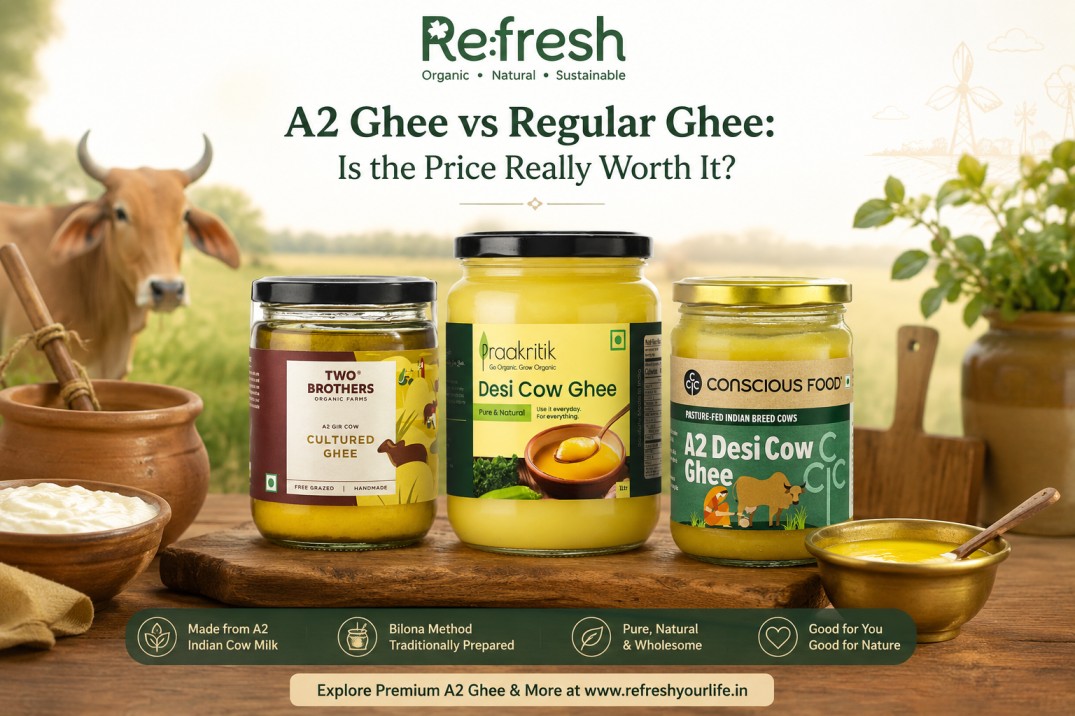
A2 Ghee vs Regular Ghee: Is the Price Really Worth It?
-

- June 30th, 2026
- 22 views

FREE SEO Topical Map Generator: Find Your Next Content Ideas
In recent years, A2 Ghee has become one of the most talked-about health foods in India. Walk into any organic store or browse online, and you'll notice that A2 ghee often costs two to four times more than regular ghee. This naturally raises an important question:
Is A2 Ghee really worth the extra price, or is it simply another marketing trend?
The answer isn't as simple as yes or no. It depends on how the ghee is made, the breed of cow, the quality of milk, and what you're looking for in your daily diet. In this guide, we'll break down the real differences between A2 ghee and regular ghee so you can make an informed choice.
What is A2 Ghee?
A2 ghee is prepared from the milk of indigenous Indian cow breeds such as Gir, Sahiwal, Red Sindhi, Tharparkar, and Rathi. These cows naturally produce milk containing the A2 beta-casein protein.
Premium A2 ghee is usually made using the traditional Bilona method, where:
- Fresh milk is turned into curd.
- The curd is hand-churned to extract butter.
- The butter is slowly simmered into aromatic golden ghee.
This traditional process preserves the natural aroma, flavor, and many beneficial nutrients.
What is Regular Ghee?
Regular ghee is commonly produced from milk sourced from mixed cattle breeds, including crossbred or exotic cows. In many commercial manufacturing facilities, cream is separated directly from milk and converted into ghee using industrial processes to increase production efficiency.
While many regular ghee products are perfectly suitable for everyday cooking, the manufacturing process and milk source often differ from those used for premium A2 ghee.
A2 Ghee vs Regular Ghee: Quick Comparison
| Feature | A2 Ghee | Regular Ghee |
|---|---|---|
| Milk Source | Indigenous Indian cows | Mixed or crossbred cows |
| Protein Type | A2 Beta-Casein | May contain A1 and A2 proteins depending on milk source |
| Traditional Bilona Method | Usually Yes | Not always |
| Aroma | Rich and nutty | Mild |
| Texture | Grainy and creamy | Smooth |
| Production | Small batches | Large-scale manufacturing |
| Price | Premium | More affordable |
Why Does A2 Ghee Cost More?
Many people assume they're paying extra simply because of branding. In reality, several genuine factors contribute to the higher price.
1. Indigenous Cow Breeds Produce Less Milk
Indian breeds naturally produce much less milk than high-yield crossbred cows.
Less milk means:
- Lower production volume
- Higher production cost
- Better focus on quality rather than quantity
2. Traditional Bilona Process
Unlike industrial methods, Bilona preparation is labor-intensive.
The process includes:
- Fresh milk
- Natural curd fermentation
- Hand churning
- Slow cooking over controlled heat
This method takes considerably longer and requires more raw material.
3. More Milk Required
It can take approximately 25–30 litres of milk to produce just 1 kg of Bilona A2 ghee.
That alone explains a significant portion of the price difference.
4. Small Batch Production
Most premium A2 ghee producers manufacture in limited batches rather than mass production.
Small batches often result in:
- Better quality control
- Fresher products
- Greater traceability
Is A2 Ghee Healthier?
Many consumers choose A2 ghee because they believe it supports a healthier lifestyle.
A2 ghee naturally contains beneficial fats and fat-soluble vitamins, including:
- Vitamin A
- Vitamin D
- Vitamin E
- Vitamin K2 (amounts vary)
- Healthy saturated fats
- Conjugated Linoleic Acid (CLA)
Some people also prefer A2 dairy products because they find them easier to include in their diet compared to products made from mixed milk sources. However, individual experiences vary, and scientific research is still evolving in this area.
Like any fat, ghee should be consumed in moderation as part of a balanced diet.
Taste Difference
One of the first things people notice is the flavor.
Traditional Bilona A2 ghee usually has:
- Rich golden color
- Distinct nutty aroma
- Creamy texture
- Grainy consistency
- Authentic homemade taste
Regular commercial ghee generally has a milder aroma and a more uniform texture.
If you've grown up eating homemade ghee, A2 Bilona ghee often feels closer to that traditional experience.
Is A2 Ghee Worth the Extra Price?
It depends on your priorities.
A2 ghee may be worth considering if you:
- Prefer traditionally prepared foods
- Value indigenous Indian cow breeds
- Appreciate premium quality ingredients
- Enjoy authentic flavor and aroma
- Want minimally processed kitchen staples
Regular ghee remains a practical option if your focus is affordability and everyday cooking.
Rather than thinking of one as "good" and the other as "bad," it is more accurate to view them as products designed for different preferences and budgets.
How to Choose Genuine A2 Ghee
Before purchasing, check for:
✔ Clearly mentioned indigenous cow breed
✔ Traditional Bilona preparation
✔ Ingredient list containing only 100% cow milk fat
✔ Transparent sourcing information
✔ Reputed organic or natural food seller
Avoid products with vague labeling or unnecessary additives.
Where to Buy Authentic A2 Ghee Online
Finding authentic A2 ghee can be challenging because many products make premium claims without providing sufficient information about sourcing or preparation.
If you're looking for carefully selected organic oils, traditional Bilona A2 ghee, cold-pressed oils, and other natural pantry essentials, you can explore the curated collection available at Re:fresh.
Browse here:
https://www.refreshyourlife.in/categories/oil-ghee
The collection includes products from trusted natural and organic brands, making it easier to compare options in one place and choose what best fits your family's needs.
Final Thoughts
The higher price of A2 ghee is generally linked to factors such as indigenous cow breeds, traditional Bilona preparation, lower milk yields, and small-batch production rather than price alone.
Whether it's worth paying more depends on what you value. If you prioritize authenticity, traditional methods, and premium quality, A2 ghee may justify the additional cost. If your primary concern is everyday affordability, regular ghee can still be a suitable choice.
The key is to buy from trusted sellers that clearly communicate how their products are sourced and prepared, so you know exactly what you're bringing into your kitchen.