
4D Massage Chairs Explained: What Makes Them Different (And Worth It)
-

- August 05th, 2026
- 34 views

FREE SEO Topical Map Generator: Find Your Next Content Ideas
If you've spent any time shopping for a massage chair, you've probably noticed the "4D" label showing up on a lot of the higher-rated models. It sounds like marketing shorthand, but it actually describes a real, meaningful upgrade in how the massage feels — not just a bigger number tacked onto the spec sheet for the sake of it.
This guide breaks down what 4D actually means mechanically, how it compares to older 2D and 3D systems, and what to look for if you're deciding whether the upgrade is worth the price difference.
What "4D" Actually Refers To
Massage chair technology has evolved through a few clear generations, and each "D" represents a real technical jump, not just a marketing label:
- 2D rollers move in two directions — up and down, left and right — along the track. The pressure stays fixed throughout the session.
- 3D rollers add depth, meaning they can push in and out against the body, adjusting how firmly they press. This was the first real step toward a more customizable massage.
- 4D rollers add the fourth dimension: speed and rhythm that change dynamically during the session, mimicking the way a human masseuse naturally varies their pace and pressure rather than repeating a fixed pattern.
In practice, this means a 4D chair doesn't just press harder or softer at set points — it can slow down, speed up, and shift intensity mid-session in a way that feels considerably less mechanical than earlier systems.
Why the Fourth Dimension Actually Matters
The difference between 3D and 4D isn't just a technical footnote — it changes how the massage actually feels session to session.
More natural rhythm. Human massage therapists rarely apply constant, unchanging pressure. They speed up, slow down, and adjust based on how a muscle responds. 4D rollers replicate that variability instead of repeating the same fixed cycle every few minutes.
Better muscle response. Constant, unchanging pressure on a muscle for an extended period can cause it to adapt and effectively "tune out" the sensation. Varying speed and depth keeps the muscle responding throughout the session instead of going numb to a static stimulus.
Reduced sense of predictability. Fixed-pattern massage (2D/3D) becomes noticeably repetitive after a few sessions, since the body quickly learns exactly what's coming next. 4D systems introduce enough variation that sessions feel less mechanically predictable over repeated use.
4D vs. 3D vs. 2D: A Practical Comparison
| Feature | 2D | 3D | 4D |
|---|---|---|---|
| Direction of movement | Up/down, left/right | Adds in/out depth | Adds dynamic speed + rhythm |
| Pressure adjustment | Fixed | Adjustable, but static once set | Continuously variable during session |
| Feels most like | A basic mechanical massage | A firmer, more targeted massage | Closer to a human therapist's variation |
| Typical price tier | Entry-level | Entry to mid-range | Mid-range to luxury |
| Best suited for | Occasional, light use | Regular use, general tension | Daily use, more nuanced muscle response |
What Else Tends to Come Bundled With 4D Systems
4D roller technology rarely shows up alone — chairs built around it usually include a stronger overall feature set, since manufacturers pair the upgraded rollers with hardware that can actually take advantage of it:
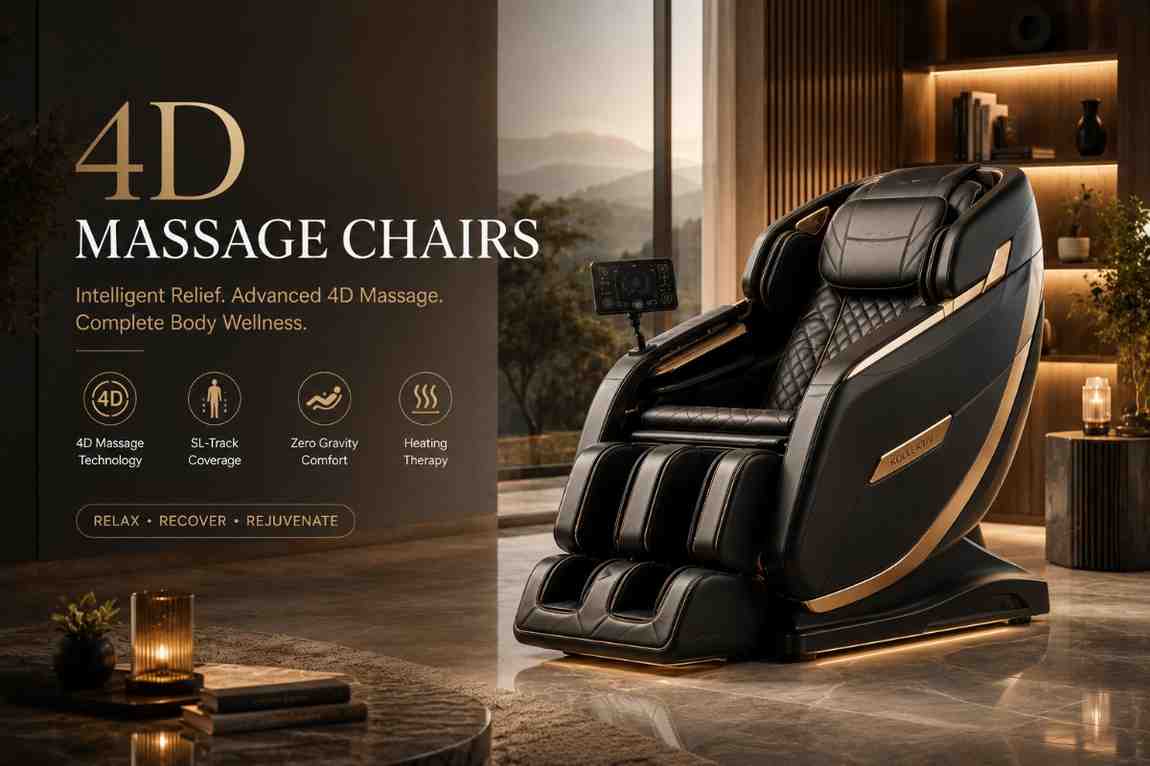
- Extended SL-tracks that follow the spine's natural curve further down toward the glutes, giving the 4D rollers more range to work with.
- Higher airbag counts, often 30 or more, to complement roller-based massage with compression across the shoulders, arms, hips, and calves.
- More sophisticated auto-programs, since dynamic rollers allow for more varied program design (deep tissue, stretch, recovery-focused, and so on) than fixed-pattern systems can offer.
- Zero-gravity recline positioning, which is nearly universal at this tier and pairs naturally with the more dynamic massage experience.
Who Actually Benefits Most From a 4D Chair
Daily users managing chronic tension. If you're using the chair most days rather than occasionally, the reduced predictability of 4D rollers matters more, since repetitive fixed-pattern massage tends to feel stale faster with frequent use.
People recovering from physical activity. Athletes and generally active people often want a massage that adapts through a session — starting lighter, building intensity, easing off toward the end — which is exactly the kind of variation 4D systems are built to provide.
Buyers who've outgrown a basic chair. If you already own a 2D or 3D chair and it feels repetitive or less effective than it used to, that's typically a sign of exactly the limitation 4D technology addresses.
Anyone treating the chair as a long-term investment. Since 4D-equipped chairs tend to sit in the mid-range to luxury tier, they're generally built with better overall components, which matters for a purchase meant to last years rather than months.
Is 4D Worth the Price Jump?
For occasional or light users, a well-built 3D chair may deliver enough value without the added cost. But for anyone planning daily or near-daily use, the price difference between 3D and 4D tends to pay for itself in how much longer the massage experience stays effective and doesn't start to feel repetitive or predictable.
It's also worth noting that 4D isn't purely about intensity — a common misconception is that "4D" means "stronger" massage. It doesn't. It means more varied, adaptive massage. Someone who prefers a gentler, more relaxing session benefits from 4D just as much as someone who wants deep tissue work, since the variability applies across intensity levels, not just at the high end.
Common Misconceptions About 4D Massage Chairs
"4D just means more airbags."
Airbag count is a separate spec entirely — some 3D chairs have more airbags than certain 4D models. "4D" refers specifically to the roller technology's added dimension of dynamic speed and rhythm, not the airbag system.
"4D chairs are always significantly more expensive."
While 4D technology does tend to sit in mid-range and luxury tiers, entry points into 4D have become more accessible as the technology has matured, and it's often not as large a jump over a well-equipped 3D chair as buyers expect.
"The 'D' numbers keep going up forever, so higher is always better."
4D currently represents genuine mechanical variation that materially changes how a massage feels. Marketing occasionally pushes higher "D" numbers as a novelty, but it's worth verifying what specific mechanical difference is actually being claimed rather than assuming a higher number is automatically better.
FAQ
What does 4D mean in a massage chair? It refers to rollers that adjust speed, depth, and rhythm dynamically during a session, adding a fourth dimension of movement beyond the up/down, left/right, and in/out motion found in 2D and 3D systems.
Is a 4D massage chair better than a 3D one? For regular or daily use, most people find 4D chairs feel noticeably less repetitive and more like a real massage therapist's variable pressure. For occasional use, the difference matters less, and a 3D chair may be sufficient.
Do 4D massage chairs cost significantly more than 3D chairs? There's typically a price difference, but it's narrowed as the technology has become more common. Many mid-range chairs now include 4D rollers rather than reserving the feature exclusively for luxury tiers.
Does 4D mean the massage is more intense? Not necessarily. 4D refers to variability in speed and rhythm rather than overall strength. A 4D chair can deliver a gentle, relaxing massage just as effectively as a deep, intense one — the technology applies across intensity levels.
How long do 4D roller systems typically last? With regular maintenance and normal use, 4D roller mechanisms in well-built chairs commonly last 7 to 10 years or more, similar to other components in mid-range and luxury massage chairs.
Are all 4D massage chairs equipped with zero gravity recline? It's extremely common at this tier since manufacturers tend to pair advanced roller technology with a fuller feature set, but it's still worth confirming on any specific model rather than assuming.
Final Thoughts
The jump from 3D to 4D isn't a marketing gimmick — it's a genuine change in how dynamic and adaptive a massage chair's movement can be, and it tends to matter most for people who plan to use their chair regularly rather than occasionally. If daily or near-daily use is the plan, the added variability of 4D rollers is generally worth prioritizing over sticking with older, fixed-pattern technology, even if it means paying somewhat more upfront.
Originally published on:
https://kollecktiv.com/product-category/4d-massage-chairs/